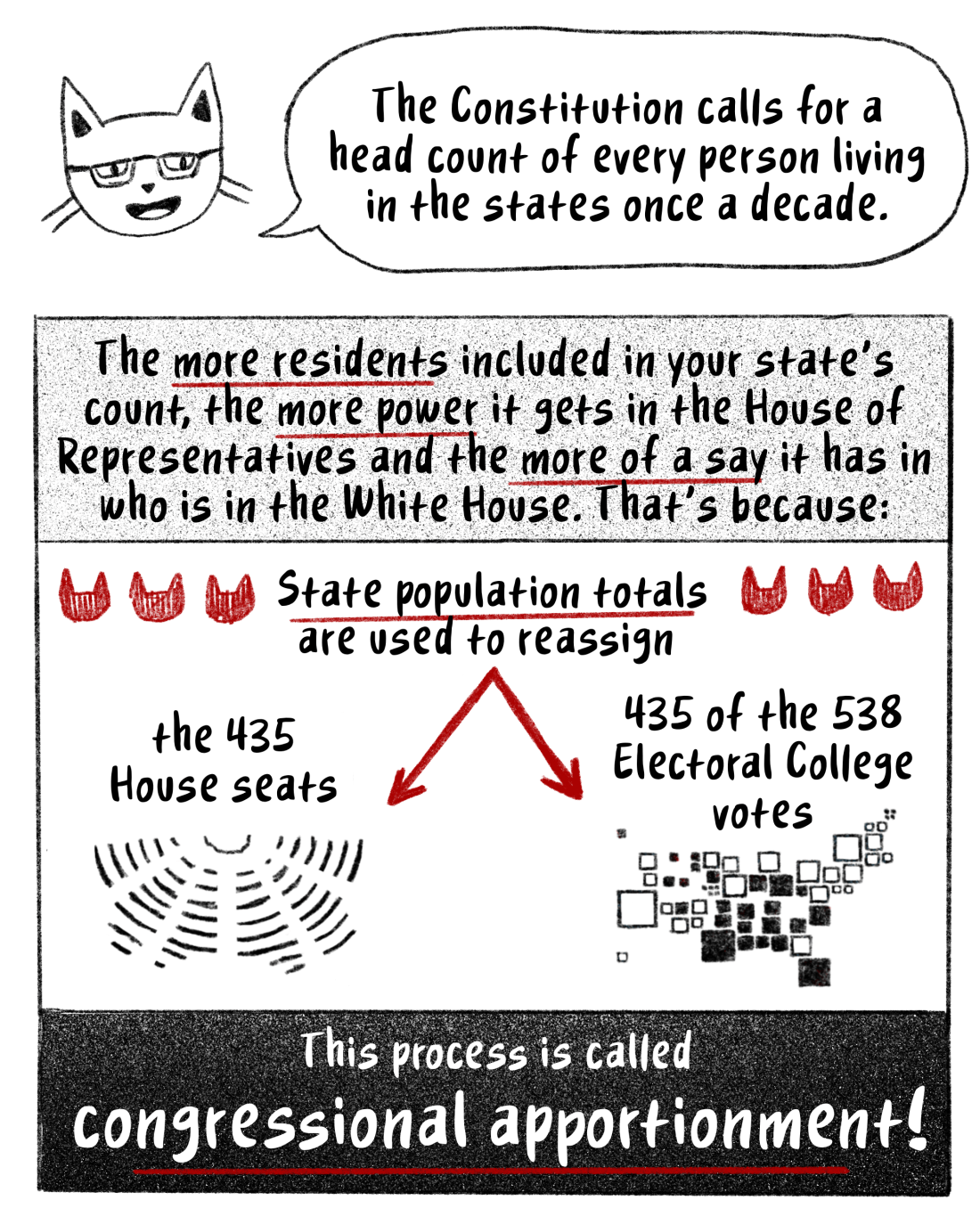
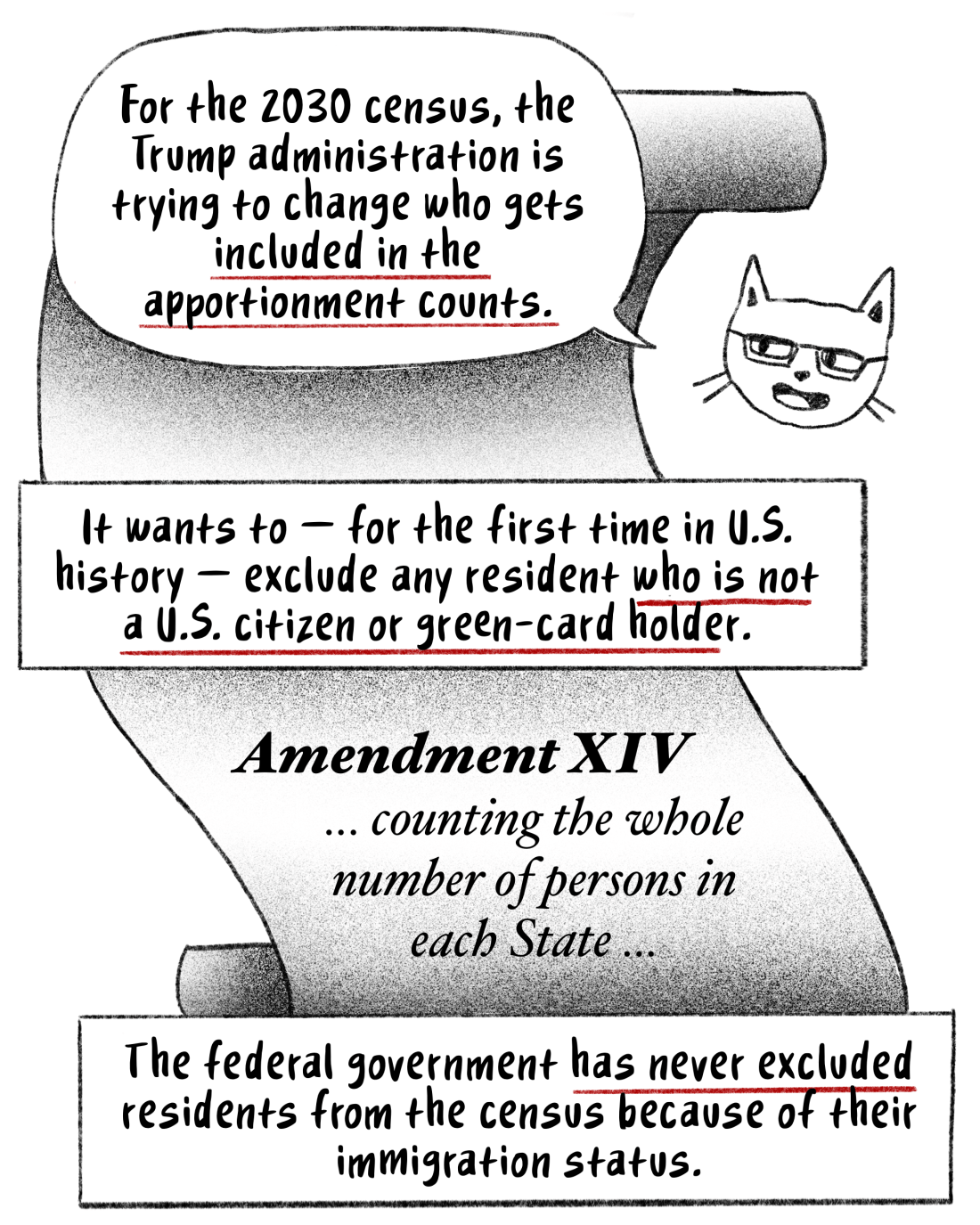
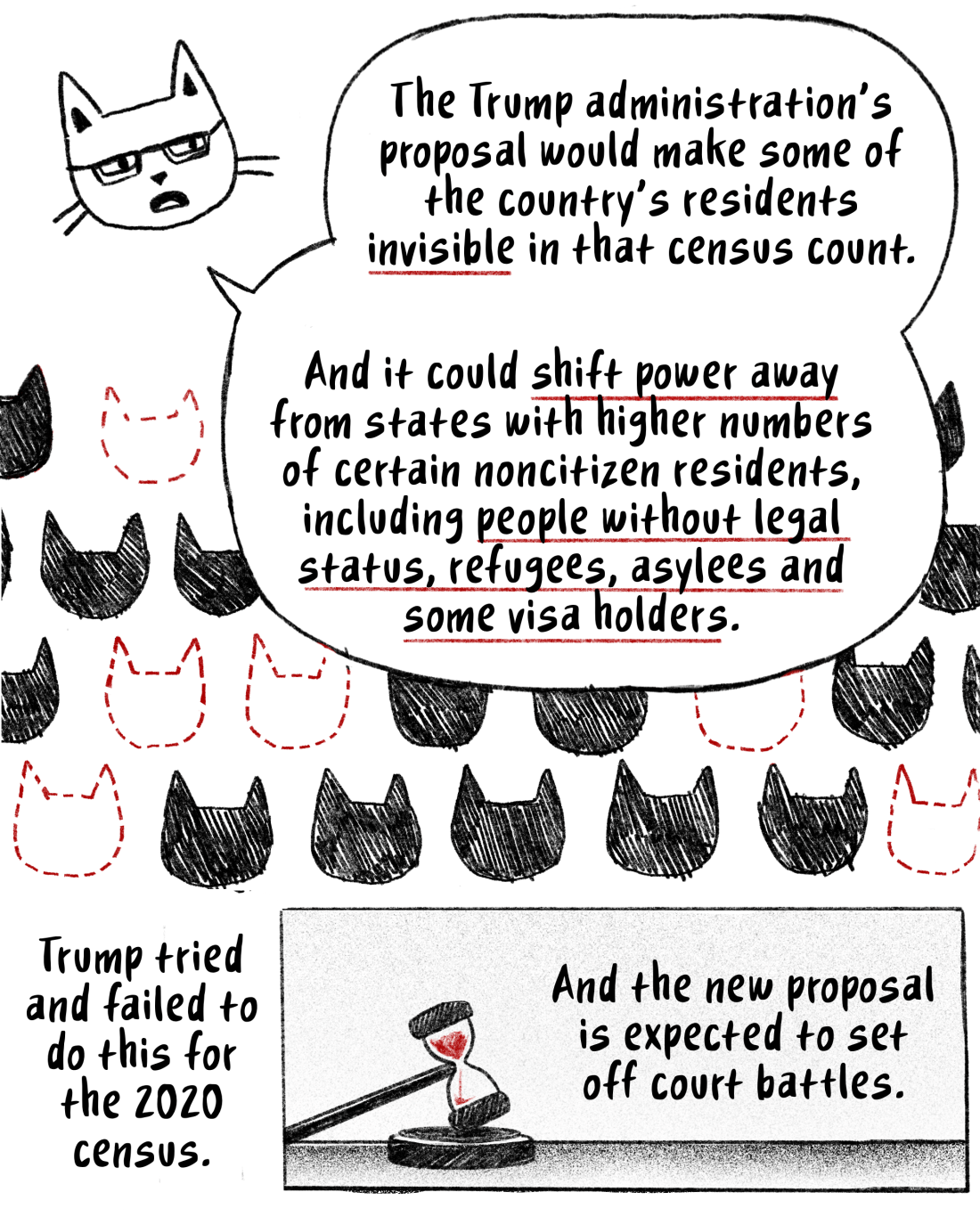
The census is used to determine how much say your state has in Congress and the Electoral College. President Trump failed to alter it during his first term, but he’s trying again ahead of 2030.
 The census is used to determine how much say your state has in Congress and the Electoral College. President Trump failed to alter it during his first term, but he’s trying again ahead of 2030.
Editor’s note: Earlier versions of this comic were published in 2020 and 2021.
![Hi! I'm NPR correspondent Hansi Lo Wang. Did you know the census helps determine how much power your state will have in Congress and the Electoral College for the next 10 years? [Image description: Hansi, depicted as a cat with glasses, waves hello.]](https://npr.brightspotcdn.com/dims3/default/strip/false/crop/2048x2560+0+0/resize/1100/quality/50/format/png/?url=http%3A%2F%2Fnpr-brightspot.s3.amazonaws.com%2F1d%2F82%2F2973bb804932be960368b73714dd%2F1.png)
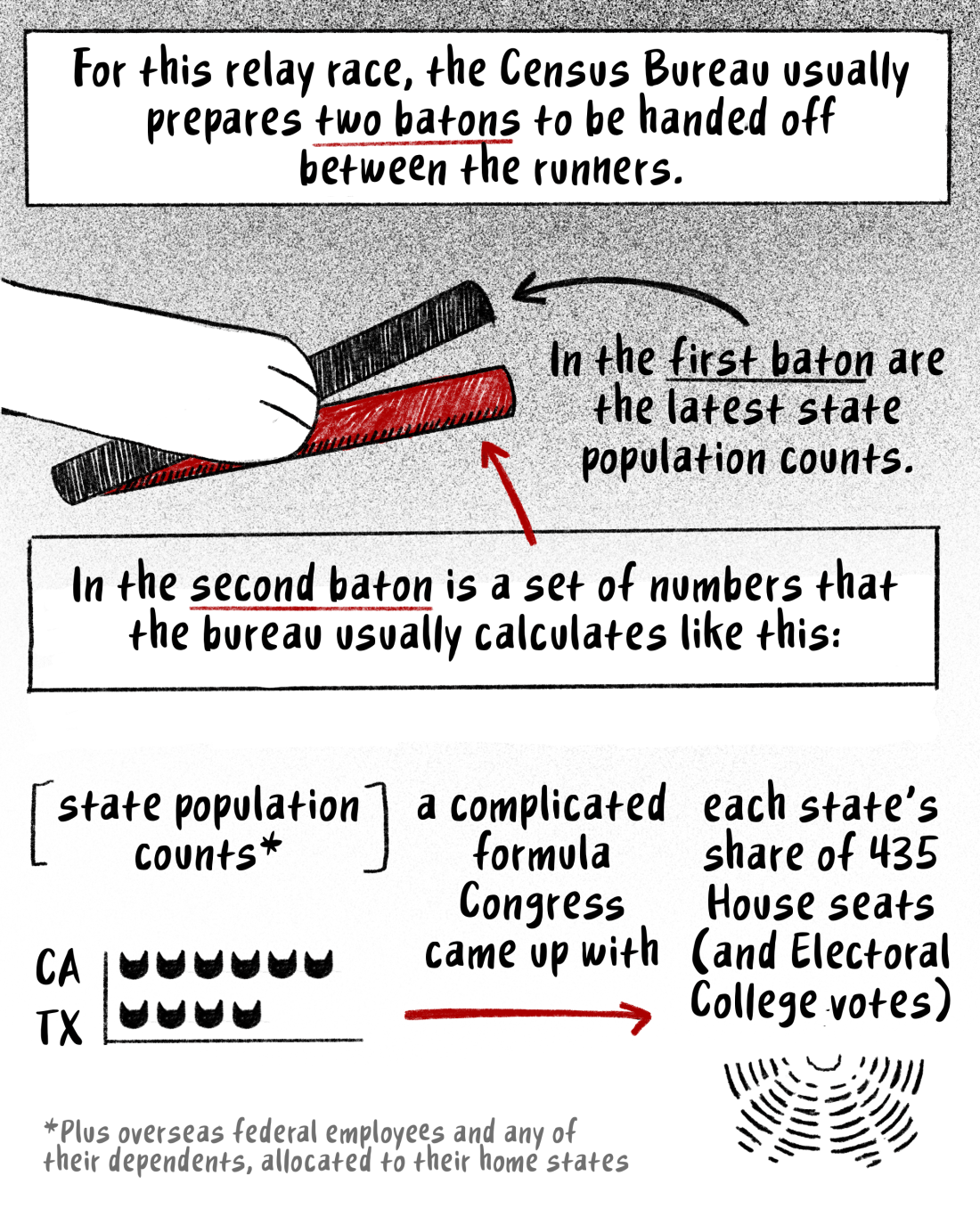
![Think of the process as a relay race. The runners are the commerce secretary (who oversees the Census Bureau), the president and Congress. The batons are state population counts and House reapportionment numbers. [Image description: Hansi puts on an exercise outfit as he talks.]](https://npr.brightspotcdn.com/dims3/default/strip/false/crop/2048x2560+0+0/resize/1100/quality/50/format/png/?url=http%3A%2F%2Fnpr-brightspot.s3.amazonaws.com%2F76%2Fd3%2F0cd173a240adba17060f46fe1cc9%2F5.png)
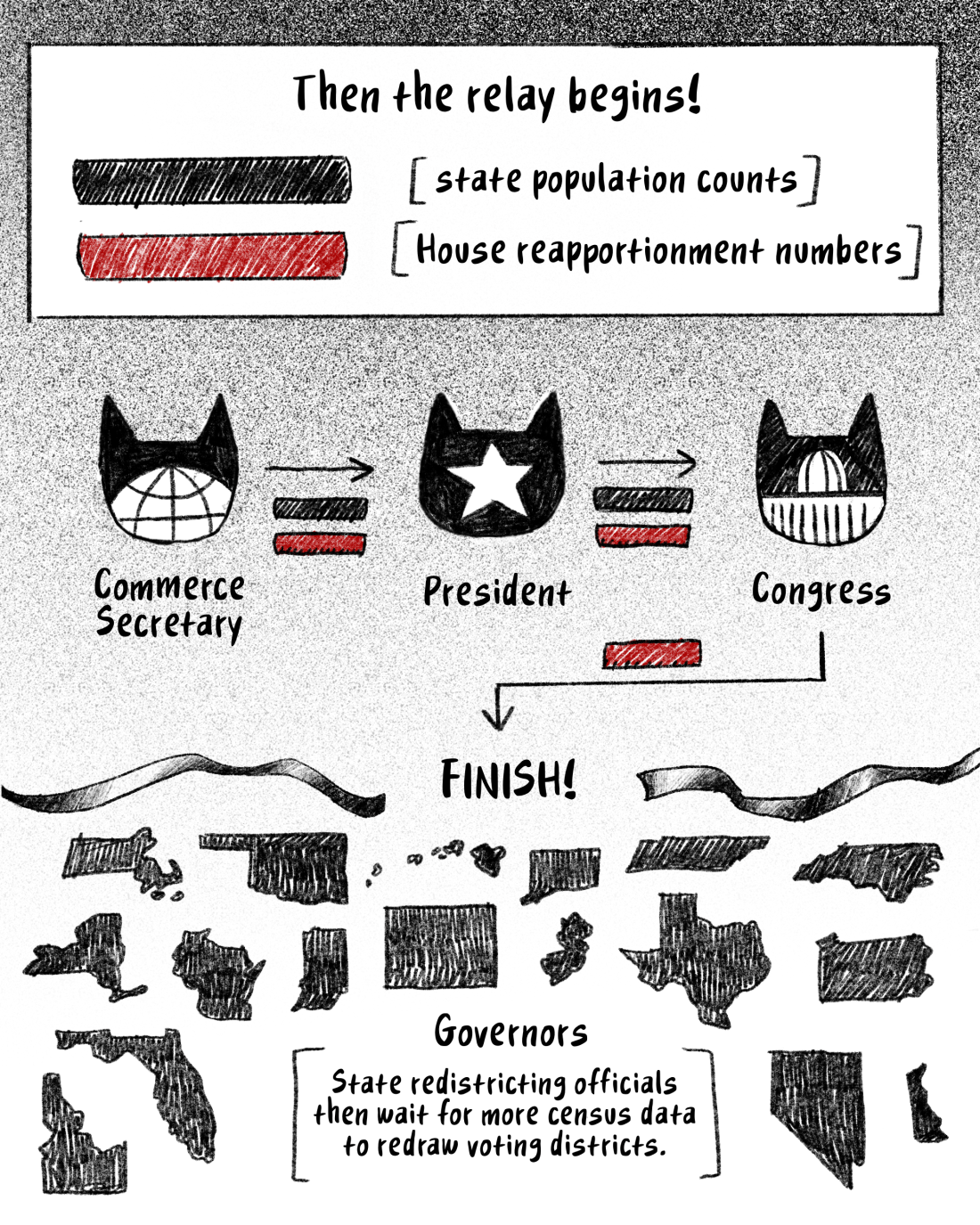
![How this relay ends will set up how much representation your state gets for the coming decade. Then, after the next census, another relay begins. [Image description: Hansi looks at a 2040 finish line in the distance.]](https://npr.brightspotcdn.com/dims3/default/strip/false/crop/2048x2560+0+0/resize/1100/quality/50/format/png/?url=http%3A%2F%2Fnpr-brightspot.s3.amazonaws.com%2F16%2Ff6%2F86cbdedc4604afba3e1b6c825b7e%2F8.png)
Edited by Acacia Squires, Nicole Werbeck and Benjamin Swasey, with copy editing by Preeti Aroon