First, I saw Ben Shelton, Tommy Paul, Leylah Fernandez, and Maria Sakkari play an exhibition—and then I took to the court myself with the former US Open championFirst, I saw Ben Shelton, Tommy Paul, Leylah Fernandez, and Maria Sakkari play an exhibition—and then I took to the court myself with the former US Open champion

All sorts of funny things happen in New York in the week leading up to the start of the main draw of the US Open: Courts appear where you’ve never seen them before: Racquet magazine hosts various festivities at an annual pop-up court at the South Street Seaport; Wilson threw a tennis party to debut their new Defyer racquet at the private Town Tennis Club, tucked into a residential building on a leafy street off Sutton Place; Serena Wilson and Carlos Alcaraz played pickleball in the stately courtyard of the Lotte New York Palace Hotel across the street from St. Patrick’s Cathedral in midtown.
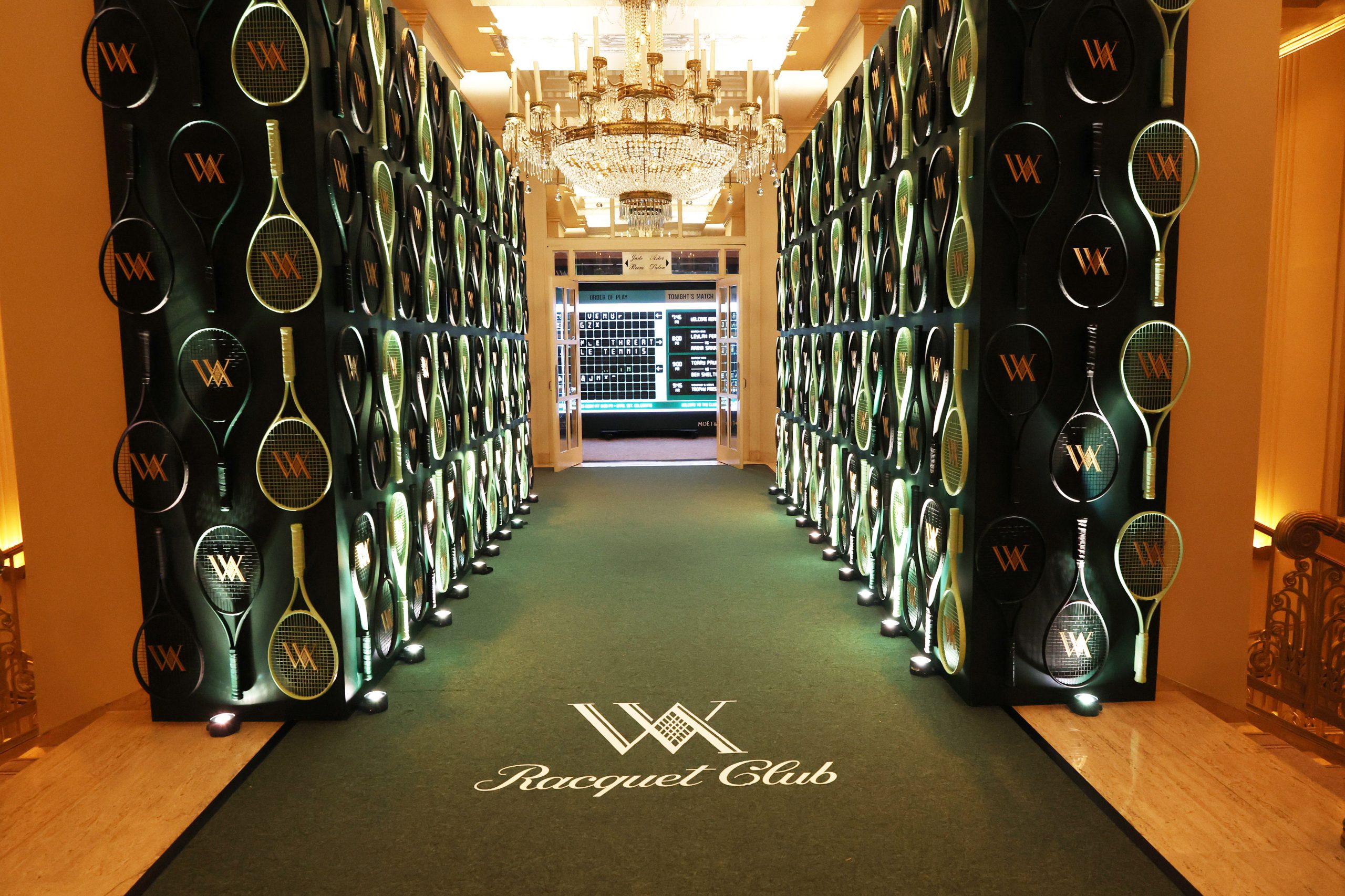
Perhaps the grandest setting the game has seen this year, though, was the regulation-size tennis court installed in the Grand Ballroom of the recently renovated Waldorf Astoria—long-ago the site of everything from concerts by Elvis and the Beatles to the Tony Awards—to host Thursday night’s Waldorf Astoria Ballroom Tennis Invitational. The elegant exhibition (a portion of the proceeds benefited the Big Brothers Big Sister America) featured—along with gripping matches featuring Leylah Fernandez taking on Maria Sakkari and Americans Ben Shelton and Tommy Paul slugging it out on the court—an array of bites from spiced lamb lollipops, wagyu hot dogs, caviar and a massive raw bar, and custom cocktails, along with a serving alley fitted with a radar gun, so you could see just how fast that killer serve of yours really is. (I’m sorry to report that my own topped out at a mere 70 mph—an hour or so later, Ben Shelton clocked the biggest one of the evening out on the ballroom court at 141 mph.)

As to the action itself: Fernandez squeaked by Sakkari in a mini-tiebreak decider, 6-5, while Paul beat the big-serving Shelton, 6-2. Former pro Sam Querrey served as the whimsical chair umpire, while Andy Roddick—still the last American to win the US Open, in 2003—acted as a sort of comic compère. The crowd—limited to 400 or so lucky tennis fans—headed back to the ballroom for an overflow of desserts: There was a summer berry Eton mess, a red velvet tartlet, a cheesecake trifle, and so much more—but, alas, I had a 9am appointment back on the ballroom court the next morning, and so I headed home to (try to) sleep.
As it’s not every day one is offered an hour-long private one-on-one clinic with a tennis legend and three-time Grand Slam champion (including the US Open, exactly a decade ago), sleep didn’t exactly come easy. But I was back at the Waldorf ballroom at 9am, where I met the so-called Stanimal, aka Stan the Man. (The hour-long private clinics are part of the extracurricular offerings from the so-called Waldorf Astoria Racquet Club.)
Stan had already had quite a week: On Monday, when the wild cards were announced for the US Open, he—shockingly—wasn’t among them. (Wild cards, awarded at the discretion of tournament directors, are a way for players who may be lower-ranked—whether because of a lighter schedule, injury, or other factors—to enter the main draw of tournaments. And while Stan is winding down his epic career and retiring at the end of the season, he saw this year’s Open as an opportunity for an emotional farewell to the city he’d come to love even before winning the tourney in 2016.)

The tennis world erupted in outrage; another wild-card player announced an injury and withdrew from the tournament, Stan was given a wild card after all, and all was right with the world. But he’d flown back to his home in Switzerland immediately after the first wild-card announcement on Monday night, and had only returned the night before meeting me at the Waldorf.
Suffice to say that he came ready to play. For an amateur—really most any amateur—hitting with a pro is both an experience of a lifetime and a crucible of terror. One desperately hopes that one’s game is, if not exactly on fire, at least competent enough to avoid bringing shame down upon one’s family name. My own experience in this regard has run the gamut, from absolutely shameful (hitting balls off the frame of my racquet with Andre Agassi on the court at Arthur Ashe Stadium) to middling (with Andy Roddick on the same court a few years earlier); at other times, it’s not the overall play that sticks in the mind but the single shot—lucky or otherwise, as when Garbine Muguruza drilled a forehand directly at me during a doubles game at an indoor court in midtown and—despite the baked-in terror—I deftly parried it away into a game-winning drop shot.
Thankfully, this morning, my game didn’t let me down. At the same time, Stan was indulgent, putting balls pretty much directly onto my racquet and offering the kind of simple yet clearly hard-won tips that made everything a little easier. I’ll spare you the details, but, essentially: Prepare and get my racquet back earlier; plant my feet and my body more steadily not just before but throughout the shot; keep my head down, focusing on the ball and not gawking to see where my brilliant shot is about to land. All are instructions that I myself was giving out at the age of 14, when I began my brief adolescent career as a tennis instructor in my tiny hometown, and the fact that I hadn’t yet absorbed them into my bloodstream was at once maddening—and, yet, somehow an odd proof of why tennis is the most glorious sport in the world.
In-between practice sessions out on the court, Stan and I swigged (me) or sipped (him) water and chatted easily. I asked him if he employed a sports psychologist, and he told me that, no, he didn’t—but he did see what he called a “regular” psychologist. “For me, it’s more about whether you’re happy and feeling good off the court—we all go through emotions off the court, whether you’re feeling happy or sad or anxious or nervous, and that affects how you play on the court. And when I’m feeling happy and with my mind free out on the court, I play better.” Then it was back out on the court for serving instruction—and yeah, I need to calm my whole procedure down, toss the ball higher, wait for it, and then reach for it.
On Monday, Stan will face the formidable Matteo Berrettini in the first round of the US Open. If he gets by Berrettini, he’ll likely face Novak Djokovic next. However the chips fall for him, I hope he plays free, and calm. A legend like him deserves the best possible send-off from New York after a masterful career.
The fact that he helped me straighten out my game—with attentiveness and patience and encouragement and a completely hands-on, all-in enthusiasm? It’s something I’ll never forget.