Foreign minister, Gideon Saar, claims UK ‘systemically working against the state of Israel’ as MPs including Jeremy Corbyn are also banned from countryUK accuses Israeli ‘terrorists’ of ethnic cleansing in West Bank with government backingThe Liberal Democrats say they have been granted a Commons urgent question today about the latest Argentinian threats to the Falkland Islands. A Foreign Office minister will be responding at about 12.30pm.Isaac Herzog, the Israeli president, has said that Britain will be “on the wrong side of history” if it goes ahead with plans to ban trade with the illegal settlements on the West Bank.Later today, we expect to see headlines announcing certain British trade sanctions on Israeli settlements in Judea and Samaria.If this happens – and other nations may join – I believe it will prove to be a grave miscalculation, a decision that will fall on the wrong side of history. Continue reading…Foreign minister, Gideon Saar, claims UK ‘systemically working against the state of Israel’ as MPs including Jeremy Corbyn are also banned from countryUK accuses Israeli ‘terrorists’ of ethnic cleansing in West Bank with government backingThe Liberal Democrats say they have been granted a Commons urgent question today about the latest Argentinian threats to the Falkland Islands. A Foreign Office minister will be responding at about 12.30pm.Isaac Herzog, the Israeli president, has said that Britain will be “on the wrong side of history” if it goes ahead with plans to ban trade with the illegal settlements on the West Bank.Later today, we expect to see headlines announcing certain British trade sanctions on Israeli settlements in Judea and Samaria.If this happens – and other nations may join – I believe it will prove to be a grave miscalculation, a decision that will fall on the wrong side of history. Continue reading…
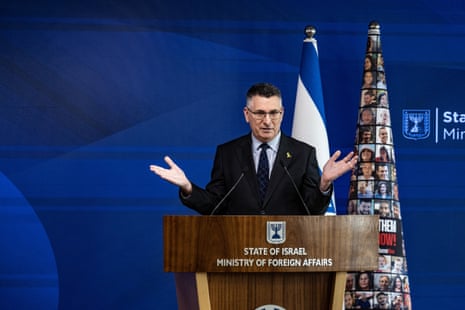
Israel’s foreign minister, Gideon Saar, has said his country will retaliate for the sanctions imposed on West Bank settlements.
He has just announced:
-
The UK consulate in Jerusalem will be shut.
-
The UK will no longer be allowed to participate in the US-led Gaza coordination mission in Israel.
-
Twelve Britons are being banned from entering Israel.
In a response, Saar also accused Miliband of “outrageous lies” and claimed the UK government was “systematically working against the state of Israel”.
UPDATE: There are 12 Britons being banned, not 10 as originally stated. See 4.13pm.
And Israel has also said Britain can no longer train Palestinian Authority forces in the West Bank under the “British Support Team in Ramallah”.
There is more about today’s announcement from Ed Miliband on the latest Latest, the evening edition of the Today in Focus podcast. It features Lucy Hough talking with Emma Graham-Harrison is the Guardian’s chief Middle East correspondent.
That is all from me for today. Charlie Maloney is now taking over.
Andy Burnham has issued a joint statement with Emmanuel Macron, the French president, and Mark Carney, the Canadian PM, about the decision by all three countries to today announce a ban on trade with the illegal settlements on the West Bank.
Here is an excerpt.
Settlements are illegal under international law. The UK, France and Canada will therefore take steps to ban the importation of goods from settlements and enforce targeted measures against settlements and those who facilitate them or profit from them.
In taking this coordinated action we reiterate our desire for a close and productive partnership with Israel, our enduring support for the Israeli people and our unwavering commitment to Israel’s security. We support a safe and secure Israel, living alongside a safe and secure Palestine.
The Green party is saying the UK should stop indirectly supplying parts to Israel for use in F-35 fighter jets. (See 4.34pm.)
During his Commons statement, Ed Miliband said the UK could not do this without ending a weapons programme essential to Nato. In response to questions from the Lib Dem MP Calum Miller, Miliband said:
I want to take on his point on the F-35s. To be clear with the house, we stopped providing direct parts to Israel’s F-35 programme in October 2024, under [David Lammy] when he was foreign secretary.
The only provision we make now is indirectly to the global supply programme.
I am afraid that those who say we should stop supplying parts to the global supply chain are actually advocating the downing of the whole programme, which is crucial to our Nato and other allies. I want to be clear about that.
If you want to read what was said during Ed Miliband’s Commons statement, the Hansard is available here.
These are from Anshel Pfeffer, the Economist’s Israel correspondent and author of a biography of Benjamin Netanyahu, the Israeli PM. Pfeffer is sceptical about what the West Bank settlements trade ban will achieve.
Sanctions on Israeli settlements fully justified, but empty gesture unless “comprehensive sanctions regime against providing services such as construction or financing for Israeli settlements” means sanctioning Israeli government and Israeli banks doing just that. Which I doubt
Miliband says he “couldn’t have been more clear in my statement about our friendship with the Israeli people and indeed our wish to have trade with Green Line Israel” but there’s really no way to differentiate. It’s a muddled empty gesture policy which won’t achieve anything
Jeremy Corbyn, the former Labour party leader who is now parliamentary leader of the small, leftwing Your Party, has issued a statement about being banned by Israel. (See 4.13pm.) He says it is “shocking” that Israel does not want the world to know what is happening in Palestine, and he says “Israel’s genocide cannot go unpunished”.
Sir Ephraim Mirvis, the chief rabbi, has issued a damning verdict on the trade ban announced by the government.
In a statement, he said:
This is truly a dark day for British Jews.
Today our government has chosen to ignore the deep concerns expressed by so many of us. The measures announced amount to little more than political flag bearing for mendacious anti-Israel rhetoric and those who harbour a dangerous obsession with the Jewish State.
These measures will succeed only in bolstering the very extremism they seek to target. On the eve of Rosh Hashanah and at a time when our community is more vulnerable than ever to the wave of extremism that has been building over recent years, these sanctions do nothing to advance the cause of peace. Nor do they make anyone safer – quite the contrary.
Gesture politics of this kind feeds into an increasingly hostile discourse about Israel, and the cumulative effect of such punitive policies is to further embolden those, at home and abroad, who use hatred as a weapon against Jews.
Marco Rubio, the US secretary of state, has been asked about the UK government’s decision to ban trade with illegal Israeli settlements. As Shrai Popat reports on our US live blog, Rubio said that the US was “not going to do what the UK did”. But he did not comment on the decision in detail.
He also said the US does not “want to see some uptick in violence or an uptick in conflict or tensions in the West Bank at a very tenuous time in the region”.
UPDATE: Here is the full quote from Rubio.
Well, they alerted us to it. We don’t have any announcements, obviously, those are decisions that they make, and we – and the president has expressed this in the past – we don’t want to see anything destabilising going on right now in the West Bank with so much going on in the region.
We think it has implications as well on our ability to make progress with regards to Gaza and the 20-point plan and the Board of Peace that we’re very committed to. Obviously, we’re not going to do what the UK did. We saw their announcement today, but I don’t have any comment on it right now.
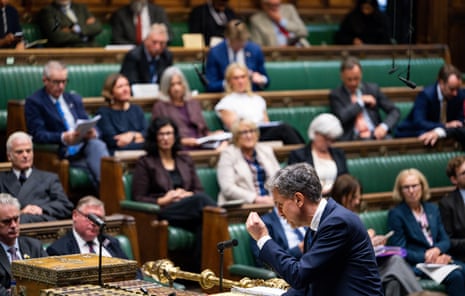
Here is the full text of Ed Miliband’s statement to MPs about the ban on trade with illegal settlements in the West Bank.
Emma Graham-Harrison is the Guardian’s chief Middle East correspondent.
This is from Michael Sfard, one of Israel’s leading human rights lawyers, on the significance of Ed Miliband saying in his statement earlier (see 1.38pm) that the UK government now believes ethnic cleansing is taking place in the West Bank.
Because ethnic cleansing is a mass atrocity that consists of war crimes and might even consist of crimes against humanity, that recognition puts an obligation on the international community, and on the UK that recognises it, to take every legal measure to pressure Israel to stop it.
And that is very important, because that would dictate many aspects of British policy towards Israel.
The Greens have more MPs sanctioned by Israel today (see 4.13pm) than any other party. Here is their response to the settlement trade ban announcement. It is from Ellie Chowns, their parliamentary leader and foreign affairs spokesperson.
The measures announced today mark a critical and overdue step towards upholding the UK’s obligations under international law – one which the Green party has long fought for and strongly supports.
We additionally welcome the government’s recognition that the occupation is unlawful and that Palestinians face ethnic cleansing in the West Bank. Exerting pressure on the Israeli Government over illegal settlements is crucial to protecting the human rights of Palestinians, and Greens are pleased to see action taken to progress this aim.
But Chowns said that the government should have gone further.
Britain’s legal duty to prevent genocide arose when ministers knew, or should have known, of a serious risk. That threshold was crossed long ago. Continuing military and intelligence cooperation with Israel while Palestinians are killed and denied lifesaving aid is a shameful failure to fulfil that duty. Ministers must take further action.
That requires a full two-way arms embargo, wide-ranging sanctions, an end to military and intelligence cooperation, and withdrawal from the UK-Israel trade and partnership agreement.
Existing export licenses that sustain the occupation must be ended, and restrictions must cover F-35 components supplied through the international pool.
Britain must also press for unimpeded humanitarian access and independent war crimes investigations to secure accountability and justice.
Aamna Mohdin is a Guardian community affairs correspondent.
While the leading British Jewish communal organisations have expressed “deep regret” at the government’s decision (see 3.21pm and 4.21pm), the response has not been uniform; progressive Jewish groups have welcomed the announcement.
Yachad, a UK Jewish organisation that advocates for a political resolution to the Israeli-Palestinian conflict, said:
The UK government’s announcement today that it will ban trade in goods with Israeli settlements in the occupied West Bank, and expand sanctions beyond violent extremists, to include those responsible for deepening and entrenching the occupation, is an important and necessary development. We believe it should be supported by those that support the rights of the seven million Israelis and seven million Palestinians to live with freedom, dignity and security.
These new policies do not target Israel; they target the occupation. They draw a clear distinction between the legitimacy of the state of Israel and the settlement enterprise which is illegal under international law.
Distinguishing settlements from Israel proper is not a judgement on where a border will ultimately fall, it’s a recognition that unilateral facts on the ground should not be allowed to decide that question in advance.
The Board of Deputies of British Jews has released its response to Ed Miliband’s announcement. Here is an excerpt.
As proud Brits who love our country, and who also have a deep religious, cultural and family ties to Israel, we feel a deep sense of anguish about this breakdown in relations. We are also impacted directly by heightened rhetoric about the conflict, including policies that focus on the actions of the Israeli government, and do not sufficiently address responsibilities of Palestinian leaders and malign actors in the region.
Announcing such measures during an already heated Israeli election – which has the potential to lead to considerable change to the situation in the West Bank and Gaza – risks perverse consequences which go against the UK’s stated objectives. We urge both governments to avoid pursuing what appear to be party interests over national interests.