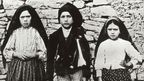
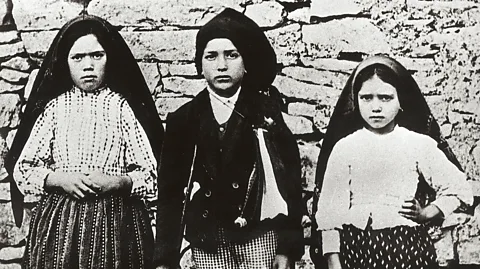
In 1917, Portuguese children said that they saw an apparition of the Virgin MaryIn 1917, Portuguese children said that they saw an apparition of the Virgin Mary
‘The Sun started spinning faster like a wheel of fire’: The ‘divine visions’ prophesying the fall of the USSR
 Getty Images
In March 1917, three Portuguese children declared that they had seen an apparition of the Virgin Mary in a meadow. The prophecies they received fuelled anti-communist sentiment in the Cold War – but one was kept secret. In 1992, a witness told the BBC about the “miracles”.
On 13 May 1917, 10-year-old Lucia dos Santos and her younger cousins Francisco and Jacinta Marta were tending sheep in a field in Fátima, Portugal when, they claimed, they saw a shining figure in an oak tree. They said that the apparition was the Virgin Mary, who told them they should return at the same time on the 13th day of the month for the next five months.
The children also said that they received three revelations. Two of them were made public, but one of them, the so-called “third secret of Fátima”, was written down and kept hidden in the Vatican until the turn of the millennium. Speculation about the secret helped to fuel the phenomenon of Fátima – a phenomenon that turned a rural shrine into an unlikely Cold War landmark.
Thousands of pilgrims were said to be present at the apparition’s final appearance, on 13 October. What they reported to have witnessed became known as the Miracle of the Sun. “All I saw was the planets in the sky in many colours. It was a miracle,” one of the witnesses, Francisco Ferreira Rosa, told the BBC’s Newsnight in 1992. “Then there seemed to be a shower of flowers falling from the sky. It was like a snowfall. And then the Sun started spinning faster and faster like a wheel of fire. It lasted for about half a minute. By the end, it was going very fast.”
Those who were there that day said that serious illnesses were cured and the blind were restored to sight. According to the 1980 book Fatima: the Great Sign by Francis Johnston, the Portuguese anti-religious newspaper O Século (The Century) published a report at the time with the headline “Terrifying event! How the Sun danced at midday in the sky at Fatima”. The writer said that at least 50,000 people had gathered there.
Whether it was a miracle or a mass hallucination – or a meteorological event – is debated. But it seemed to have had a profound effect on some of the people who were present. “Everyone knows I already had faith. But after that, I began to believe even more strongly,” Rosa told the BBC in 1992. “I wasn’t afraid, but many people, when they saw the Sun spinning like that, they were afraid. When something like that happens, you have to believe and have faith.”
The first two prophecies
Of the three children who’d had the apparitions, two died in the Spanish Flu outbreak a few years later – leaving Lucia as the only bearer of the messages and prophecies. While the first “secret” offered a vision of Hell said to prophesise World War Two, the second – given to the children just before the October Revolution – claimed that if prayers were devoted to the Virgin, Russia would eventually be saved from communism. Uneasy at first with the rapidly growing popularity of Fátima, the Vatican only officially sanctioned the Fátima prophecies in 1930.
In History
In History is a series which uses the BBC’s unique audio and video archive to explore historical events that still resonate today. Sign up to the accompanying weekly newsletter.
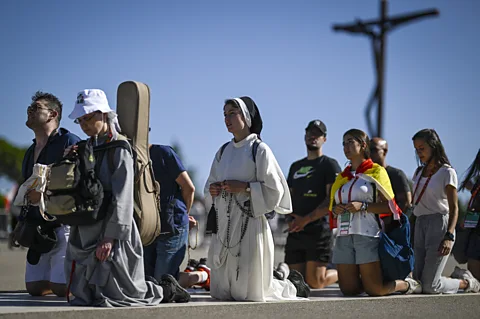
Under the ultra-conservative António de Oliveira Salazar dictatorship in Portugal, the rural village became one of the most popular Virgin Mary shrines in 20th-Century Catholicism. Pilgrims still visit in their thousands. Worshippers often crawl on their knees along a marble pathway – the Via Penitencial – to the Chapel of Apparitions, where five of the Virgin Mary’s six apparitions were said to have occurred.
But in the years that followed the children’s visions, Fátima picked up a different kind of following. By including a prediction of the spread, then the collapse, of communism in Russia, the prophecies developed a political dimension. During the Cold War, Fátima became an ideological shrine for anti-communists.
Speaking to the BBC in 1992, the year after the Soviet Union collapsed, theologian Michael Walsh said: “The real problem with Fátima is the message about Our Lady, which has developed in the 20s, about the anti-communism of Fátima… it has become a divisive force, almost, in the Church.”
 Getty Images
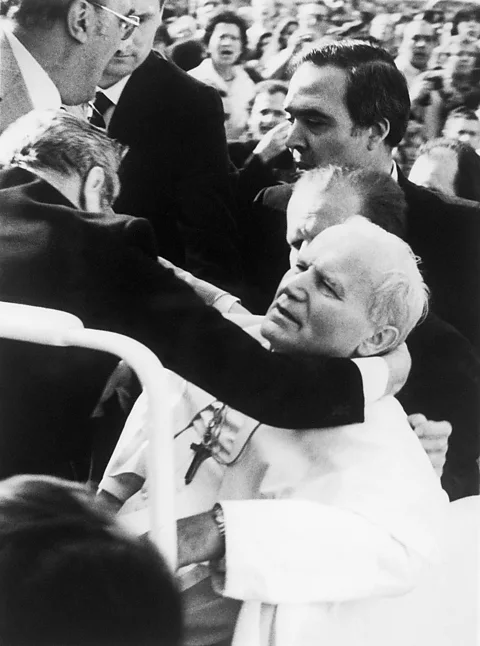
Fátima’s anti-communist associations increased when the Polish-born Pope John Paul II became a fervent supporter in 1981, after an event that took place on 13 May – on an anniversary of the first apparition. While in his “popemobile” in St Peter’s Square, Vatican City, he was shot twice at close range. Despite the arrest of the lone gunman, there were theories that others were behind the assassination attempt. The Pope alleged in his 2005 memoir that “someone else masterminded it”. Could it have been someone in the USSR?
The Soviet leadership viewed the Pope as a threat, with a Communist Party directive warning in 1979 that the Pope was their “enemy”, due to his support for Poland’s Solidarity movement. Documents recovered from former East German intelligence services in 2005 indicated that Soviet military intelligence initiated the plot to kill him – something that the Russians denied.
The secret in the sealed envelope
Because of the date he was shot, the Pope credited his recovery to Our Lady of Fátima – bringing even more anti-communist fervour to believers in the prophecies. He visited the shrine twice, and one of the bullets extracted from his body was placed alongside diamonds in the gold crown worn by the statue of the Madonna there.
As well as drawing worshippers because of its anti-communist interpretations and support from the Pope, Fátima was the subject of fevered speculation fuelled by the existence of the “third secret”. Lucia wrote it down in 1944, asking that it not be revealed until 1960, and successive popes refused to make it public.
More like this:
Kept in a sealed envelope at the Vatican, and known only to each pope and his inner circle of advisors, it led to Fátima attracting conspiracy theories and doomsday cults. Attempting to force the Vatican to reveal the secret, Fátima fanatics held hunger strikes, and one even hijacked a plane.
Conspiracy theorists had suggested that the prophecy warned of a third world war, or another apocalyptic event threatening mankind. Yet the Vatican described the secret as a vision of the 1981 assassination attempt on Pope John Paul II, warning that a man “clothed in white… falls to the ground apparently dead”.
When the prophecy was revealed by the Vatican in 2000, an estimated 500,000 worshippers gathered at the Fátima shrine for the announcement. Yet for some, it was a letdown. The New York Times reported at the time that “the belated disclosure of the third secret of Fátima last week was a little like the FBI announcing that Elvis is, in fact, dead”, and that witnesses scoffed at the announcement as a “made-to-measure revelation”.
 Getty Images
Despite the disclosure of the “third secret”, speculation has continued about the supposed links between what happened at Fátima and events in the Cold War. Some argue that it was no coincidence that, when John Paul II did as the Virgin had asked – consecrating Eastern Europe “to her immaculate heart” in 1984 – Mikhail Gorbachev became Soviet leader and Perestroika began.
However, there are critics who question both the sensationalist interpretations of the prophecies and how they were embraced by those in power. When releasing the “third secret” as a Cardinal, Joseph Ratzinger – who became Pope Benedict XVI in 2005 – said that “no great mystery is revealed, nor is the future unveiled”, shifting the focus away from apocalyptic predictions.
“Original reports simply had the Virgin asking people to pray for the ‘conversion of the world’,” says Michael Carroll, author of the book The Cult of the Virgin Mary: Psychological Origins. “It was only later, in the late 1920s, that Lucia (then in a convent) revised the story and suggested that the Virgin had asked people to pray for the ‘conversion of Russia’.”
He argues: “There is no doubt that the Church, especially in the immediate post-World War Two period, used the Fatima apparitions in its fight against communism. Did that contribute to the collapse of the Soviet Union? Fatima per se aside, the Church’s opposition generally to communism likely did likely play a role in that collapse, but so likely did a host of other factors.”
But there is no doubting the impact the visions had. When Lucia died in 2005, at the age of 97, Portugal declared a day of mourning, and canvassing in the general election was suspended. And on 13 May 2025, around 270,000 worshippers gathered at the shrine to mark the day the children said they saw their first vision.
—
For more stories and never-before-published radio scripts to your inbox, sign up to the In History newsletter, while The Essential List delivers a handpicked selection of features and insights twice a week.