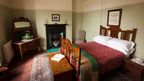
Staying in the poet’s home is a surreal experienceStaying in the poet’s home is a surreal experience
Sleeping in Dylan Thomas’ house in Wales
 Alamy
AlamyPart time portal, part museum, the legendary poet’s childhood home offers travellers an all-access stay in Swansea – and a surreal experience.
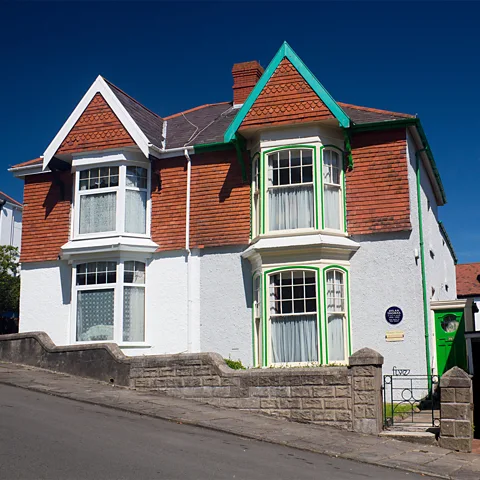
Walking up to No 5 Cwmdonkin Drive is murder on the calves. The semi-detached house sits near the top of a too-steep hill, in a middle-class Swansea suburb called The Uplands. To the untrained eye, it might look like just another Edwardian amid many Edwardians, but the blue plaques near the entrance reveal that it’s the childhood home of legendary Welsh poet Dylan Thomas, the self-titled “Rimbaud of Cwmdonkin Drive”.
After catching my breath, I knocked on the front door and prepared to sleep in my literary hero’s bed.
From Jane Austen’s country cottage in Hampshire to Charles Dickens’ Georgian house in London, Britain is filled with writer residences-turned museums that travellers can tour. But while The Dylan Thomas Birthplace is open for self-guided tours, the real joy is in spending the night where he slept – a part time portal, part museum, all-access crash pad where you can learn about the author while living like him too.
 Alamy
AlamyAn all-access stay
Thomas was born here (literally, in the front bedroom) on 27 October 1914 and lived in the house for the first 20 years of his life. The interior has since been restored, with every item harking back to Thomas’ time. The website promises that “no rooms are out of bounds” for guests, and that’s no exaggeration. Guests can cook in the kitchen where Thomas’ mother prepared meals on a tight budget, write on the poet’s desk, play a few tunes on the pianola in his father’s study and even sleep in Thomas’ childhood bed. The experience, much like Thomas’ writing, often feels surreal.
Plan your trip:
Overnight stays at The Dylan Thomas Birthplace start at £144 ($191). The home can accommodate up to seven people and guests have access to the whole house. Self-guided visits start at £9 ($12).
I started with a tour from the home’s current owner and lifelong Uplander, Geoff Haden. The former structural engineer decided to restore the century-old home from a student boarding house in 2003, after visiting it on the 50th anniversary of the poet’s death. The house had suffered years of neglect – with worn-down carpets, tattered windows, crumbling walls – but after receiving and locating items that once belonged to the Thomas family, and furnishing the house in the Edwardian style, Haden opened No 5 to the public in 2008, inviting people to stay the night.
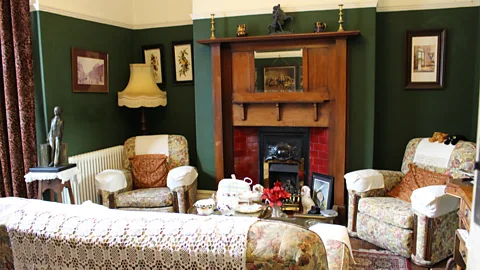
Haden started by offering me a brief a tour, available to all overnight guests. We started in the parlour room, which Thomas references in his work. “Large men sat in the front parlour, without their collars, uncles almost certainly,” he writes in A Child’s Christmas in Wales. A corner table is dedicated to “Thomas the plagiarist”. The young poet was notorious for copying poems from other writers. “Immature poets imitate. Mature poets steal,” TS Eliot wrote. Teenage Thomas certainly stole, with 12 out of 24 early poems evidently plagiarised.
Haden told me that in recent years, an array of famous faces have travelled to the Uplands to pay respects to Thomas, including Johnny Depp, Lord David Owen and singer Cerys Matthews. The residence recently welcomed a swarm of Swifties armed with selfie sticks, after the singer-songwriter referenced Thomas in her 2024 album, The Tortured Poets Department.
 Ioan Marc Jones
As Haden finished the tour, he explained that certain lights only work when others are switched off and showed me a few gifts left behind for guests, including Welsh cakes, tea and two beers. Then he handed me the keys and I essentially had free reign of the place.
It’s a strange feeling, sitting alone in an Edwardian Parlour room with 10ft-high (3m) ceilings and bay windows, a room where the Thomas family listened to a crackling wind-up phonogram and the tick-tock of a grandfather clock. I was too giddy to sit, so I made a cuppa and continued exploring, seeking further curiosities.
Living like Thomas
One of the joys of staying at No 5 is reading the framed scraps of writing left in each room, revealing how the space influenced the budding poet. I stepped into the smallest one and saw a note Thomas wrote to his first girlfriend, Pamela Hansford Johnson: “My room is a tiny, renovated bedroom… Smelly. Painful. Hot water pipes very near. Gurgle all the time. Nearly go mad.”
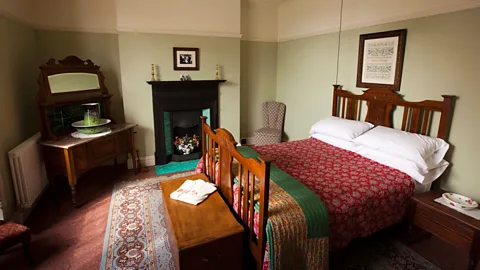
Today, Thomas’ childhood bedroom is a masterpiece of restoration and recreation. And, as ever with No 5 Cwmdonkin Drive, nothing is off limits to the all-too-curious visitor.
 Ioan Marc Jones
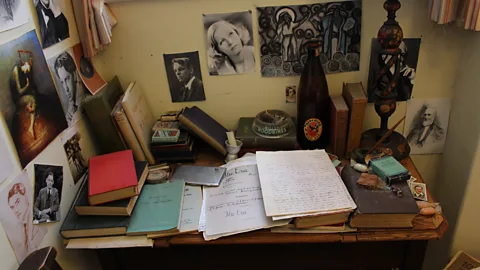
I sat at a desk covered by Thomas’ favourite things: a Woodbine ashtray; portraits of writers he admired like William Shakespeare, James Joyce and Virginia Woolf; and a pint-sized bottle of Hancock Ale. Framed prints of birds graced the walls, with an illustrated heron receiving pride of place. I laid my head on what Thomas called the “warm, safe island” of his bed and felt my toes reach over the edge.
I went back downstairs and played the pianola, trying to remember the few songs I could actually play. Then, after ruffling through the wash house and coal shed, I decided to take a walk and explore Thomas’s neighbourhood.
More like this:
“[The Uplands] was more than just a place he was raised,” says Dr Siân Round, a fellow at Swansea University’s English Literature department. “It shaped Thomas’ writing.”
My first stop was Cwmdonkin Park, a park where Thomas spent a lot of time as a boy. He revisits the park several times in his writing, most notably in his book, Portrait of Artist as a Young Dog and in BBC radio broadcasts. It was in Cwmdonkin Park that Thomas “endured, with pleasure, the first agonies of unrequited love, the first slow boiling in the belly of a bad poem”.
 Ioan Marc Jones
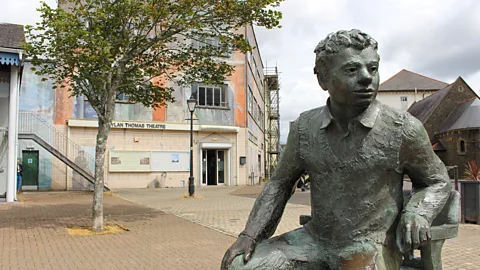
The park might have shaped Thomas, but now Thomas shapes the park. You can hardly take a step without seeing some reference to him. His name adorns a huge, foreboding memorial shelter. His chubby cheeks are painted on a park bench. Signposts point out myriad Thomas hotspots like 5 Cwmdonkin Drive and The Dylan Thomas Centre, which tells the story of his life – unhelpful to anyone who is actually lost. And, by an algae-filled pond, a memorial stone from Cwmrhydyceirw Quarry displays the final lines of the poem Fern Hill.
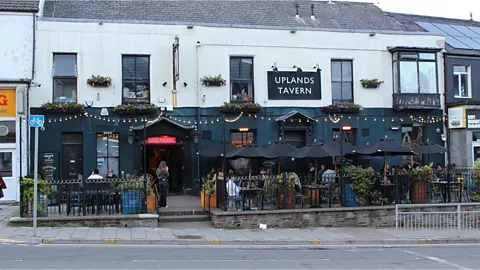
I walked through Cwmdonkin Park to a place Haden had recommended – a place where Thomas also spent much of his time: the Uplands Tavern. “My sane mother saved my sanity,” Thomas once wrote to a lover, “driving me out to the pubs with a stern and sad demand to drink myself steady.”
Haden told me how, as a young man, he’d walk into the tavern and every head would turn to the door, just to make sure the new arrival was a local. Now only students run amok. When I myself entered, every head turned to door, but only because I’m approaching 40. I settled down with a beer, stared at the Thomas mural on the wall and then flicked through a few of his poems that I’d brought for the journey.
After a few pints, I stumbled back up that too-steep hill, destroying what was left of my calves. I stepped into the kitchen, with adjacent pantry and scullery, and made myself another cup of tea.
 Ioan Marc Jones
After a long day of exploration, I eyed the deep cast iron bath, of which Thomas wrote that the “click, click of the geyser sounds like the distant champing of a lady tenor”. It turns out that the family bath was much larger than Thomas’ childhood bed – and far more comfortable. I settled into the quiet of the evening, the water washing over me, the only sound the caw of Upland crows.
Thomas was born in his parents’ bedroom, and that night, his father celebrated by going to the Uplands Tavern (then called the Uplands Hotel) and drank so much that the maid had to take off his boots. Mine was a tamer evening.
After the bath, I climbed into the bed in the same room where my childhood hero was born. I had borrowed a copy of A Child’s Christmas in Wales from the parlour room, and before slowly drifting off to sleep, I re-read words that had inspired me so many years ago.
“I could see the lights in the windows of all the other houses on our hill and hear the music rising from them up the long, steadily failing night. I turned the gas down. I got into bed. I said some words to the close and holy darkness, and then I slept.”
—
If you liked this story, sign up for The Essential List newsletter – a handpicked selection of features, videos and can’t-miss news, delivered to your inbox twice a week.