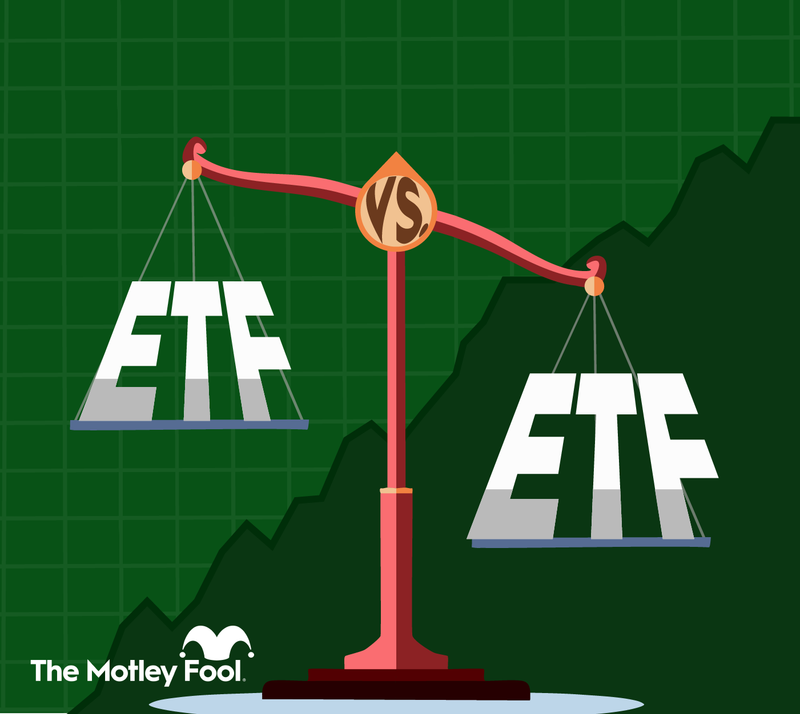

The State Street SPDR Portfolio S&P 600 Small Cap ETF (NYSEMKT:SPSM) offers a lower-cost entry to small caps, while the iShares Core S&P Small-Cap ETF (NYSEMKT:IJR) provides superior liquidity and historical longevity.
Both funds target the S&P SmallCap 600 Index, providing exposure to profitable small-cap U.S. companies. While they share the same underlying index and risk profiles, investors typically choose between them based on subtle differences in expense ratios, trading volume, and assets under management (AUM).
Beta measures price volatility relative to the S&P 500; beta is calculated from five-year monthly returns. The 1-yr return represents total return over the trailing 12 months. Dividend yield is the trailing-12-month distribution yield.
Expense ratios and dividend yields set these two small-cap ETFs apart, despite nearly identical returns and risk profiles over five years.
The State Street SPDR Portfolio S&P 600 Small Cap ETF (SPSM +0.02%) offers a lower-cost entry to small caps, while the iShares Core S&P Small-Cap ETF (IJR 0.13%) provides superior liquidity and historical longevity.
Both funds target the S&P SmallCap 600 Index, providing exposure to profitable small-cap U.S. companies. While they share the same underlying index and risk profiles, investors typically choose between them based on subtle differences in expense ratios, trading volume, and assets under management (AUM).
Snapshot (cost & size)
| Metric | SPSM | IJR |
|---|---|---|
| Issuer | SPDR | iShares |
| Expense ratio | 0.03% | 0.06% |
| 1-yr return (as of May 7, 2026) | 37.30% | 37.10% |
| Dividend yield | 1.40% | 1.20% |
| Beta | 1.04 | 1.04 |
| AUM | $15.6 billion | $102.9 billion |
Beta measures price volatility relative to the S&P 500; beta is calculated from five-year monthly returns. The 1-yr return represents total return over the trailing 12 months. Dividend yield is the trailing-12-month distribution yield.
The State Street fund is more affordable with a 0.03% expense ratio, saving investors three dollars per $10,000 invested annually compared to the iShares fund. It also currently offers a slightly higher distribution yield of 1.40%.
Performance & risk comparison
| Metric | SPSM | IJR |
|---|---|---|
| Max drawdown (5 yr) | (27.90%) | (28.00%) |
| Growth of $1,000 over 5 years (total return) | $1,324 | $1,320 |

iShares Core S&P Small-Cap ETF
Today’s Change
(-0.13%) $-0.18
Current Price
$138.17
What’s inside
The iShares Core S&P Small-Cap ETF (IJR 0.13%) holds 640 stocks and was launched in 2000. Its largest positions include Viavi Solutions (VIAV +4.63%) at 0.74%, Sanmina (SANM 0.66%) at 0.71%, and FormFactor (FORM +3.50%) at 0.66%. The fund focuses on financial services (16.00%), industrials (16.00%), and technology (15.00%). It has a trailing-12-month dividend of $1.60 per share.
The State Street SPDR Portfolio S&P 600 Small Cap ETF (SPSM +0.02%) holds 606 stocks and was launched in 2013. Its top holdings include FormFactor (FORM +3.50%) at 0.61%, Viavi Solutions (VIAV +4.63%) at 0.58%, and Semtech (SMTC +8.42%) at 0.58%. It has a similar sector profile led by industrials (17.00%) and financial services (17.00%), and paid $0.77 per share over the trailing 12 months.
For more guidance on ETF investing, check out the full guide at this link.

SPDR Series Trust – State Street SPDR Portfolio S&P 600tm Small Cap ETF
Today’s Change
(0.02%) $0.01
Current Price
$53.84
What this means for investors
Small-cap stocks — companies too small for the S&P 500 — have historically outperformed large caps over long time horizons, but with a catch: The small-cap universe is full of speculative, unprofitable companies that can drag returns down significantly. Both SPSM and IJR sidestep that problem by tracking the S&P SmallCap 600, an index that requires profitability before admission. That shared quality screen is what sets them apart from broader small-cap funds.
In fact, these two funds are so similar that the choice between them is almost entirely about fund mechanics rather than strategy. Both hold the same roughly 600 companies in the same proportions. But SPSM charges half of what IJR does. That’s a difference that amounts to a few dollars annually per $10,000 invested, but one that compounds quietly over decades.
What IJR offers in return is scale and history. With roughly six times the assets and a track record stretching back to 2000, IJR is the more established vehicle and carries deeper liquidity. For buy-and-hold investors, SPSM’s lower cost is the stronger argument. Those who value a longer track record and greater fund depth will find IJR worth the modest premium.