Broadly speaking, artificial intelligence (AI) stocks have led the market higher over the last few years, but not every player in this space has been a surefire winner. SoundHound AI (NASDAQ: SOUN) stock, for example, is down 18% this year and 66% from its December 2024 peak.
SoundHound is a leading developer of conversational AI software, and its customers include some of the world’s biggest brands across industries such as automotive manufacturing, hospitality, and financial services. The company doubled its revenue in 2025 on the back of soaring demand, and on May 7, it will release its operating results for the first quarter of 2026 (ended March 31), which are likely to show even faster growth.
Should investors buy the dip in SoundHound stock ahead of the upcoming report? Read on for the surprising answer.
SoundHound AI doubled its revenue last year, but investors are paying a hefty price for that growth.
Broadly speaking, artificial intelligence (AI) stocks have led the market higher over the last few years, but not every player in this space has been a surefire winner. SoundHound AI (SOUN 0.37%) stock, for example, is down 18% this year and 66% from its December 2024 peak.
SoundHound is a leading developer of conversational AI software, and its customers include some of the world’s biggest brands across industries such as automotive manufacturing, hospitality, and financial services. The company doubled its revenue in 2025 on the back of soaring demand, and on May 7, it will release its operating results for the first quarter of 2026 (ended March 31), which are likely to show even faster growth.
Should investors buy the dip in SoundHound stock ahead of the upcoming report? Read on for the surprising answer.

Image source: Getty Images.
Conversational AI is transformative for enterprises
Conversational AI is designed to interpret voice-based prompts and respond in kind, so it’s more versatile than traditional text-based AI software. It’s a game-changer in call centers, in quick-service restaurants, and even in cars, which is why SoundHound is experiencing such strong demand.
Restaurant chains use SoundHound products like Dynamic Drive-Thru and Dynamic Kiosk to autonomously take customer orders in the drive-thru and in-store, reducing staff workload. SoundHound also offers a product called Employee Assist, which stands ready to help workers prepare menu items or understand store policies.
Car manufacturers are also using tools like Voice AI, which can help drivers with practically any query, whether it’s about their vehicle’s features or finding local entertainment. Car companies can pair Voice AI with third-party models from top developers like OpenAI and Anthropic, and they can even customize its personality to match their specific brand.
In 2024, SoundHound acquired another conversational AI company, Amelia, which has supercharged its expansion into industries like healthcare, financial services, insurance, and more. The combined companies have since launched Amelia 7, a platform that enables businesses to build custom AI agents to assist their clients and even their employees.
Business is booming for SoundHound
SoundHound’s revenue soared 99% to a record $168.9 million in 2025, giving it significant momentum entering 2026. According to management’s guidance, the company could deliver somewhere between $225 million and $260 million in revenue this year, representing further growth of 43% at the midpoint of the range.

SoundHound AI
Today’s Change
(-0.37%) $-0.03
Current Price
$8.16
SoundHound’s first-quarter report on May 7 could set the tone. Wall Street analysts estimate the company delivered $42.5 million in revenue for the period (according to Yahoo! Finance), representing a 46% year-over-year increase. But investors will also be looking for a potential update to management’s full-year forecast, which could indicate whether demand for SoundHound’s software is as strong as originally expected.
Another point of focus on May 7 will be SoundHound’s bottom line. Scaling an AI software business isn’t cheap, so the company suffered an adjusted (non-GAAP) net loss of $53.8 million last year. That was an improvement from its 2024 loss of $69.1 million, but until profitability is clearly in sight, investors will worry about the prospect of future debt financing or dilutive capital raises, which can impact their long-term returns.
Fortunately, SoundHound had zero debt and $248 million in cash on hand at the end of 2025, so it probably won’t run into a cash crunch for at least a couple of years, as long as its losses don’t grow significantly larger from here.
Should you buy SoundHound stock before May 7?
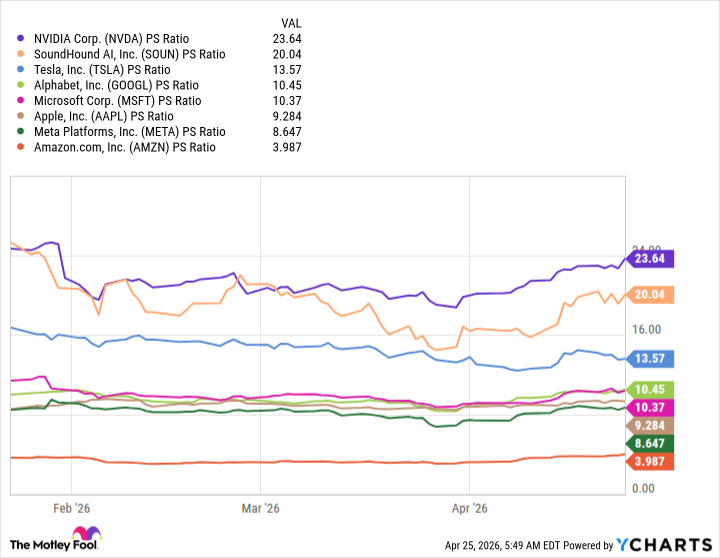
Valuation might be the reason SoundHound’s stock is plummeting even amid the company’s blistering growth. The stock is trading at a price-to-sales (P/S) ratio of 20 as I write this, making it more expensive than every tech giant in the “Magnificent Seven,” except Nvidia.
The Magnificent Seven companies dominate various segments of the AI industry, including semiconductor hardware, software, cloud computing, and autonomous driving, to name just a few. Therefore, the fact that SoundHound trades at a premium valuation to most of this group might be difficult to stomach for some investors, given that the company is still in the early stages of commercialization and continues to lose money.
Data by YCharts.
On a more positive note, SoundHound stock looks more attractive if we value it at the midpoint of management’s 2026 revenue forecast. On that basis, its forward price-to-sales (P/S) ratio is a more palatable 14.4.
In summary, whether or not investors should buy SoundHound stock ahead of May 7 depends entirely on their time horizon. Those who are looking for blistering short-term gains over the next few months should probably stay away. However, those who are willing to hold the stock for a long-term period of three to five years could do very well as the company grows into its valuation.