
Last October, NuScale Power (NYSE: SMR) stock hit an all-time high of about $57 a share. At that price, it carried a market cap of roughly $17 billion, despite generating only about $30 million in revenue through the first nine months of 2025. At that premium, it was trading at about 270 times sales — more than 68 times the multiple of nuclear heavyweight Constellation Energy (NASDAQ: CEG).
Fast-forward seven months, and NuScale’s stock is down about 75% from that all-time high. At about $12 a share, the company still carries a $4 billion market cap — not cheap by conventional standards.
The company, however, has been gaining momentum. It’s closing in on its first project in Romania, and it could deploy up to 6 gigawatts (GW) of its small modular reactor (SMR) technology to the Tennessee Valley Authority, in partnership with ENTRA1 Energy.
The stock has been gaining some momentum. Could this nuclear energy provider rise tenfold?
Last October, NuScale Power (SMR 0.36%) stock hit an all-time high of about $57 a share. At that price, it carried a market cap of roughly $17 billion, despite generating only about $30 million in revenue through the first nine months of 2025. At that premium, it was trading at about 270 times sales — more than 68 times the multiple of nuclear heavyweight Constellation Energy (CEG 2.35%).
Fast-forward seven months, and NuScale’s stock is down about 75% from that all-time high. At about $12 a share, the company still carries a $4 billion market cap — not cheap by conventional standards.

NuScale Power
Today’s Change
(-0.36%) $-0.04
Current Price
$12.54
The company, however, has been gaining momentum. It’s closing in on its first project in Romania, and it could deploy up to 6 gigawatts (GW) of its small modular reactor (SMR) technology to the Tennessee Valley Authority, in partnership with ENTRA1 Energy.
Things are looking up for NuScale. But can the momentum take its stock to $120? Let’s look at the math.
Image source: Getty Images.
The math behind a tenfold gain for NuScale is brutal
For NuScale to climb from about $12 a share to $120, its market cap would likewise need to rise roughly tenfold from here. That would take its market cap from roughly $4 billion today to about $40 billion, assuming the share count stays about the same.
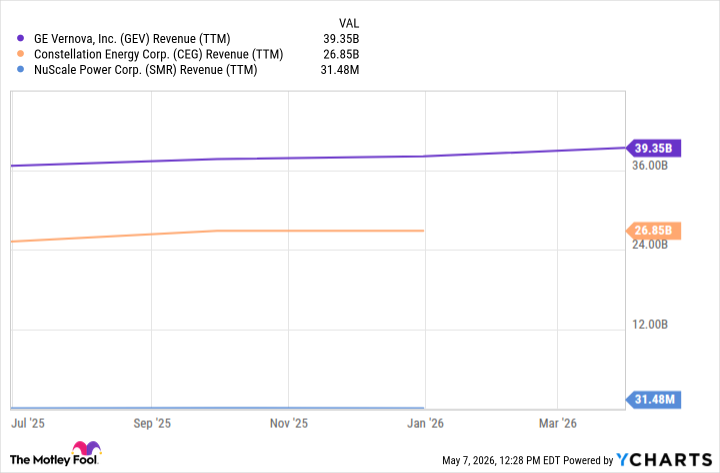
That number alone isn’t unheard of. Constellation has a market valuation of $115 billion, while GE Vernova is currently at about $290 billion. The difference, however, is that both Constellation and GE Vernova are profitable and raking in billions of dollars of revenue every quarter. Meanwhile, NuScale is burning cash and hasn’t yet made an SMR sale.
Data by YCharts; TTM = trailing 12 months.
Let’s imagine, for the fun of it, that NuScale is at $120 a share. If we assume it’s trading at 25 times sales, which is still a rich premium for a nuclear energy stock, then the company would need to generate roughly $1.7 billion in annual revenue to support a $40 billion market cap. That means NuScale would need to grow its 2025 revenue ($31.5 million) by about 54 times. Not a small commercial leap by any means.
What would $1.7 billion look like in reactor revenue?
NuScale expects its SMR to produce about 77 megawatts of power, with a target price of roughly $89 per megawatt hour. Assuming each module runs at 95% capacity over the course of a year, a single reactor could generate about $57 million in annual power revenue. In total, NuScale would need about 30 operating modules to generate $1.7 billion in annual revenue.
Of course, this assumes that investors would support a $41.5 billion market cap on $1.7 billion in revenue. If they assign it a lower price-to-sales ratio (P/S), the revenue hurdle would climb quickly. For example, a P/S of 10 would require about $4 billion in annual revenue (73 modules). A multiple of 5 would require about $8.3 billion in annual revenue, or roughly 146 modules.
And NuScale has yet to deploy a single SMR.
This isn’t to say that NuScale stock won’t ever climb to $120; it certainly could. But investors will need to think in years — possibly a decade — before that price reflects a strong underlying business. As such, this stock remains speculative: It has the potential to 10x, but only if it can start deploying reactors soon.