


Amazon‘s (NASDAQ: AMZN) founder and first CEO, Jeff Bezos, was instrumental in getting the company off the ground and scaling it into the diversified technology behemoth it is today. His successor, Andy Jassy, has also played a huge role in its success since taking the helm in 2021 by cutting costs and helping secure consistent profitability across its operating segments.
But while Jassy has historically focused on maximizing efficiency, he seems to be taking a page out of Bezos’ more maximalist playbook when it comes to the company’s generative artificial intelligence (AI) transition.
In a recent interview on CNBC’s Mad Money, Jassy expressed his optimistic projections about the future of generative AI, calling it a “once-in-a-generation opportunity” and claiming “it’s going to reinvent every single customer experience we know and altogether new ones we never imagined.”
Amazon management expects generative artificial intelligence to be a once-in-a-generation opportunity.
Amazon‘s (AMZN 1.43%) founder and first CEO, Jeff Bezos, was instrumental in getting the company off the ground and scaling it into the diversified technology behemoth it is today. His successor, Andy Jassy, has also played a huge role in its success since taking the helm in 2021 by cutting costs and helping secure consistent profitability across its operating segments.
But while Jassy has historically focused on maximizing efficiency, he seems to be taking a page out of Bezos’ more maximalist playbook when it comes to the company’s generative artificial intelligence (AI) transition.

Amazon
Today’s Change
(-1.43%) $-3.91
Current Price
$268.77
Jassy calls AI a once-in-a-generation opportunity
In a recent interview on CNBC’s Mad Money, Jassy expressed his optimistic projections about the future of generative AI, calling it a “once-in-a-generation opportunity” and claiming “it’s going to reinvent every single customer experience we know and altogether new ones we never imagined.”
If that forecast proves accurate, it would put generative AI alongside previous megatrends such as the internet and mobile phones, which totally transformed the way people live and do business.
Jassy’s optimism helps explain why the company is pouring such huge amounts of money into AI chips and other data center equipment. For 2026, Amazon raised its capital expenditure forecast to $200 billion. That’s more than double the $80 billion in operating income the company earned last year. And with capital expenditures potentially remaining elevated for the next few years, it’s hard to imagine how this level of spending will pay off for investors within a reasonable time frame.
Jassy used his Mad Money interview to help reassure investors. He said he believes that the high level of spending today could generate outsize returns in the future, with better operating margins and free cash flow.
He compares the company’s massive AI investments to the rollout of the company’s web hosting and cloud computing unit, Amazon Web Services (AWS), in the 2000s: “We’ve lived this movie once before in the first wave of AWS, and I think the same story is going to play out, except with much larger revenue and free cash flow downstream.”
CEOs aren’t always right about new technologies

Image source: Getty Images.
While it’s reasonable to expect CEOs to have clearer insights into where their companies are headed than the general population, that doesn’t mean they’re always right. Just ask Meta Platforms CEO Mark Zuckerberg about how his metaverse investments have turned out. (It hasn’t been pretty.) Corporate leaders’ proximity to their industries can create biases and wishful thinking.
Ultimately, Amazon’s leaders have an incentive to see and present generative AI as a one-in-a-lifetime technology because it would create a larger market for the infrastructure services the company provides through AWS. If you sell lemons, you should hype up lemonade. But it becomes risky when you spend heavily to plant more lemon trees in advance of future demand that might not materialize. That’s analogous to what Amazon is doing with its extreme spending on data centers, and investors are right to be a little cautious.
Capital spending can drive future growth. But it also represents money that could have been returned to shareholders through stock buybacks and dividends, both of which tend to boost a stock’s price. Over the past five years, Amazon’s total return lagged behind that of Apple, which has been more focused on directly returning value to its shareholders.
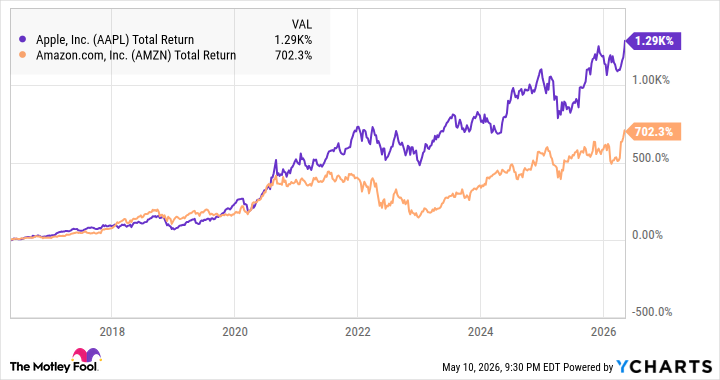
AAPL Total Return Level data by YCharts.
If Jassy is right about AI, this pattern could reverse over the next five years. But it will take more tangible progress on that front before I get excited.