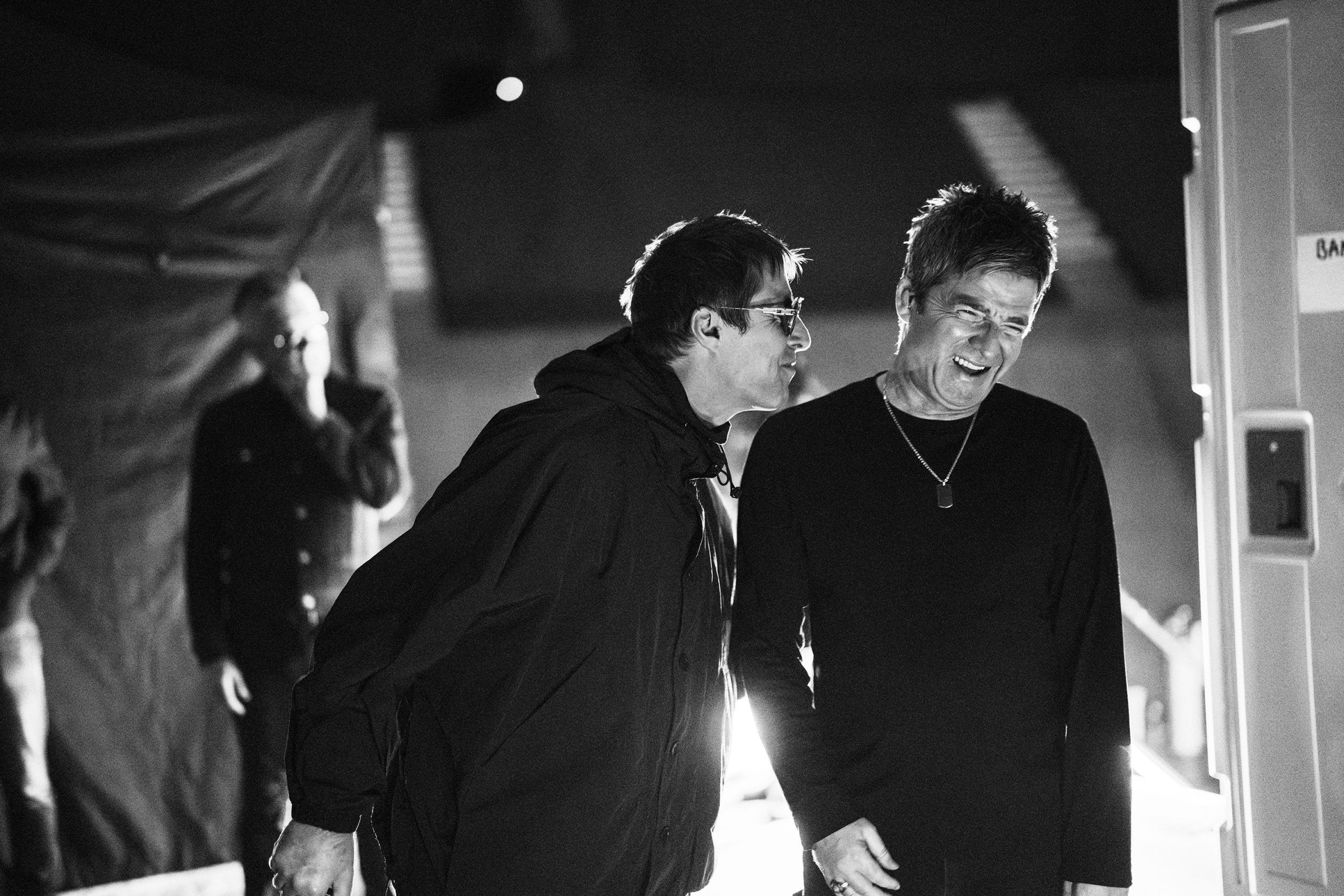
How did Liam Gallagher heal things with his brother Noel? As the new film “Don’t Look Back in Anger” shows, they didn’t hug it out—they sorted it onstage, in epic gig after epic gig.How did Liam Gallagher heal things with his brother Noel? As the new film “Don’t Look Back in Anger” shows, they didn’t hug it out—they sorted it onstage, in epic gig after epic gig.

The day before I attended an advance screening of the new Oasis documentary, out today, I boldly pronounced, on my fellow-Oasis-fans text thread, that this was going to be like The Odyssey, only better. My thinking was that if Christopher Nolan’s film limned the universal story of finding one’s way home while parrying everything that life throws at you, then Don’t Look Back in Anger—written and created by Steven Knight—interrogates that other universal story: You love your brother, but sometimes your brother is a knobhead.
I thought I was being clever, but no: Just after the lights went down in the IMAX theater and the crowd—approximately 90% of us wearing bucket hats and/or various Oasis gear of various vintages, from the ’90s to now—applauded in anticipation, someone screamed out: “This is our Odyssey!”
Given that the band is run by two famously hard brothers who didn’t speak to each other for 15 years (don’t worry: the essential timeline of the band—its accelerated rush to fame and glory and its bitter dissolution—is dealt with in a few minutes at the start of the film), the amount of both emotion and devotion that they induce in their fans is astonishing. Early on in the film, one English man, talking of the band’s breakup, says that “It was like losing a child for me.” Moments later, another one refers to their reunion last year as “like the rebirth of Christ.” I’d place an easy bet that this film conjures more tears than Steel Magnolias. (I watched this with my young son on one side of me and my teenage daughter on the other, and let’s just say: We were there for each other. The complete stranger we gushed about the film with right after the screening? Yeah, he cried, and of the seven people in our extended party, all but one shed a tear—and he, of course, is English.)

As for the essential question I was hoping the film would answer: how did Liam and Noel heal their rift? How do two brothers who, for 15 years, seemed to go out of their way to antagonize, berate, insult, demean, and otherwise assassinate each other’s character find a way through to…what…forgiveness? Acceptance? Harmony, peace, love, all of that?
We see, early in the film, in a nerve-wracked moment, the entire band waiting in their rehearsal studio in Wimbledon for Liam’s supposedly imminent arrival. (The film’s directors had placed a number of fixed cameras throughout the studio, which they monitored from a tiny, un-air-conditioned cabin just outside.) They wait and wait—and suddenly, the studio door is flung open, Liam struts in (again, having not been in the same room as his brother for 15 years), immediately complains about the drum setup, then drops his bag and says, “Are we ready then?” before leaning into the microphone with his trademark admixture of aggression and heart. When he’s had enough—with the band still playing the end of “Champagne Supernova”—he simply grabs his bag and walks out the door, leaving Noel and crew dumbfounded.
We don’t see it all, but that’s more or less what Liam did in every rehearsal in advance of Live ’25—with the exception of the last rehearsal, which he skipped. But then, just as they walked out in Cardiff, Wales, for the first Oasis gig since 2009, Liam did something else that unnerved Noel: he grabbed his hand and raised them both up, with the two of them taking the stage in a kind of spontaneous triumph of brotherhood. The “healing,” if you will, didn’t happen by talking it out; it happened by being in the same room, and on the same stage, long enough together for them both to realize how great they were together when things worked the way they should.
The film also benefits from some astounding luck. On the one day when they were able to film inside St. Bernard’s Church in Burnage, Manchester—where both Liam and Noel were baptized—Father Luke Bradbury’s reading from the Bible—selected months, if not years in advance, by the Vatican—just happened to be about the biblical theme of brotherly forgiveness (”Peter came to Jesus and asked, ‘Lord, how many times must I forgive my brother, who has sinned against me?’”). Father Bradbury notes the throngs of people gathering in the streets for the Oasis gig taking place that weekend in the city, he talks about the rift between the two brothers, and he adds that forgiveness “doesn’t necessarily mean forgetting what happened—it means looking forward, not back.”
If I have a criticism of Don’t Look Back in Anger, it’s that the occasional fan stories interspersed throughout the film—people of all ages from all around the world who are devoted to Oasis, many of whom credit the band for getting them through hard times or for being either a rock of stability or the perfect escape from a world gone mad—while wonderful, are occasionally a bit too much of a detour. By the time we get to the South Korean haenyeo (traditional free diver) who tells us—in between dives where we see her harvesting abalone, conch, and sea urchins—how Oasis helped her through problems with depression and anxiety, I’m anxious to get back to the gigs, and to hear the brothers explain, in their inimitable way, how they got to where they’re at.
“It was all forgiven without saying a word,” Noel says. Liam, typically, has a slightly more askew take on things: “It takes a lot of caring,” he says, “to not give a fuck.”
A decade ago, Noel said something that resonated with me at the time, and it came back to me in the screening room: “You couldn’t say that anyone that was ever in Oasis, me included, was the best in the world at anything,” he said. “But when it all came together, we made people feel something that was indefinable—and people will never forget the way you made them feel.”
The great triumph of this film—whether you were lucky enough to score tickets to last summer’s tour or not—is that, for two hours and three minutes, you’re not a bystander. You’re squarely in the middle of that feeling.