In Retail Ritual, presented on the occasion of her first institutional solo exhibition at the National Gallery of Bosnia and Herzegovina during the Sarajevo Photography Festival, Carlota Guerrero transforms the luxury fitting room into a stage where motherhood, performance, consumer culture, and the female gaze converge. We spoke with the artist about desire, identity, ritual, and the images that emerge before experience itself can be understood.In Retail Ritual, presented on the occasion of her first institutional solo exhibition at the National Gallery of Bosnia and Herzegovina during the Sarajevo Photography Festival, Carlota Guerrero transforms the luxury fitting room into a stage where motherhood, performance, consumer culture, and the female gaze converge. We spoke with the artist about desire, identity, ritual, and the images that emerge before experience itself can be understood.

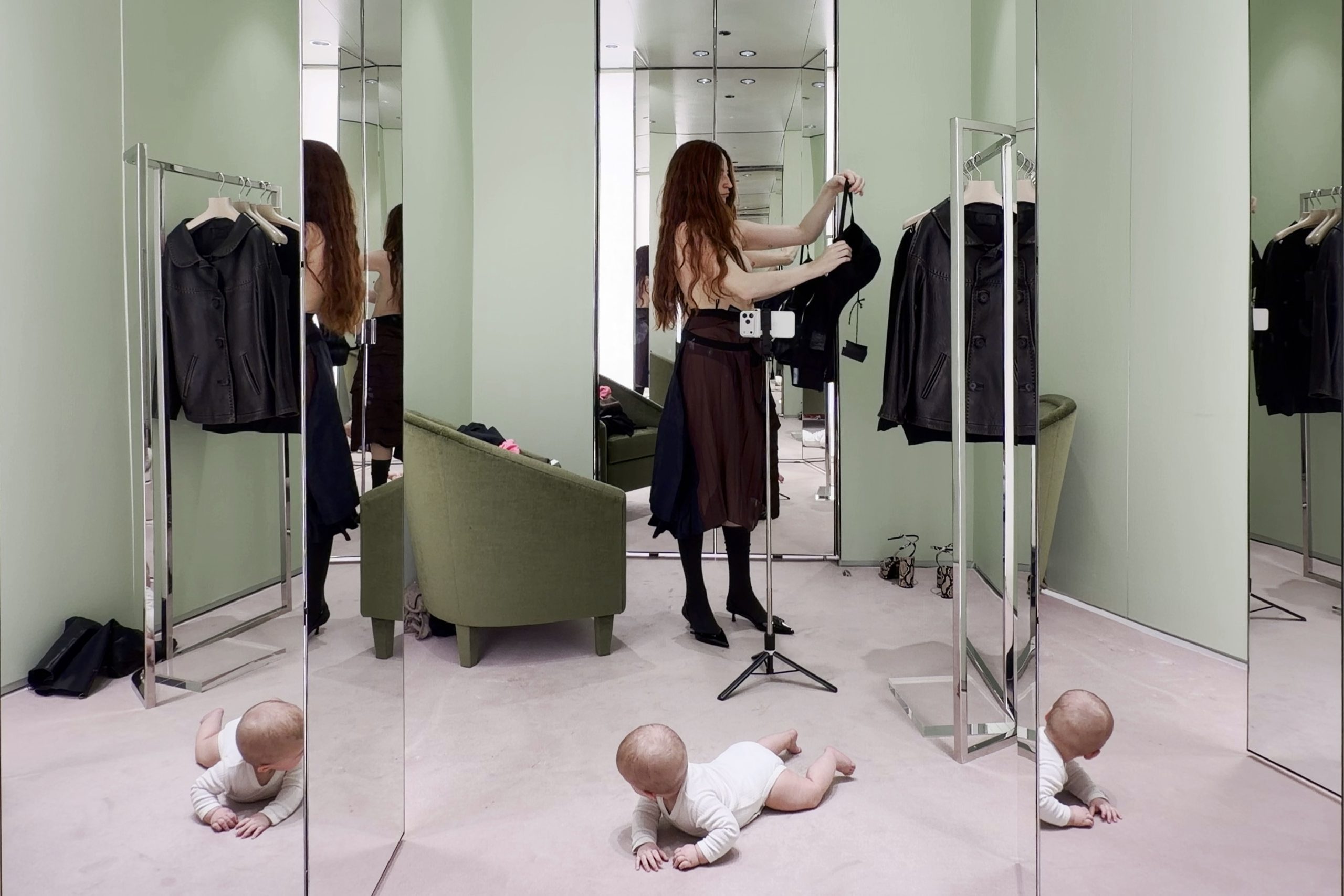
Presented on the occasion of Carlota Guerrero‘s first institutional solo exhibition at the National Gallery of Bosnia and Herzegovina, as part of the Sarajevo Photography Festival, Retail Ritual consists of seven large-scale photographs made entirely with an iPhone. Yet the work exceeds photography. It unfolds somewhere between performance, conceptual practice, self-portraiture, and social observation, transforming the luxury fitting room into a liminal space where motherhood collides with the carefully choreographed rituals of consumer culture.

“When Carmina was born, I thought I could kill for her. I did not recognize the woman who had this thought,” Guerrero writes. “Following her birth, I repeated the same action for months. I would visit luxury retail stores. I spoke to sales assistants. I asked for high heels and an outfit. I accepted the glass of champagne. Then, I entered the fitting rooms with her. I registered our actions in the mirror. It became a sustained search: procedural, almost ritualistic.” Within these spaces, designed to produce idealized performances of femininity, the unpredictable rhythms of postpartum life become a quiet act of disruption. “I displaced the intended use of that liminal space. These images are the record of that intrusion.”

As curator Melanie Isabel García observes in her accompanying essay, the work unfolds through “a cross between performance, sociological experiment, and postpartum ritual,” where repetition itself becomes the artwork. She also reminds us that the mirrors contain “several different timelines hidden in the reflections of the reflections”: the artist, her daughter, the child Carlota once was, and her own mother, all inhabiting the same image at once. The fitting room becomes not merely a site of reflection but of temporal collapse, where personal history, maternal lineage, and contemporary constructions of femininity coexist.

Throughout her practice, Carlota Guerrero has persistently challenged the visual conventions through which women’s bodies have been represented, reclaiming sensuality, vulnerability, and intimacy through an unmistakably female gaze. Retail Ritual extends this investigation into new territory. Rather than asking what motherhood looks like, it asks what motherhood does to the act of looking itself. What happens when a body that has become functional, public, nurturing, and exhausted refuses to relinquish complexity? What happens when the maternal body enters spaces built around aspiration, beauty, and desire, not as a contradiction but as an undeniable presence?
In this conversation, Guerrero reflects on motherhood not as a fixed identity but as a radical reconfiguration of perception, time, and embodiment. She speaks about performance as a way of acting before understanding, about claiming spaces where she and her daughter were never expected to belong, and about image-making as a structure capable of holding experience until experience itself becomes legible.


AG: The fitting room is a particularly charged space: private but commercial, intimate but surveilled, a place where women rehearse possible versions of themselves in front of a mirror. What did this space allow you to explore about the instability of your identity after Carmina’s birth?
CG: I didn’t have a full-length mirror at home, and at that time I could easily lose track of time. The fitting room came with a mirror and a time limit.
At the same time, the mirrors were playing with time. As Melanie Isabel García writes in her curatorial text, the reflections contain several different timelines: Carmina, the child I used to be and my own mother. I wasn’t consciously looking for all of them, but they surely appeared there.

AG: Much of your earlier work creates collective, almost mythological images of femininity through carefully choreographed bodies. Here, the gesture is more solitary and repetitive, yet you are never entirely alone because Carmina is physically and psychologically part of the image. Has motherhood altered your understanding of where one body, one identity, or one subject ends and another begins?
CG: I’ve been obsessed for years with images of groups of women, no men in sight, a kind of utopian fantasy. My father died when I was young, so my mother, my sister and my female friends became my first muses.
With Carmina, especially during her first months, it was difficult to tell where one subject ended and another began. I knew that state would be brief, and I needed to create something with her while it lasted. We felt so physically attached at that time that I experienced the photographs almost as just self portraits.

AG: The photographs are made with an iPhone, through mirrors, inside spaces whose primary purpose is to produce and sell images of desirable femininity. How important was it that the work emerged through a device and a visual language associated with self-surveillance, self-fashioning, and the constant circulation of women’s images?
CG: It was essential that I didn’t enter those spaces as a photographer. The iPhone allowed me to remain a customer and kept the images inside the fiction.
It was also practical. We wandered around the city and could find a store at any moment, walk in and begin our mission. We didn’t need any preparation as I wasn’t trying to produce an ideal image, I was simply registering.

AG: Your practice has always moved between instinct and construction, intimacy and performance, the personal and the archetypal. In Retail Ritual, an intensely private postpartum experience becomes a repeated action, a fictional persona, and eventually a public artwork. What can performance reveal about an experience that direct autobiography cannot?
CG: Direct autobiography would have required me to know what I was feeling. I didn’t. Performance gave me rules instead: enter a store, ask for an outfit, accept the champagne, take a photograph.
The character allowed me to act before I understood why. She helped me move through the world without overthinking and gave Carmina and me a shared mission. This is how my projects have always been therapeutic for me. Giving my ideas structure saves me from existential dread.