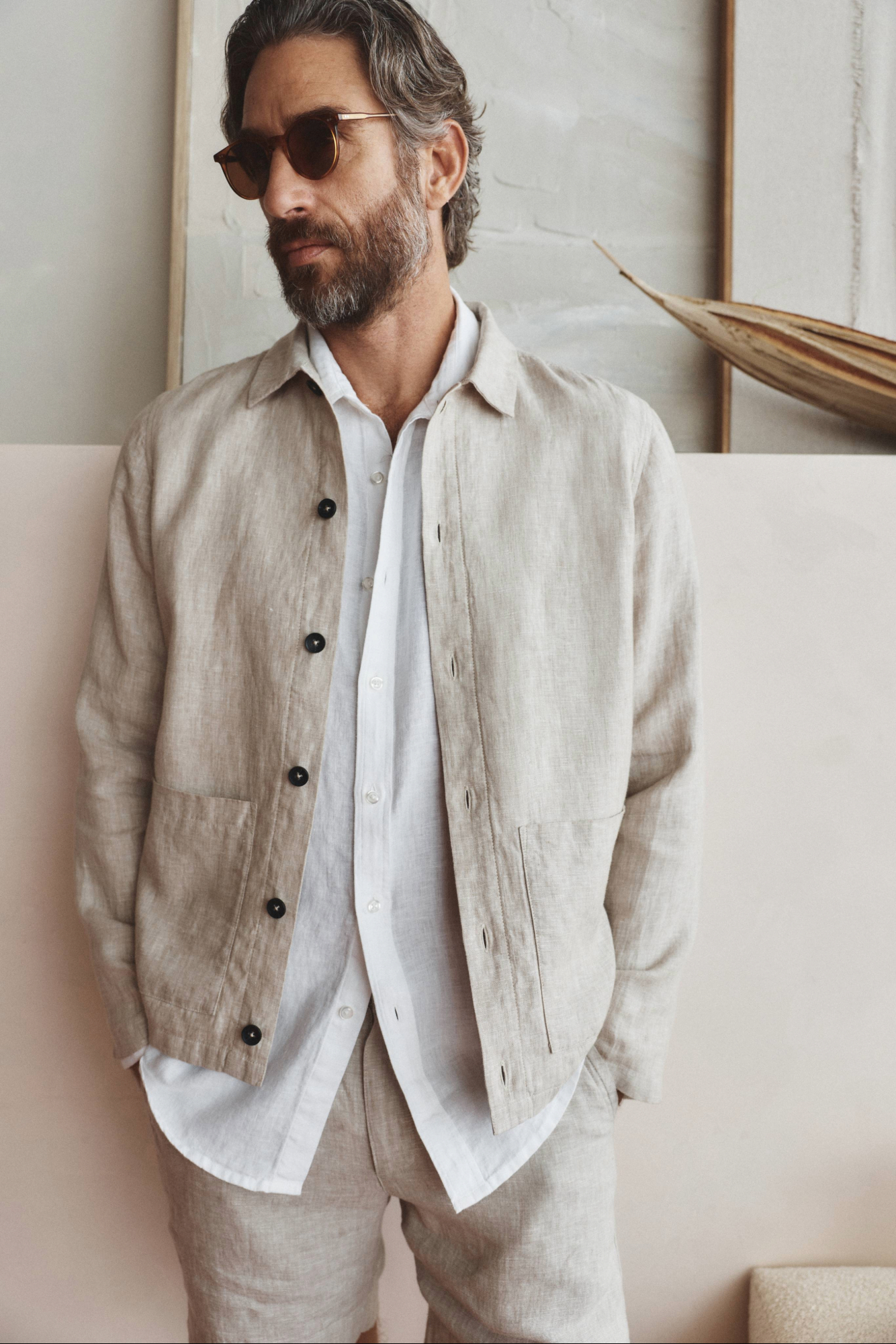
The DTC essentials brand believes menswear can account for 40 percent of its $1 billion volume by 2027.The DTC essentials brand believes menswear can account for 40 percent of its $1 billion volume by 2027.
Quince has big goals for its menswear business.
The San Francisco-based direct-to-consumer brand founded by Sid Gupta, Sourabh Mahajan, Becky Mortimer and Zunu Mittal in 2018, has already made significant inroads in the apparel, accessories, home, beauty and supplements markets. Now it’s turning its sights to the guys.
Men’s products currently account for around 20 percent of Quince’s $1 billion-plus sales, and the goal is to double that number by as early as next year, according to Christopher Sung, the company’s general manager of men’s apparel.
“Men’s is one of our fastest-growing categories,” he said. “We’re really looking to scale up to 40 percent, probably by 2027. We’re going to do that through finding those essentials that drive a ton of productivity, identifying some new category opportunities and then quickly moving into those spaces to fill the guy’s closet.”
You May Also Like
Quince is known for its sharply priced essentials such as its $50 Mongolian cashmere crewneck sweaters. It’s able to fulfill its promise to sell luxury goods at below-market prices because of its AI-powered business model that can predict weekly demand of both sizes and styles, and the use of a shorter supply chain.

Courtesy of Quince
In March, Quince closed on a $500 million Series E funding round, led by Iconiq with participation from Baillie Gifford, Basis Set Ventures, DST Global, MarcyPen Capital Partners, Notable Capital, Wellington Management and WndrCo. The fund raise valued the company at $10.1 billion.
Sung, whose résumé includes stints at Abercrombie & Fitch, Pacific Sunwear, Lucky Brand and Amazon Fashion as well as several technology firms, joined Quince two years ago to oversee the men’s division. He believes his varied background in both merchandising and technology offers him an advantage in his role working for a “full vertical operator. At our core, we’re a technology platform powered by data.”
Even though men’s is already a sizable business for Quince, Sung said since joining the company he and his team have sought to understand what has made the women’s and home products so successful. What he found is that customers respond to the quality raw materials and the reasonable prices. As it touts on its website: “Quality shouldn’t be a luxury. [We’re] committed to making exceptionally high-quality essentials at a price within reach. Because everyone deserves to fill their life with the finer things.
“Those are nonnegotiable in men’s,” Sung said, adding that he has learned “we only have one opportunity to make a first impression. The name of the game is repeat customers.”
Over the past couple of years Quince has invested in adding dedicated menswear teams in design, sourcing and other areas to support the planned growth. Currently, linen shirts and pants as well as cashmere sweaters are among the bestselling items. Sung pointed to the 24/7 pants that offer comfort in a “refined” silhouette, as well as the Comfort Stretch Traveler, which he described as “an everyday pant.” Jeans, as well as the Japanese Lotus and superfine cashmere T-shirts, are also popular. “Jeans and Ts are the bread-and-butter for our guy,” he said.
Activewear is also a “huge” business for the brand, he said, citing the Commuter performance pant that can be worn for work or play; the Flowknit Breeze performance T-shirt, and the ProTech golf pants as perennial bestsellers.
He hinted that Quince will soon begin offering sports equipment in partnership with a golf company in its quest to become “a real golf destination.” Next month, a denim range will launch, and going forward, Quince will expand its offering of T-shirts, most of which retail for $19.90.

Courtesy of Quince
Sung said Quince attracts a broad range of men, not defined by demographics. “He’s definitely aware of quality but has struggled with knowing why great essentials need to cost a lot,” he said in describing the customer. He’s not chasing trends but instead seeking timeless, classic everyday pieces. “We want to wow him when he opens the box for the first time and the pricing seals the deal and helps make sure he comes back.”
Quince actually breaks down the price for each item on its site, revealing the cost for materials, packaging, freight and handling, duties, taxes and other fees. It then adds a graph with the final price of the piece and compares it to what a traditional retailer would charge. In the case of the ProTech golf pant, that differential is $49.90 at Quince and $128 at another store.
Right now, Quince is strictly DTC, but it has dipped its toe into physical retail with an experiential pop-up in New York for its jewelry and fragrance products last month, and later this month, one will open in Los Angeles, dedicated to its furniture. But there are no plans to open permanent stores at this time.
In addition to expanding the denim and T-shirt offerings, Sung sees opportunities to expand footwear and accessories. “There’s some really killer footwear in the wings like runners and court shoes,” he said. “We have performance hats, exotic leather belts and rugged canvas bags and duffels. I would love to see Quince fill our customers’ households, that’s one of our ambitions. So they may come in for our men’s product, and then discover our bedding, our home goods or our supplements. Just being able to fill that guy’s closet with everything from their cashmere sweaters to their bottoms and Ts, to their footwear to accessories, and then get into their kitchen and pantry and even their cookware, is something I’m just really excited to see as we scale.”
Because Quince is essentially a technology platform, it allows the company to move into a wide range of categories quickly. Ditto for quickly producing popular products and “ruthlessly” cutting non-performers. “We test products in small batches and then quickly evaluate customer feedback to decide what gets to scale in the line,” he said.
Sung declined to say how quickly Quince can manufacture its products or the impact that tariffs have had on its supply chain, but the goal is ensure the lead time is as short as possible to ensure it’s not out of stock and disappointing customers.
Quince does some online advertising but the bulk of its customers discover the site through word-of-mouth. “The platforms are where we see a lot of community engagement and peer recommendations,” Sung said.
In addition to the U.S., Quince recently launched in Canada and the company believes there’s potential in both the U.K. and continental Europe in the future.
But it hasn’t been all wine and roses for Quince, whose products have been criticized as dupes of designer brands. In addition, the company was sued by Deckers Outdoor Corp., which alleged that Quince’s dress shoes had infringed on its Ugg shoes. Quince won that suit and subsequently sued Deckers for antitrust. That lawsuit is ongoing.