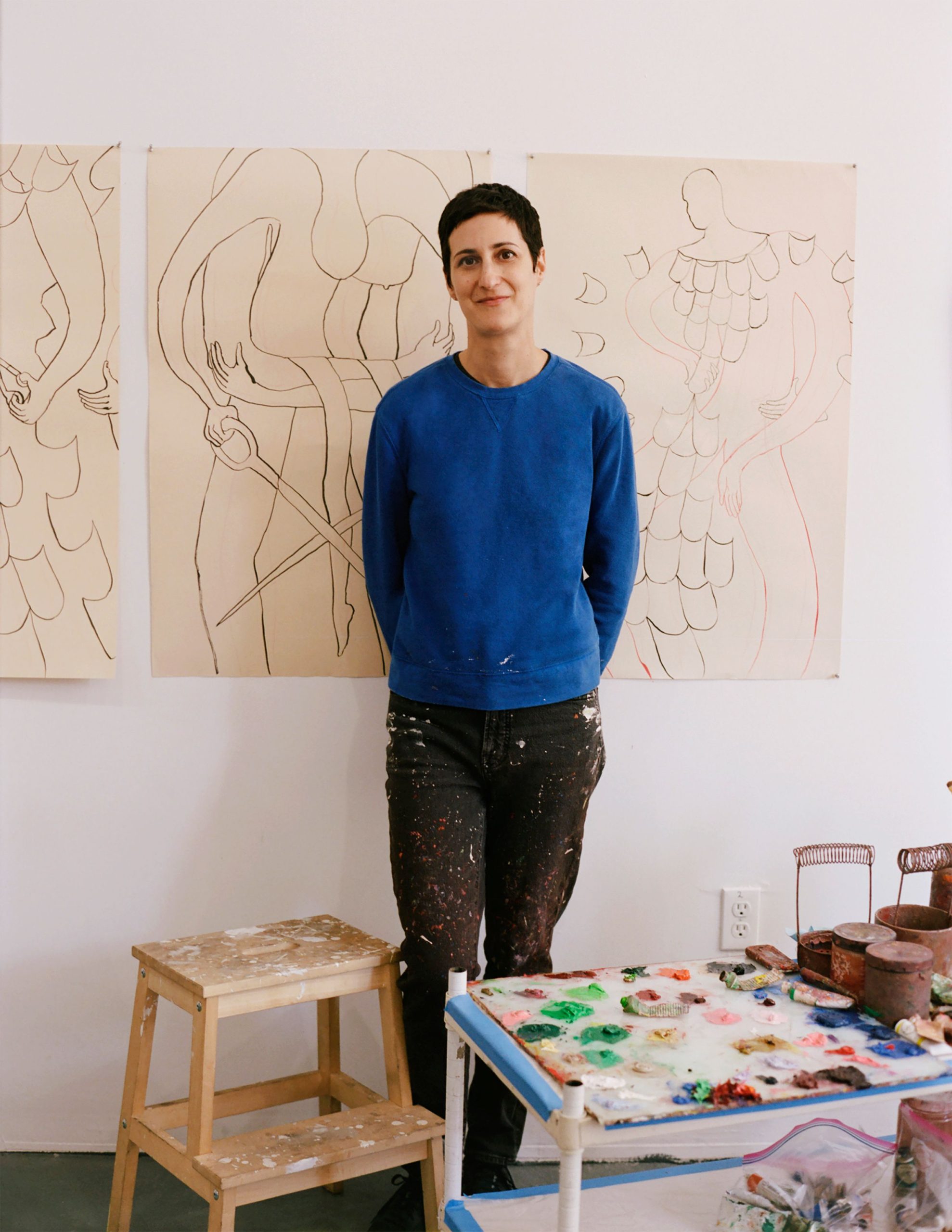
“Sascha Braunig: Wrist Painter” is on view at the Portland Art Museum in Maine from November 13, 2026, through March 14, 2027.“Sascha Braunig: Wrist Painter” is on view at the Portland Art Museum in Maine from November 13, 2026, through March 14, 2027.

Sascha Braunig’s paintings have a tendency to produce visceral reactions: a pit in the stomach, an eyebrow raise, a need to move closer. This is not unintended.
“I want the viewer to have a bodily experience,” Braunig says.
The paintings are bright, smooth, candy-colored—lighthearted contrasts to the psychologically intense shapes: luminously rendered heads and torsos often bound by wiry tentacles. At times the figures recede into their matching optic backgrounds, as if hiding in plain sight.
Braunig, who is 43 and splits her time between New York and Maine, has been painting with this funky verve for close to two decades. Not long after she got her MFA from Yale’s painting program in 2008, she was having solo exhibitions of her small paintings of heads at the now-defunct Foxy Production in Manhattan. Inclusions at the New Museum Triennial and MoMA PS1 soon followed. (Attention from critics came quickly as well; one called her an “inspired reanimator of Surrealism,” another a “phenom.”)
Braunig is excellent at capturing the inherent tension of living in a body—especially one that is subjected to societal expectations of femininity. She’s playing with the ways women have been contorted and cinched and squeezed for time immemorial, asked to fit into archetypes that seem at turns glamorous or sinister. Often they are both.

These themes of gender performance and corporeal control permeate “Wrist Painter,” Braunig’s most extensive exhibition to date, which opens November 13 at the Portland Art Museum. The show brings together some 45 works, including paintings, sculptures, works on paper, and sketchbooks. It will be her first solo institutional show in Maine. (A special occasion, as almost all of the pieces in the show were made a block and a half away, in her studio at the Portland arts nonprofit SPACE, over the last 15 years.)
“Sascha really stands out here in this arts ecosystem. She’s doing something really singular,” says Sayantan Mukhopadhyay, a curator at PMA who organized the show. When people think of Maine painters, they usually think of landscapes. But Braunig leans toward the cerebral, with a bit more bite. “The paradoxes are what really excite me about the work,” Mukhopadhyay says.
And the dichotomies are many. “Sascha has a way of presenting an abstraction that can read both soft and strong, feminine and violent,” says Olivia Smith, whose New York City gallery, Magenta Plains, now represents Braunig. “I think that’s what I’ve always loved: that she offers a way for the viewer to re-associate, which ends up telling them more about themselves than about Sascha.”

One of the earliest artworks in “Wrist Painter” is Sequins, from 2010. It’s from Braunig’s head series, which she began in grad school. Her process starts with a drawing, then she brings her sketch to life by making an embellished three-dimensional model. Then she’ll light the model and paint what she observes. She applies her lustrous oil paints with such precision that these strange bodily shapes start to look “real.”
She continued this system as she moved on to her bodies series a few years later, using clay resin, wire, and paper to make her maquettes. This haptic process is why works like Warm Leatherette, a 2015 painting at PMA that looks like a snatched Michelin Man encased in chartreuse padding, seem so tactile. (She has often described her choice of colors as “seasonal” or “dietary”—she finds a palette that works for one show and then cycles to a new one for the next.)
Her maquette process also lends a certain theatricality. She is literally setting up a scene, as if the entire idea of femininity were on a velvet-curtained stage, the whole specter aglow under klieg lights. What is gender if not a performance?

Braunig, who grew up in British Columbia, Canada, liked drawing and painting from a young age. Her father (a dentist) and mother (a nurse) enjoyed creative pursuits outside of work, and the house was full of art books. She loved watching Pee-wee’s Playhouse, which she credits as being just as formative, even more so, than going to museums.
Her parents encouraged her to attend an intensive summer art program at Skidmore College in upstate New York when she was 16. It was there that she first learned about Cooper Union, the New York City school where artists Lee Krasner and Wangechi Mutu got their start. Braunig decided it was the place for her.
New York City was the perfect place for the budding artist. “I was totally in love. It maybe ruined me forever,” she jokes now. She went to Yale right after Cooper, and then she moved to Maine in 2010, in her mid-20s. “I was really fortunate to have a New York gallery as I left the city, because I was able to have shows and have my work represented here even though I wasn’t here.”
Living somewhere far less expensive was also a game changer—she didn’t need to pile on jobs to make ends meet, and could instead focus on building her deeply personal style. “I had been exposed to so many influences coming to New York. And maybe those first five years in Maine were a time when I was able to process them alone.”
Braunig knows her art history, and she gets why people connect her style back to Surrealism. But her artistic comrades are more like French self-portraitist Claude Cahun or even Frida Kahlo, she says, “who’s really making work that is influenced by events of her own life.” Her art might feel dreamy (or perhaps like an acid trip), but “it’s not a dream space. I really am thinking about actual forces in the actual world.”

For many years Braunig used her work to illustrate broader ideas around culture and gender, but her most recent output has taken a turn toward the autobiographical. A few years ago she went through a creative block that left her stranded from her art practice, unable to make anything. As she emerged from this period last year, she started making her most personal paintings yet.
That work went into her radiant show “Cauldron” at Magenta Plains this past spring, its title a reference to the messy, transformative stew of midlife. Its anchor painting was My Death (2025), which, along with several others from the show, will travel to Portland for “Wrist Painter.”

She calls My Death an “explicit self-portrait” about her own reanimation—an emergence through the void of creative block. It’s juicy and haunting and beautiful. She employed those tentacles again, but this time they are like a life force attached to a sleeping Braunig. A mysterious figure made from strips of vermilion orange pulls on them like marionette strings, bringing the artist back to life.
“I’ve come to understand that painting is a survival practice,” she says. “That can be a framing practice where you’re using it to talk about ideas in the world, or it can be a practice where you’re directly processing your own experiences. Maybe those two things aren’t that different.”

For the PMA show, Braunig has made one brand-new work, titled Torsion. At 78 inches tall by 60 inches wide, it is the largest painting of her career. She previously used the title for a museum show in Norway, but realized she’d never given it to an individual painting. The term, in physics, refers to the twisting of an object around an axis: a towel wrung out to dry.
This new Torsion is a painting of a fleshy pink figure with a tiny, twisted torso standing on tiptoes within a gray box. The figure’s muscular back is to the viewer, its knees fanning out in a plié. Dramatic tentacles in orange and yellow trace its exaggerated outline.
The figure’s head is cut off by the box’s ceiling, and its arms stop around the elbows, where they encounter the side walls. Maybe the figure’s been blocked, held back by the confines of this shadowy encasement. Or maybe, somehow, it has broken free.
“Sascha Braunig: Wrist Painter” is on view at the Portland Art Museum in Maine from November 13, 2026, through March 14, 2027.