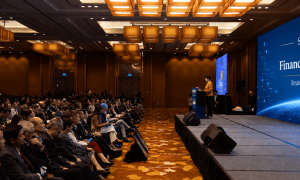
Mass timber is a social and political—not just technical—issue, architect Lindsey Wikstrom said during the third Another Tomorrow “New Earth” dialogue.Mass timber is a social and political—not just technical—issue, architect Lindsey Wikstrom said during the third Another Tomorrow “New Earth” dialogue.
How would our cities change if we treated our buildings with the same care we give to a living forest?
Sustainable ready-to-wear brand Another Tomorrow hosted its third “New Earth Dialogue” installment with architect Lindsey Wikstrom—founding principal of Mattaforma and recent recipient of the Cooper Hewitt National Design Award—to discuss.
“Our idea of care for the built environment, I think, would be another big shift,” Wikstrom said during the discussion, which was held Thursday evening in partnership with media platform Madame Architect at the luxury label’s 2,000-square-foot Soho shop on Wooster Street.
“Those meeting the material systems in the world would unlock this plant-based city for the future.”
Debuted in January, the B Corp’s series of conversations began “in service of a vision for our collective future grounded in regeneration and abundance,” according to an Instagram caption posted earlier this year.
The dialogue examined moving away from the fossil-fuel-intensive reliance on concrete and steel. With moderator Julia Watson, Wikstrom discussed circular design, sustainable innovation and collaborative strategies to transform urban and environmental interaction.
For context, Wikstrom wrote “Designing the Forest and other Mass Timber Futures” in 2023 to explore the relationship between forestry and architecture. Here, she argues that choosing plant-based, regenerative building materials is crucial to creating cities that actively benefit the planet rather than deplete it.
“What I predict, with a lot of hope and optimism, is that what we want to see is plant-based cities of the future,” she said. “Entire cities made from regenerative materials that can regrow and don’t rely on mining.”
For background, Mattaforma primarily focuses on mass timber to link the city with the landscape of production. But the business of mass timber—a category of “truly massive” urban wood materials, according to Wikstrom—can be complex. Implementing mass timber at scale means navigating property lines and managing infrastructure boundaries between private owners.
It’s one of the reasons why she described the material as a social and political question rather than a merely technical one.
For Another Tomorrow, architecture is not just about individual buildings but about fostering the interconnected flourishing of communities, landscapes and planetary systems—a core principle for redefining urban development through care and regeneration. “Architecture can be a choreography of care, according to the luxury label.
“Our job is to choreograph that movement, really think about it in motion,” Wikstrom said.
Her interest in mass timber began with the question of whether it could be the “link that we can make between the city and the landscape of production,” given the current not-so-sustainable standard inputs—namely, brick and concrete.
The carbon-heavy process used to make these traditional inputs requires fossil fuels, which “cook”(or fire) the materials for use. Mass timber, meanwhile, is regenerative—meaning it regrows and doesn’t depend on mining. It’s not going to erupt or explode, either.
“If you’ve ever tried to light a giant log on fire at a camp, it’s not going to burn, it’s usually going to char and put itself out,” Wikstrom said. “It’s this amazing nature, this magic that nature has.”
Mass timber allows cities to function as carbon sinks while maintaining urban fire safety standards, according to Wikstrom, who wrote a book exploring the relationship between forestry and architecture.
“If we can manage this huge amount of data that the forest presents us… there’s a chance that we can design the forest in a way that our harvest improves its health. Our buildings actually save the forest. That’s the ultimate goal,” she continued.
Wikstrom’s resulting research challenges the idea that mass timber leads to deforestation—instead, proposing a system where urban construction actively supports forest health.
“I spoke with foresters. I looked at the data, looked at how quickly certain species grew,” she said. “The question became so much more interesting.”
She referenced a study sponsored by the UN Environment that found New York State grows more than enough wood to build the 50 million square feet of new construction New York City requires annually.
“It’s a very long scientific paper… [that] shows that we have more volume of wood in the state than what we would need to build 50 million square feet every year,” Wikstrom said. “We could build more than that.”
And, she continued, we’re about to kick off the next century of plant-based cities.
“We’re at the beginning of this material era—we’re a toddler—and we’re about to see this next 100 years unfold,” Wikstrom said.
On greenwashing and sourcing transparency, she stressed that solving new concerns requires new lines of questioning.
“I think it’s more pertinent to ask what the design is sustaining,” Wikstrom said. “Who is meant to benefit from this choice is a big pivot… in your directionality of determining whether a material is ethical or meeting your standards.”