The CIIE reveals global brands’ next bets on China, to boost desirability in challenging times.The CIIE reveals global brands’ next bets on China, to boost desirability in challenging times.

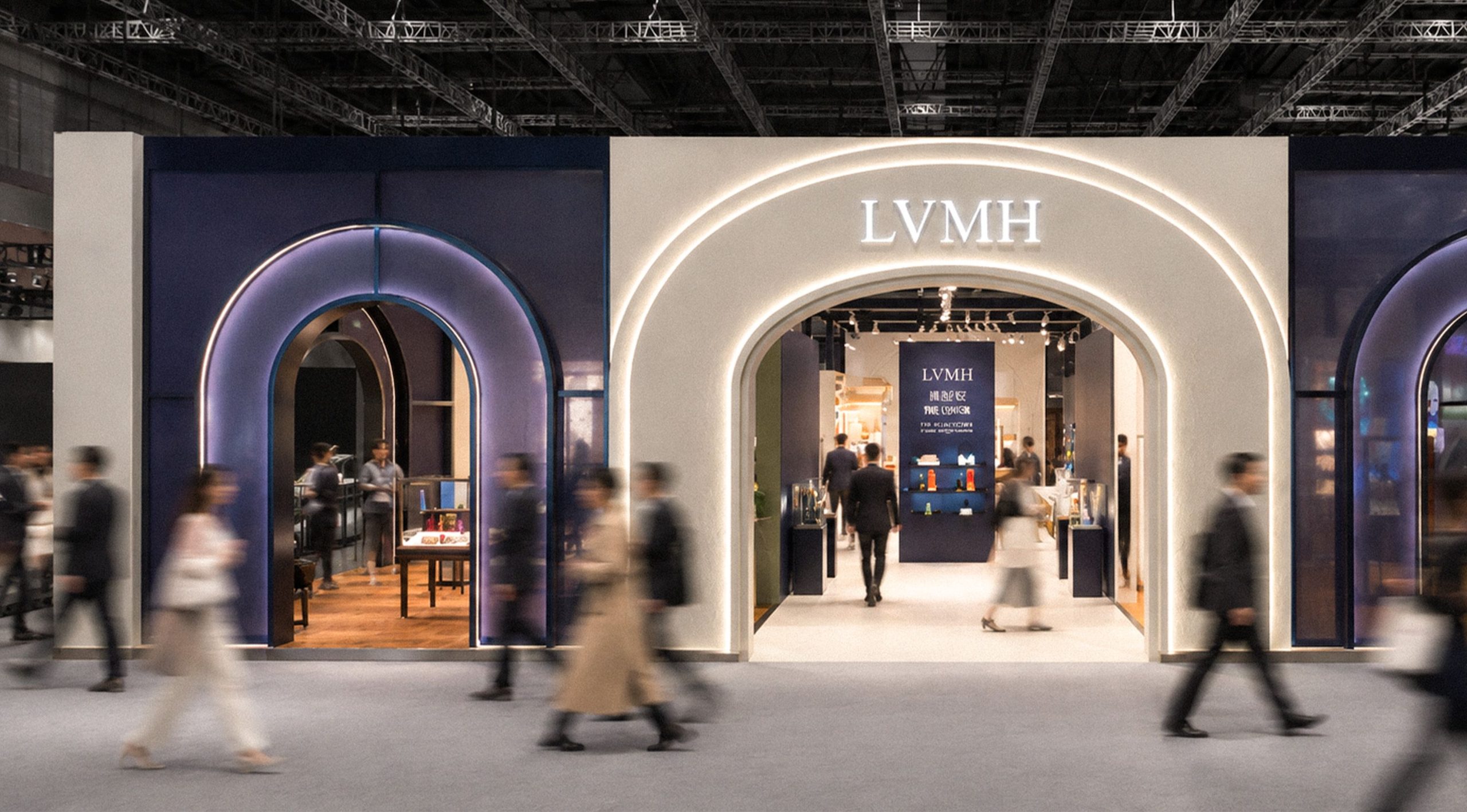
As the global luxury industry searches for its next growth engine, some of its biggest players have doubled down on China in recent years. Their ambition was clear at the China International Import Expo (CIIE), a flagship government-backed trade event in Shanghai that has become a key stage for global brands to signal their value in the world’s second largest economy.
On November 5, the ninth CIIE opened in Shanghai, drawing a record 4,100-plus overseas exhibitors across the five-day event. From luxury conglomerates LVMH, Kering and Richemont, to sportswear giants like Nike, and beauty powerhouses like L’Oréal, this time, brands arrived with more than new products to unveil.

But this year’s CIIE tells a bigger story than another wave of international brands courting Chinese consumers. While many Western players have bet heavily on China’s recovery, the luxury market remains under pressure. According to Bain & Co., Mainland China luxury sales fell 3-5% in 2025, following a much steeper 17-19% contraction in 2024. Despite early signs of recovery, the latest earnings suggest a fragile rebound. LVMH reported a 5% organic decline in its fashion and leather goods division in the third quarter of 2026, citing softer conditions in China, while Kering flagged weaker store traffic in Mainland China as a drag on Gucci’s performance. Increasingly, Chinese shoppers are scrutinizing prices, questioning brand value, and increasingly prioritizing experiences over possessions.
Against this backdrop, a more consequential shift is taking shape. China is no longer simply a market where global brands compete for growth. It is increasingly a space for testing ideas, forging partnerships and shaping strategies that could influence their future far beyond the nation.

Louis Vuitton, for example, traced its longstanding ties with the country through the art of travel. A recreation of the maison’s historic Asnières salon featured three heritage trunks, including a studded leather trunk crafted by a Cantonese trunk maker in the 19th century. By placing an object of Chinese craftsmanship within its own heritage narrative, Louis Vuitton offered a reminder that the relationship between European luxury and China extends well beyond the country’s emergence as a major consumer market. This is wise in a moment when Chinese consumers are increasingly seeking authentic cultural connections, rather than familiar Chinese motifs repackaged by Western luxury brands.
Dior, meanwhile, drew a line from its iconic 1947 Bar suit to current creative director Jonathan Anderson’s contemporary reinterpretations of the house’s signature silhouette, bringing together fashion history, craftsmanship, and creative reinvention.

China shaping luxury’s creative future
Kering is taking the conversation a step further, positioning Chinese creativity as part of its future strategy. Returning to CIIE for the eighth consecutive year, the French luxury group presented an exhibition inspired by its strategic vision — True Luxury, Next Luxury — with Chinese contemporary art at its center.
The pavilion’s exterior featured an experimental calligraphic interpretation of the Thousand Character Classic, a traditional Chinese text dating back more than a thousand years, by artist Wang Dongling. In the courtyard, artist Ren Tianjin’s Taihu Stone: East Wind brought together calligraphy and sculpture, drawing on the aesthetics of traditional Chinese scholar’s rocks through a contemporary lens.

“For Kering, China is not only one of our most important markets, it’s a vital force of innovation and creative inspiration,” said Jean-Marc Duplaix, Kering’s COO and CEO of Kering Jewelry, at CIIE. “Guided by this vision, we’re executing our global innovation and talent strategy in China.”
That thinking is beginning to translate into product strategy. On November 6, Qeelin, the Chinese-rooted fine jewelry house owned by Kering, unveiled Qeelin Gold, a new gold jewelry brand, alongside its debut collection, Bajing.
The launch marks a notable departure from the localization playbook traditionally favored by international luxury groups, which has often centered on limited-edition products, festive campaigns, and market-specific retail experiences.
Instead, Kering is looking to build on a distinctly Chinese cultural and commercial opportunity. Gold has deep cultural significance in China, where it has long been associated with prosperity, celebration and the preservation of wealth. As consumers increasingly seek jewelry that combines intrinsic material value with contemporary design, Qeelin Gold represents an attempt to translate that heritage into a new luxury proposition.

China’s booming domestic gold jewelry sector offers further incentive. The meteoric rise of Laopu Gold, alongside Kering Ventures’s investment in Chinese jeweler Borland, underscores the growing appeal of homegrown luxury brands — and the opportunity for international groups to capitalize on this momentum.
Richemont, meanwhile, approached the conversation through craftsmanship and heritage. The Swiss luxury group brought Cartier, Van Cleef & Arpels, Vacheron Constantin, Alaïa, and Montblanc to the expo. Among the highlights were Vacheron Constantin’s Year of the Goat timepiece from its Chinese zodiac collection, a Cartier high jewelry creation interpreting the maison’s signature panther through intricate construction, and a Montblanc special-edition writing instrument paying tribute to martial arts icon Bruce Lee.

Sportswear’s next ideas come from China
Sportswear giants are taking a more direct approach at CIIE, putting Chinese consumers at the center of product development and innovation.
At Adidas’s expanded 500-square-meter pavilion, a globally debuted collection of Chinese-inspired jackets sat alongside performance running technology and professional sports equipment. According to Adidas, more than 65% of the products it sells in China are now designed by local teams, while 95% are manufactured domestically. The brand even staged a runway show in Shanghai last year, to showcase the brand’s local work. More significantly, around a quarter of the products developed by its Chinese design teams have made their way into the brand’s global distribution network. One example is the Chinese-inspired jacket first showcased at last year’s CIIE. When launched in North America, 12,000 units sold out in just 27 minutes, according to the company.

Nike, meanwhile, is placing greater emphasis on localizing the innovation process itself. Returning to CIIE for the seventh consecutive year, the American sportswear giant showcased its Radical AirFlow apparel cooling technology, alongside new basketball and performance running footwear, as well as locally developed collections including Nike Swooshfly, designed with Chinese younger consumers in mind.
Speaking to Vogue Business, Flavia Cervantes, VP of local product creation for Nike Greater China, explained the thinking behind the company’s expanding creative operations in the country. Rather than relying solely on conventional market research, the team is immersing itself in the lives of young Chinese consumers — from trail running and hiking to community gatherings and music festivals — to better understand how they move, dress, and express themselves. These observations, she explained, feed directly into decisions around materials, silhouettes and product innovation. “Having a local team in China allows us to drive innovation and product development at the pace of young Chinese consumers,” she said.

Arc’teryx, making its CIIE debut, brought another dimension of product innovation into focus: what happens to performance gear after it is sold. The outdoors specialist showcased its Sperro SV technical shell jacket, the first product developed under System 0, its circular innovation platform. Beyond waterproofing, wind protection and breathability, the jacket has been designed with maintenance, repair and eventual material recovery in mind. It also features a digital product passport (DPP), allowing consumers to scan a QR code for information on product care and repair services.

Brands are selling a lifestyle
Beyond luxury and sportswear, another theme emerged at this year’s CIIE is that international brands are increasingly competing for a place in Chinese consumers’ lifestyles, not just their closets.
Making its CIIE debut, Ralph Lauren presented four immersive spaces inspired by the American West, coastal living, country estates and urban sophistication. Spanning fashion, homeware and hospitality, the exhibition reflected the brand’s longstanding strategy of selling an aspirational way of life.
Fellow newcomers Woolrich and Bogner introduced further options in premium outdoors and lifestyle categories, while established players focused on deepening consumer engagement.
Beauty groups are pursuing a similar strategy, increasingly combining product innovation with technology and personalized experiences.
L’Oréal Group, returning for its ninth consecutive year, expanded its presence to 28 brands, introducing names including Color Wow and Skinbetter Science alongside AI-powered beauty technology. Estée Lauder Companies showcased 17 brands and more than 80 new products, including a Mac Cosmetics setting product developed with Asian skin tones in mind. Dolce & Gabbana Beauty, meanwhile, used the expo to highlight its expanding China ambitions through fragrances, makeup and interactive AI experiences.
Nine editions in, CIIE offers a revealing snapshot of how international brands are rethinking the fast-changing market. For years, international brands came to China in search of growth. Increasingly, they are also looking to China for ideas on where growth might come from next.