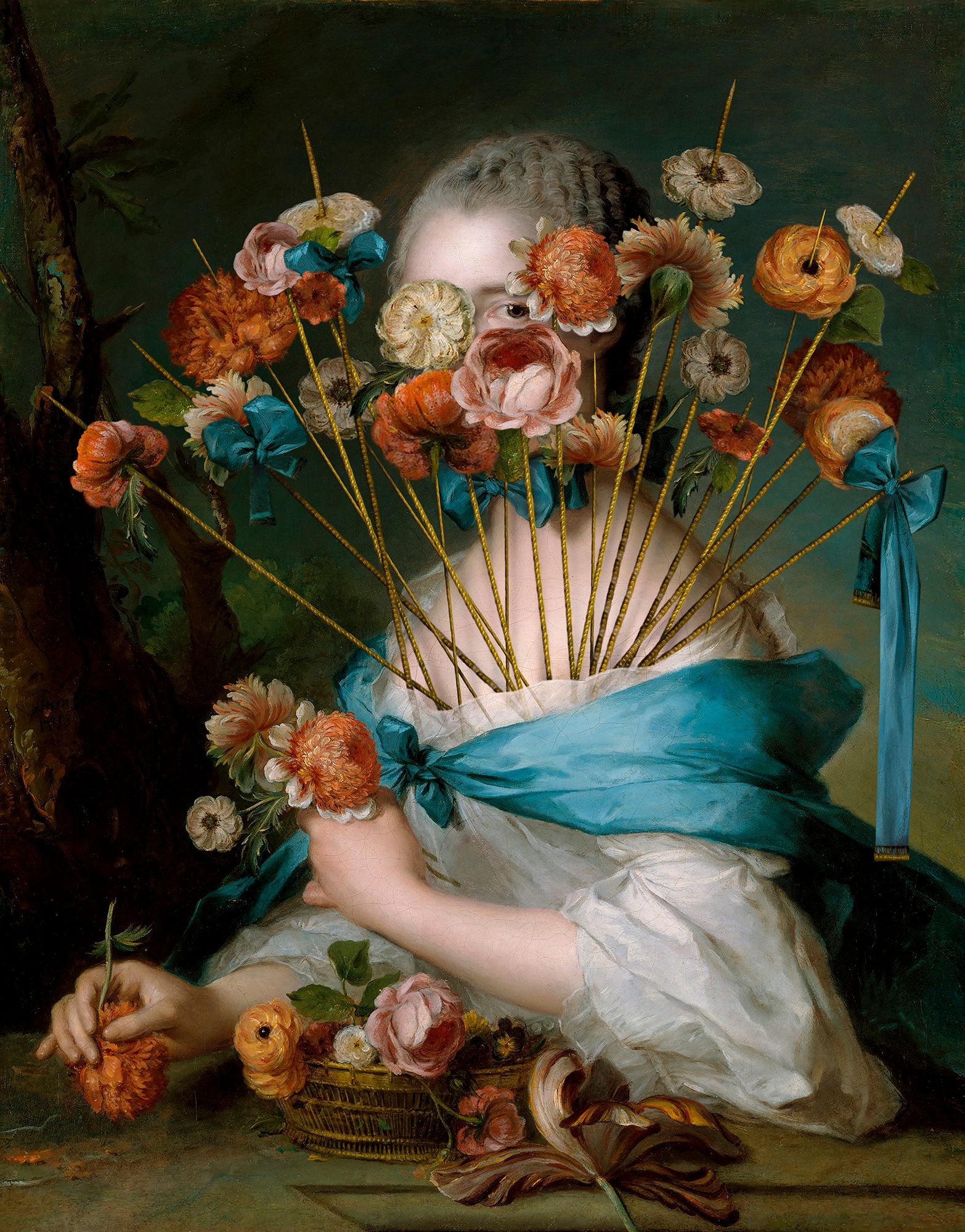
“Hidden Portraits,” the German artist’s first solo exhibition in New York, places his photo collages in close proximity to some of the artworks at the Met and the Frick that inspired them.“Hidden Portraits,” the German artist’s first solo exhibition in New York, places his photo collages in close proximity to some of the artworks at the Met and the Frick that inspired them.

The intersection of craft and technology is almost certainly not the first thing that comes to mind when faced with Volker Hermes’s reworked historical portraits. But it is a subject central to this artist’s work, now on view at DeVore44.
“I think the biggest, also kind of controversial discussion about my work is the technique. I’m not painting and people think that this is ruining something,” says Hermes.

A student of philosophy before taking up painting at the Kunstakademie Düsseldorf, Hermes began developing the digital image-editing technique he uses to create his archival pigment prints, based on portraits he finds online, in about 2007. “My work is really like a bow to this historical art, and that is exactly the reason why I’m not transforming them into mediocre paintings,” he says. Though based on the visuals of the past, his output is determinedly contemporary. “I didn’t want to repaint them because I think it’s not a solution to paint like Rembrandt in 1625,” he explains. “Nostalgia doesn’t have a future; there is no energy in nostalgia… Mixing things up and making them come alive again, I think this is the best that can happen to historical artworks.”

When we see a portrait, we are often drawn to the face at the expense of other details. Hermes wants his work to give us pause. He wants us to take in the many splendors of the imagery, yes, but also to notice its messaging. “I’m choosing portraits [that deal with] the topic that I want to talk about at the moment,” he says.
His subjects are various. “I want to point out, for example, that [formal portraits] are relics of an elite; this is the top 1% of a society. And the restrictions for women, or for people who were thinking different, were so hard.” Hermes is aware that his interventions can be triggering—but the point is to wrestle, intellectually and optically, with what you think you know. Enchanting surfaces can, and often do, hide darker realities.

Gallerist Loie DeVore, whose space is partly arranged as a salon, has created a welcoming atmosphere for Hermes’s artworks by displaying them amid Old Master paintings as well as laces, jacquards, and accessories, with the collaboration of textile expert Cora Ginsberg. “To show them all together is wonderful and it’s charming,” the artist says. “Art is the company of our lives and gives us so much joy and beauty and invention.”


The history of female portraiture is nearly impossible to imagine without flowers. Rich in symbolic meaning, they carry a range of associations that have been projected onto women from the beginning. Beauty, grace, freshness, naturalness, youth: all qualities to which women have so often been reduced. In my intervention, I transformed the young woman herself into a bouquet. Flowers emerge from her open neckline, but are impaled on sharp stakes that I fashioned from her basket.
This introduces a subtle sense of aggression: a reminder that treating beauty as the whole of a woman’s identity is, fortunately, an outdated notion, even if it has by no means disappeared entirely. Now, peering out from within the bouquet is a single eye. She watches those who watch her, no longer just an object to behold, but a woman who holds our gaze.


There was a time when being painted by a renowned artist increased one’s chances of being remembered. Madame Récamier was no doubt aware of this when she commissioned Jacques-Louis David to paint her portrait. Fortune added what she could not: the daybed on which she reclines was later named after her. The récamier is not an especially practical piece of furniture, but one on which a person could pose elegantly and decoratively, especially at a time when fashion favored flowing white dresses inspired by antiquity.
To draw the eye away from her person and toward the position and status she represents, I transformed her white dress into a large hood that surrounds her. From the furnishings around her I created elaborate jewelry: the legs of the daybed, the decorative cushions, and parts of the candelabra become precious necklaces that adorn her body.
The necklaces borrow their shape from the imagery of another unforgettable woman: Cleopatra, who was herself so often portrayed in staged and carefully arranged poses. Through this connection, the portrait becomes a reflection on beauty, female influence, and the way women are remembered throughout history.


Frans Hals‘s original is a very small painting, more a tronie—a character study—than a formal portrait. Yet despite its modest scale, the brushstrokes of this extraordinary artist possess a freedom and vitality that create an astonishing range of textures.
My work is a kind of inventory. What fabrics and surfaces can be found within this portrait? The magnificent lace of the collar, the shimmering black of the garment, the delicate, almost weightless cuffs. I isolated each as a ribbon and let them cascade over the enormous hat. The focus shifts away from the sitter’s individuality and toward the richness and refinement of his attire, which undoubtedly conveys his status and pride.


When we look at portraits of women across the history of art, we cannot avoid the concept of beauty. Men have rarely been judged primarily on their beauty; for women, it has often been the defining, and sometimes the only, criterion by which they are perceived. Closely connected is the ideal itself, which has continually evolved across historical periods.
In this remarkable portrait, what caught my attention, aside from her fashionably pale complexion and its echo in the delicate white tones of her dress, is a certain sense of restraint. I had the impression that she was holding her breath rather than breathing freely in the nature around her. The portrait seems to place her on a stage, where she is expected to embody the beauty ideals, social expectations, and conventions of the elite society of her time. No one breathes freely on a stage. To express this idea, I extended the ribbons of her flamboyant hat. They transform into a kind of stage curtain, framing this performance of the self. While they partially conceal her distinctive face, and even constrain it, they also create a protective space: an escape from being reduced to, or defined solely by, a system of beauty and its expectations.
“Volker Hermes: Hidden Portraits” is on view through October 29, 2026 at 44DeVore, 44 East 65th Street, New York.