Finance
Stock-Split Follow-Up: How Nvidia, Alphabet, Amazon, Netflix, and Tesla Have Performed Since Their Historic Splits

These past few years have been major ones for stock splits. Some of the world’s biggest companies have executed these operations after periods of explosive stock performance. The idea is to bring the price level back down to Earth, making the shares more accessible for investors — and opening the door to another era of gains.
From 2022 through last year, the following stock market giants have completed stock splits:
Amazon, Alphabet, Nvidia, and Tesla are tech powerhouses involved in the artificial intelligence (AI) boom — and are members of the Magnificent Seven stocks that have driven S&P 500 performance in recent years. Netflix probably doesn’t need an introduction. As a streaming giant, it’s become a household name around the world, with services available in more than 190 countries.
History shows us a key trend.
These past few years have been major ones for stock splits. Some of the world’s biggest companies have executed these operations after periods of explosive stock performance. The idea is to bring the price level back down to Earth, making the shares more accessible for investors — and opening the door to another era of gains.
From 2022 through last year, the following stock market giants have completed stock splits:
- Amazon (AMZN +0.56%)
- Alphabet (GOOG +0.44%) (GOOGL +0.66%)
- Tesla (TSLA +3.93%)
- Nvidia (NVDA +1.73%)
- Netflix (NFLX 0.91%)
Amazon, Alphabet, Nvidia, and Tesla are tech powerhouses involved in the artificial intelligence (AI) boom — and are members of the Magnificent Seven stocks that have driven S&P 500 performance in recent years. Netflix probably doesn’t need an introduction. As a streaming giant, it’s become a household name around the world, with services available in more than 190 countries.
Now, the question on investors’ minds is: Have these stocks indeed offered shareholders a new phase of growth? Let’s take a look at these operations and find out how each stock has performed since the company’s historic split.

Image source: Getty Images.
Why decide on a stock split?
First, though, it’s important to understand exactly why a company decides on a split and what it means for shareholders at the time. Companies generally launch such an operation after a period of significant stock price gains. The idea is that a broader range of investors may flock to the stock at a lower price point.
Here’s how the process unfolds. During a split, a company offers current shareholders additional shares according to the ratio of the split — so in a 10-for-1 stock split, if you originally owned one share, you’ll find yourself with a total of 10 shares post-split. The value of your investment remains the same — so instead of one share being worth $1,000, for example, you’ll now have 10 shares that each are worth $100.
Stock splits don’t change anything fundamental about a company or a stock, so on their own, they aren’t a reason to buy or sell a stock. But, as mentioned, over time, the lower price makes it easier for more investors to buy shares.
Amazon, Alphabet, and Tesla before their stock splits
Amazon, Alphabet, and Tesla each performed stock splits in 2022, around mid-year, and in the previous three years, they had climbed in the triple or quadruple digits.
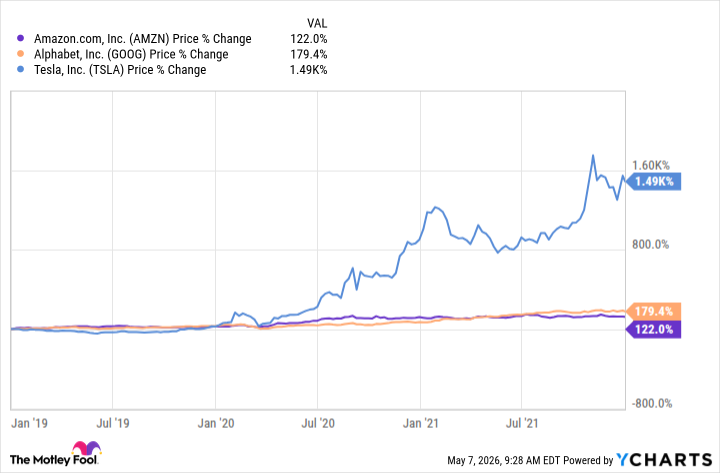
As for Nvidia, in the three calendar years preceding its stock split, it advanced more than 200%, and in the two and a half years leading up to the Netflix split, the stock jumped more than 300%. So it’s clear that each of these players had seen its stock skyrocket prior to deciding on a stock split.
Now, let’s consider the post-split performance.
| Company | Stock split date | Split ratio | Performance since split |
|---|---|---|---|
| Amazon | June 3, 2022 | 20-for-1 | up 124% |
| Alphabet | July 15, 2022 | 20-for-1 | up 250% |
| Tesla | Aug. 24, 2022 | 3-for-1 | up 34% |
| Nvidia | June 7, 2024 | 10-for-1 | up 71% |
| Netflix | Nov. 14, 2025 | 10-for-1 | down 20% |
|
Data source: Ycharts |
History suggests that, over the long run, companies that have completed stock splits have gone on to see their share prices soar once again — and deliver growth to investors. It’s important to note that not much time has passed since the Netflix stock split, so it’s difficult to compare it to the other companies — their stock splits happened at least a couple of years ago.
Netflix and Warner Bros.
Also, Netflix went through a time of uncertainty recently: It announced its intention to acquire Warner Bros. back in December, and this planned proposal weighed on the stock — Netflix then rebounded after the deal fell through in February, though the shares remain down year to date.

Netflix
Today’s Change
(-0.91%) $-0.80
Current Price
$87.45
So what does all of this tell us about investing in stock split stocks? Immediate gains aren’t a given, and corporate news — whether positive or negative — is more likely to drive the stock’s movement than the fact that it’s trading at a lower price. After all, stock splits don’t impact a stock’s valuation — so they don’t make a stock cheaper or pricier than it was prior to the split.
The reason that these market giants have delivered such gains post-split is due to the fact that they were running strong businesses prior to their operations — this trend continued, and that’s pushed the stock prices higher. The message to investors? If a quality company splits its stock and then continues to deliver earnings growth and offer promising prospects, it may once again deliver spectacular returns.