Led by visionary founder Elon Musk, Tesla (NASDAQ: TSLA) is currently attempting an incredible evolution in how it generates money. For the past few years, Tesla’s auto sales have actually been on the decline. Still, the company’s market cap remains well above $1 trillion. Investors appear to believe in Musk’s vision for Tesla’s new future.
What exactly is Tesla’s new future? It hinges almost entirely on a $10 trillion global opportunity that is just now starting to take shape.
Before we get to Tesla’s big opportunity, it’s important to understand how Tesla became the Goliath it is today. Only then can investors understand why the company is so perfectly designed to take advantage of an emerging $10 trillion market.
Tesla’s entire business model is ready to evolve.
Led by visionary founder Elon Musk, Tesla (TSLA +2.40%) is currently attempting an incredible evolution in how it generates money. For the past few years, Tesla’s auto sales have actually been on the decline. Still, the company’s market cap remains well above $1 trillion. Investors appear to believe in Musk’s vision for Tesla’s new future.
What exactly is Tesla’s new future? It hinges almost entirely on a $10 trillion global opportunity that is just now starting to take shape.

Today’s Change
(2.40%) $9.34
Current Price
$398.71
Tesla is betting big on this $10 trillion opportunity
Before we get to Tesla’s big opportunity, it’s important to understand how Tesla became the Goliath it is today. Only then can investors understand why the company is so perfectly designed to take advantage of an emerging $10 trillion market.
Tesla was founded in 2003. Its first vehicle — a luxury priced sports car dubbed the Roadster — was delivered to customers in 2008. The market for the Roadster was quite small, however, prompting Tesla to release two additional luxury vehicles — the Model S and Model X — in 2012 and 2015, respectively. It took Tesla more than a decade just to have a few luxury priced models on the market with relatively limited mass appeal.
Everything changed in 2017 when deliveries of the Model 3 — Tesla’s first vehicle priced under $50,000 — started deliveries. Then in 2020, deliveries of the Model Y — Tesla’s second affordable model — began.
Today, these two vehicles are some of the best-selling models globally. They comprise more than 90% of Tesla’s auto sales volumes.
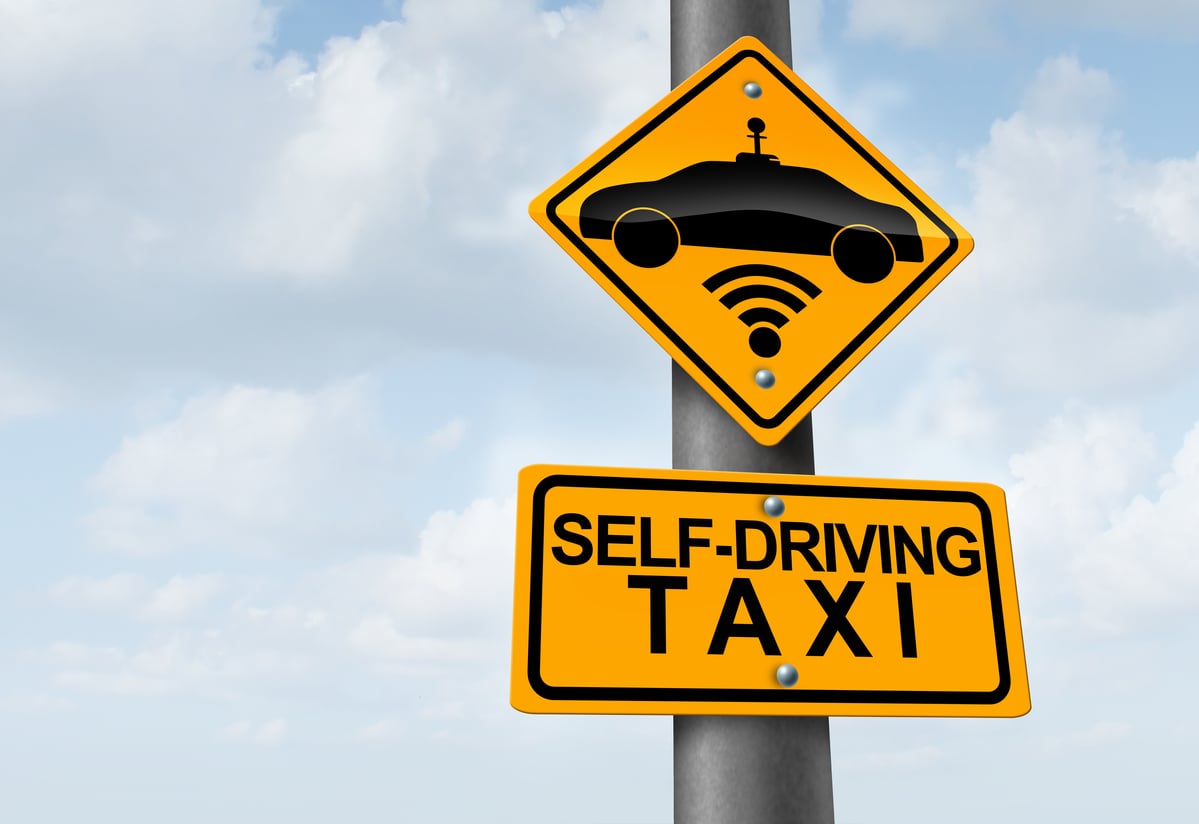
Image source: Getty Images.
Here’s the important takeaway: It has taken Tesla more than two decades to achieve mass production scale of its affordable vehicles. Remember that when you consider Tesla’s upcoming opportunity: the robotaxi market, which investors like Cathie Wood believe may eventually be valued at $10 trillion globally.
Tesla already has pilot programs available to the public in select cities for its robotaxi service, as do deep-pocketed competitors like Uber Technologies and Alphabet, the parent company of Waymo. While his exact predictions have varied, Musk will likely aim to expand this service to perhaps a dozen new markets over the next year or so. If successful, a global scaling could occur within the decade.
Here’s the huge advantage that Tesla has but competitors including Uber and Waymo lack: the ability to internally produce hundreds of thousands of vehicles for a global robotaxi fleet. Waymo, Uber, and other robotaxi aspirants must outsource production to third parties, many of which have yet to fully scale their own production facilities. Tesla, on the other hand, can produce its own self-driving Cybercabs at mass scale rather quickly. This is a strong competitive advantage that shouldn’t be discounted.
While there will be plenty of volatility and surprises along the way, Tesla — at least in my view — has the leading position to take the robotaxi market by storm. And that leading position is largely the result of decades of investment in production infrastructure.