The three largest cloud companies have just released their first-quarter 2026 results. After reviewing all three reports, it may surprise investors that Alphabet‘s (NASDAQ: GOOGL) (NASDAQ: GOOG) Google Cloud grew at 63%, outpacing Microsoft‘s Azure at 40% and Amazon‘s AWS at 28%.
Looking at that data, investors may wonder why Google is outgrowing AWS and Azure, which are No. 1 and No. 2, respectively, in terms of market share. When looking more closely at the industry, four reasons seem to explain Google Cloud’s outperformance.
Image source: Getty Images.
Google Cloud revenue rose by 63% in Q1, far faster than AWS or Azure.
The three largest cloud companies have just released their first-quarter 2026 results. After reviewing all three reports, it may surprise investors that Alphabet‘s (GOOGL +0.20%) (GOOG +0.27%) Google Cloud grew at 63%, outpacing Microsoft‘s Azure at 40% and Amazon‘s AWS at 28%.
Looking at that data, investors may wonder why Google is outgrowing AWS and Azure, which are No. 1 and No. 2, respectively, in terms of market share. When looking more closely at the industry, four reasons seem to explain Google Cloud’s outperformance.

Image source: Getty Images.
1. Google Gemini integration
In terms of AI models, Google Gemini seems to be gaining attention. Although it is an early AI pioneer, ChatGPT appeared to leave it behind at first.
Nonetheless, the company responded well to the competitive challenge. It has integrated AI agents, which gave it a “search first” orientation and also added the latest version of its AI platform, Gemini, throughout its ecosystem.
That has likely helped Alphabet counter the narrative that search was dead, reinforcing a business that has supported the company throughout its history.
Consequently, Vertex AI, its machine learning platform that builds and deploys AI models, has experienced increased adoption. As a result, its cloud gen AI model revenue grew by nearly 800% yearly.
Furthermore, Gemini Enterprise reported a 40% quarter-over-quarter increase in revenue. This increased interest in its paid model bodes well for Google Cloud and the strength of its Gemini platform.
2. Alphabet’s custom AI chips
Additionally, Alphabet has focused on the development of Tensor Processing Units (TPUs). TPUs are a specific type of AI accelerator specifically designed for high-volume AI inference and the handling of training workloads. With that, it recently unveiled new AI chips to take on Nvidia.
This gives Google Cloud an advantage, since it makes it less dependent on Nvidia, which is dealing with a backlog of its own. Thus, Google is gaining business and attention as competitors wait for Nvidia to deliver the needed chips.

Alphabet
Today’s Change
(0.20%) $0.78
Current Price
$385.58
3. Google’s data
As most investors know, Google Search dominated the search industry for decades. This, along with apps such as Android, YouTube, Google Cloud, and others, has allowed it to collect massive amounts of data.
That can help the company train AI models with data that is not available to competitors in many cases. Moreover, AI defines the “garbage in, garbage out” concept, meaning any given model is only going to be as good as the data it can access.
In comparison, Amazon has collected data primarily from selling and serving cloud customers, while Microsoft’s data collection also revolves around cloud clients, computer usage, and gaming.
This means their data collection is stronger in specific areas. In comparison, people and customers have turned to Google more for general queries, which likely gives it a more “all-around” approach to data collection and an edge in AI model training.
4. Backlog growth
Amid the aforementioned successes, the company’s backlog grew to nearly $460 billion, up from $240 billion in the previous quarter.
This took it much closer to Microsoft’s $627 billion backlog and well above the AWS backlog of $364 billion. Google Cloud’s focus on AI-native projects, as opposed to AWS’s and Azure’s emphasis on legacy footprints, probably explains that faster growth.
Such increases could potentially transform the cloud’s competitive landscape. As of Q4, Google Cloud was the No. 3 cloud company, significantly behind AWS and Azure. However, if that growth continues, Google Cloud appears poised to significantly close this gap.
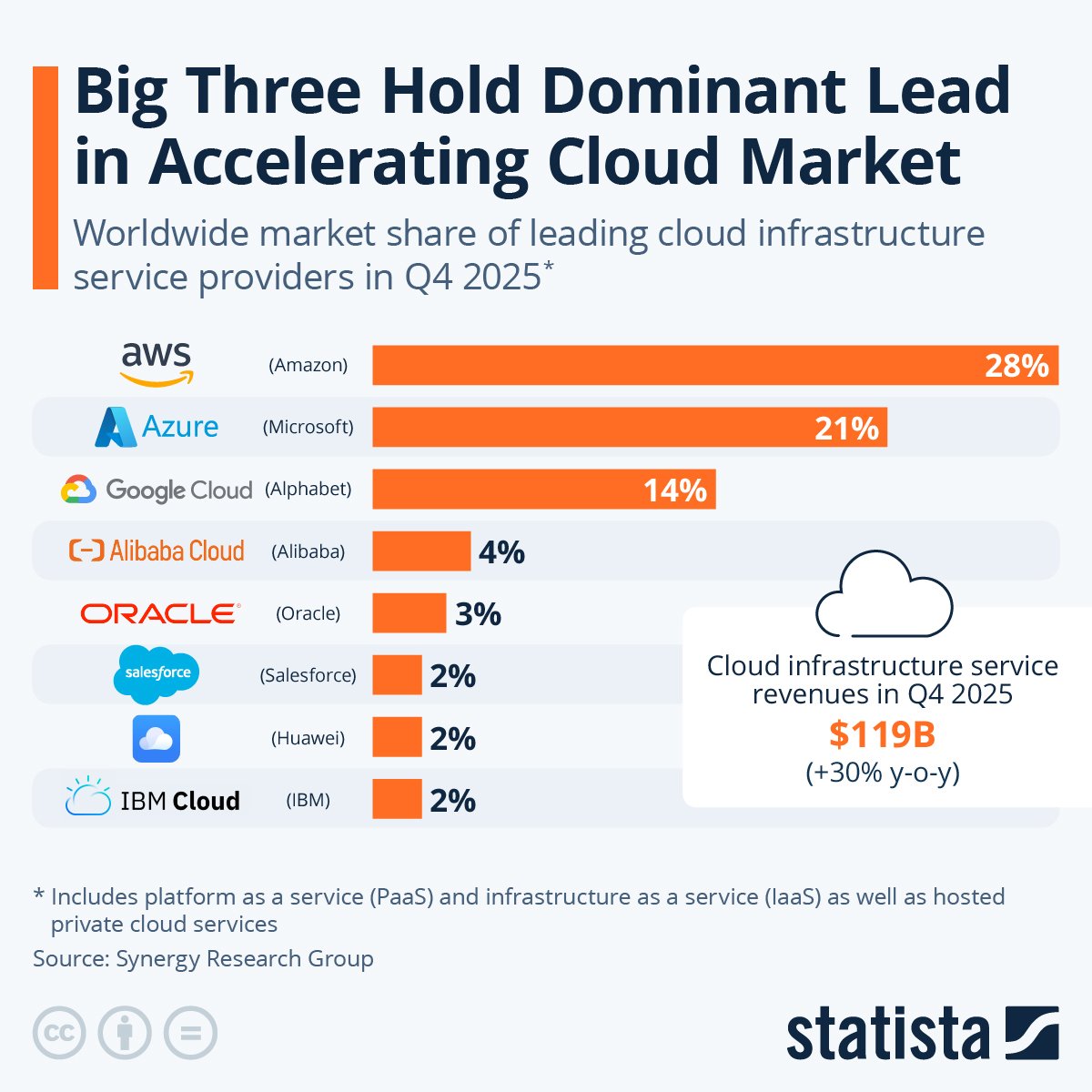
Data source: Statista.
Making sense of Google’s faster growth
Alphabet’s Google was not the first to capitalize on the cloud or generative AI, but investors should take notice of Google Cloud’s faster growth.
Google responded to ChatGPT’s challenge with Gemini, which has become increasingly successful at creating a competitive advantage through the Google ecosystem. Thanks to the use of its custom AI chips and treasure trove of data, it has achieved faster revenue growth than its largest peers, and the size of its backlog has spiked.
Admittedly, Amazon and Microsoft will almost certainly respond to this competitive challenge, and time will tell how such responses could affect the cloud stock. Nonetheless, for now, Google Cloud has shown it can outpace its peers and will likely continue to do so for the foreseeable future.