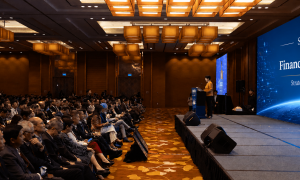
Economists and business leaders say port inefficiencies, high trade costs and weak infrastructure must be addressed before 2030 targets are achievable.Economists and business leaders say port inefficiencies, high trade costs and weak infrastructure must be addressed before 2030 targets are achievable.
Bangladesh will need an overhaul of its logistics ecosystem if it intends to reach its $100 billion export goal by 2030, several of the country’s economists and business leaders said at a Saturday roundtable.
Attaining this figure with the country’s current logistics capacity—even by as late as 2033—“will not be possible unless we significantly improve efficiency, reduce time and cut costs,” warned M Masrur Reaz, chairman of thinktank Policy Exchange Bangladesh.
Citing World Bank data, Reaz noted that cutting logistics costs by 25 percent could boost exports by 20 percent and reducing port dwell time by just one day could increase exports by 7.4 percent.
Bangladesh’s primary seaport, Chattogram Port, handles roughly 92 percent of Bangladesh’s imported and exported general cargo as well as nearly 98 percent of containerized cargo. But the port is easily congested, whether it be due to a worker disruption, an extreme weather event or a pileup of ships. At least eight vessel collision-related incidents have taken place in the port’s dock and anchorage areas over the past year.
To reduce congestion at Chattogram Port and improve the country’s logistics efficiency, the Bangladesh Investment Development Authority (BIDA) recently proposed gradually allowing 80 percent of imported goods to be cleared through private inland container depots (ICDs).
According to BIDA, expanding the use of private ICDs could increase the handling capacity of the port’s New Mooring Container Terminal and Chittagong Container Terminal by nearly 1.6 to two times by reducing operational pressure. Currently, the country’s National Board of Revenue allows clearance of only 65 categories of imported goods through private ICDs, although all export cargo is already handled through the 21 depots nationwide.
However, Reaz said relying only on public funding for port development is no longer realistic due to limited government resources and fiscal pressure.
“Developing ports through a fully public-sector model is neither feasible nor desirable,” said Reaz at Sunday’s roundtable. “We have to move toward public-private partnerships.”
Reaz also noted that the southeast Asian nation’s high trade costs, long cargo waiting times and weak logistics infrastructure pale in comparison to regional competitors such as Vietnam and India.
According to the World Bank’s Container Port Performance Index released September 2025, Chattogram ranked 356 across all global ports in efficiency, where India’s Nhava Sheva Port ranked 23 and Vietnam’s Haiphong secured 30th, he noted.
Fellow apparel exporting giant Vietnam has lapped Bangladesh over the past few decades when it comes to shipping goods out of the country.
While Vietnam’s total exports were $11.5 billion in 1999, more than doubling the $5.3 billion in shipments out of Bangladesh that year, that gap has since expanded exponentially.
In 2025, while Bangladesh’s global merchandise exports totaled $48.3 billion, Vietnam’s exports were tallied at a whopping $475 billion.
Reaz said Bangladesh’s export costs are about 1.5 times higher than Vietnam’s and nearly double those of India in some cases. The economist also noted that import processing takes significantly longer in Bangladesh.
At the roundtable, which was organized by the Dhaka Chamber of Commerce and Industry (DCCI), other leaders said their piece on where improvements must be made.
Md Habibur Rahman, a former administration and planning member of the Chattogram Port Authority, said the country needed to prioritize rail connectivity for faster and cheaper inland cargo transportation.
Rahman called rail the most viable solution given that there is limited room to expand the country’s Dhaka-Chattogram highway, the vital inland trade passage which connects the two Bangladeshi cities.
SK Masadul Alam Masud, managing director of Shahriar Steel Mills Ltd., said the absence of scanning devices at another logistics hub, the Pangaon Inland Container Terminal, discourages importers and exporters from using the gateway.
Masud also indicated that inadequate inland waterway infrastructure has increased industrial transportation costs instead of reducing them. On Monday, the DCCI followed up this concern by calling on the Bangladeshi government to accelerate the development of this infrastructure.
DCCI president Taskeen Ahmed said the proper management of an approximately 112-kilometer (70-mile) circular route connecting five waterways surrounding Dhaka could serve as an alternative transport network that helps ease traffic congestion in the capital.
Reaz also touched on inland transportation for truckers, estimating that setting the minimum driving speed at 40 kilometers per hour (25 miles per hour) across national highways could also increase the exports by 3.7 percent.
“If there were no congestion, the total costs borne by truck operators would be 35.5 percent lower on average, along with 0.5 percent reduction in carbon dioxide emission and an average 84 percent decrease in in-transit inventory carrying costs,” Reaz added.