

The stock market has experienced some extreme volatility this year, as the ongoing geopolitical tensions between the U.S. and Iran leave investors weighing the consequences of higher oil prices on corporate earnings and the economy. However, Spotify (NYSE: SPOT) stock has plummeted by 44% from its peak for a different reason.
The company operates the world’s largest music streaming platform, and management is investing less aggressively in growth right now and focusing on profitability instead. The strategy is working, but it forced investors to rethink Spotify’s previously elevated valuation.
With that said, management still believes the platform’s user base will grow significantly over the long term, so should investors use the recent dip in Spotify stock as a buying opportunity?
The world’s largest music streaming platform is currently on sale.
The stock market has experienced some extreme volatility this year, as the ongoing geopolitical tensions between the U.S. and Iran leave investors weighing the consequences of higher oil prices on corporate earnings and the economy. However, Spotify (SPOT 0.30%) stock has plummeted by 44% from its peak for a different reason.
The company operates the world’s largest music streaming platform, and management is investing less aggressively in growth right now and focusing on profitability instead. The strategy is working, but it forced investors to rethink Spotify’s previously elevated valuation.
With that said, management still believes the platform’s user base will grow significantly over the long term, so should investors use the recent dip in Spotify stock as a buying opportunity?

Image source: Getty Images.
Creating unique experiences through technology
Most music streaming platforms offer very similar content catalogs, because record labels want their artists to reach the widest possible audience. That means Spotify has to beat its competitors by creating a better user experience and by offering other content formats like video podcasts and audiobooks.
Spotify launched over 50 new features last year alone, many of which are powered by artificial intelligence (AI). One of them was Prompted Playlist, which allows users to curate their recommendation algorithm by feeding instructions into the feature’s chatbot-style interface. During the first quarter of 2026, Spotify also introduced SongDNA and About the Song, which give users more information about the artists, producers, and songwriters behind their favorite tracks.
Spotify’s investments in these features are designed to boost engagement, because the more time a free user spends on its platform, the more likely they are to become a paying member.
Soaring earnings growth
Spotify ended the first quarter of 2026 with 761 million monthly active users, which was up 12% compared to the year-ago period. That included 293 million Premium members, who pay a monthly subscription fee for an ad-free listening experience and the ability to unlock features like Prompted Playlist. These users accounted for 91% of Spotify’s $5.3 billion in total revenue for the quarter, so they are far more valuable to the platform than free users who are monetized purely through advertising.
In theory, Spotify could be growing its user base even faster, but management is exercising cost discipline to drive more profits instead. As a result, the company’s operating expenses actually declined by 4.5% during the quarter, while revenue climbed at a modest pace of 8%. With more money coming in and less money going out, Spotify’s net income surged by 220% to $844 million.

Spotify Technology
Today’s Change
(-0.30%) $-1.33
Current Price
$445.22
Spotify’s business will be more sustainable over the long term if its profits continue to grow, because it will give management the flexibility to invest in innovation and user acquisition without having to raise more money from investors or tap into debt financing. In other words, this could be a short-term sacrifice that leads to significant rewards for investors over time.
Spotify stock is trading at an attractive valuation
Spotify generated earnings of $12.57 per share over the last four quarters, placing its stock at a price-to-earnings (P/E) ratio of 34.5. That is only a slight premium to the Nasdaq-100 technology index, which trades at a P/E ratio of 33.4, and given Spotify’s blistering earnings growth, I would argue it probably deserves a higher valuation.
We can also value the company based on its $20.5 billion in trailing-12-month revenue. That places its stock at a price-to-sales (P/S) ratio of 4.7, which is modestly above its average of 4.3 since going public in 2018. However, Wall Street believes Spotify could grow its annual revenue to $25.9 billion in 2027 (according to Yahoo! Finance), placing its stock at a forward P/S ratio of just 3.4.
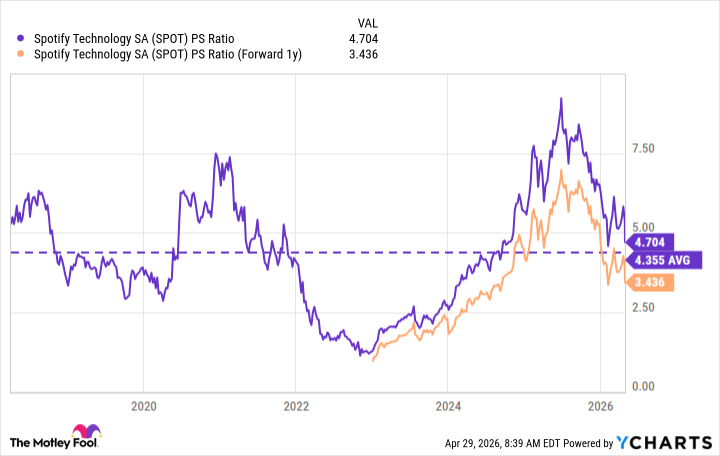
SPOT PS Ratio data by YCharts.
That means Spotify stock would have to climb by 26% by the end of next year just to trade in line with its long-term average P/S ratio of 4.3 or by 38% to maintain its current P/S ratio of 4.7. However, investors who are willing to hold the stock for the longer term could earn even better returns. Roughly 3.5% of the world’s population is currently subscribed to Spotify Premium, but the company’s co-CEO Alex Norström believes that figure could grow to 10% or even 15% in the future.
It won’t happen quickly, but even if it takes well over a decade, we’re talking about a fourfold increase in the size of Spotify’s business, which could result in a similar increase in its stock price.