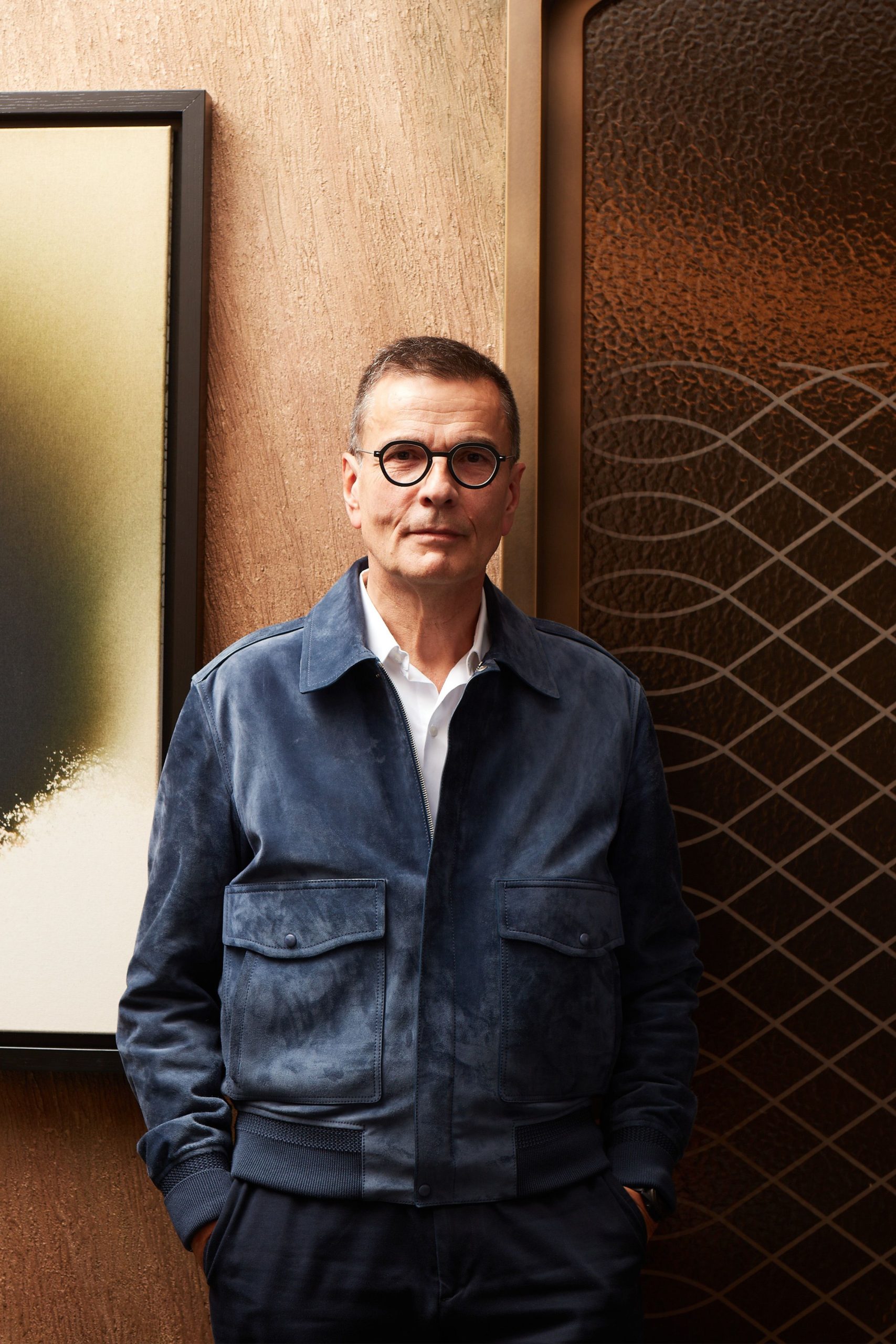
It’s part of the strategy CEO Jean-Marc Mansvelt is implementing, focusing on building community over expansion.It’s part of the strategy CEO Jean-Marc Mansvelt is implementing, focusing on building community over expansion.

On the upper floor of its Ginza flagship in Tokyo, one of Berluti’s dutiful and well-groomed staff is manning a bar stocked with liquor from France, Japan and Italy, as well as rare teas; off to the side is a record player, with records by Patti Smith, Frank Sinatra and Haruomi Hosono on the shelves. While this brand-new, invite-only space might be akin to a private members’ club, Berluti is careful not to label it as such.
It’s all part of Berluti CEO Jean-Marc Mansvelt’s vision for the future of luxury. With product prices rising and quality diminishing, there has been an erosion of trust between brand and customer that is playing out on balance sheets across the industry. “[Luxury has] broken the moral contract,” says Mansvelt. Berluti, he hopes, can light the way.
Enter Parenthèse, which aims to offer clients “a suspended moment” — a break from work and the distractions of daily life (all phones and laptops surrendered at the door). Parenthèse is not a VIC room, he says, and there is no expectation to spend. Instead, the space is more attuned to a listening bar, intended to reinvigorate a sense of community among Berluti’s top clientele as they stop by, maybe share a drink, and eventually build a connection.

The challenge, though, will be proving the business success of a space that’s not pursuing pure transactions. “They will take the moment [and] bring it back to humanity, which is really at the core of Berluti,” says Mansvelt. And, of course, a little exclusivity. “If everything is accessible every single second in one second, where is the dream anymore? Where is the desire anymore?”

There was also no aggressive move into — and subsequent pullback from — China, which many big brands undertook in the early 2020s. With LVMH and Kering now citing a slump in Chinese demand as a major reason for negative growth, Berluti had little skin in the game. “We are still like an outsider in China, so we are impacted less than the others,” the CEO flags.
With a selective approach to the expansion of its retail footprint, the brand has invested in renovating and optimizing its existing stores globally, focusing on courting existing customers and refining its current product offering — hence Parenthèse. “What is difficult today in the world of luxury is that [many brands] go all over the place,” says Mansvelt. “One day they speak about something, another day it’s something else. People don’t want any more maisons that are doing all categories, with an endless sort of exploration.”
Inside Parenthèse
Beyond the first room (the grand salon) of Parenthèse is a shoe library: a wall of drawers featuring 110 hand-painted illustrations of Berluti shoes, while the room beyond that has a long table scattered with leather swatches, where clients can customize their clothing and accessories (or even host a lunch or private dinner). There is commercial logic to all of this: the more time clients spend in the space, the more opportunities they may find to buy something — perhaps Berluti’s iconic Alessio Oxford shoe ($2,230), or maybe a Forestiere jacket in calf leather suede ($9,400)?
How does one become a member of this new space? “Alors, it’s going to be a mix,” says Mansvelt. “For sure, important clients from Berluti — either from Japan or from the rest of the world — and also friends and lovers of [the brand]. It’s a little bit the spirit of what Olga [Berluti] did with the Swann Club.” Though entry is strictly invite-only, it is tailored to captivate a sense of belonging between like-minded Berluti fans and encourage socializing.
The concept isn’t entirely new. In the ’90s, Berluti had the Swann Club, a now-defunct elite circle of brand enthusiasts brought together by Olga, the great-granddaughter of Alessandro Berluti, who founded the brand in 1895. “Everyone was welcome, except for the ones who were a bit boring,” Mansvelt smiles.
That they should undertake the project in Japan makes sense. The country represents Berluti’s biggest market, and — unlike many other luxury stores that are increasingly frequented by tourists queueing outside — Berluti’s clients in Japan are, according to Mansvelt, 90% local. The maison currently has 17 boutiques throughout the country, as well as a local workshop of around 10 artisans each trained in leather care.
The brand typically does good business in shoes in Europe, he says, but in Japan, leather goods are most popular, with clients enjoying the personalization process. The brand’s iconic Scritto pattern can be added to certain leather items or on ready-to-wear, for instance, while others go further, adding more personalized decoration. (At a cocktail event at the Ginza store last week, one high-spending local client flaunted a Berluti briefcase hand-painted with a mural of his beloved Persian cats.)

With “hundreds of hours” spent perfecting the space with an internal team, how will the CEO justify the investment to his higher-ups at LVMH? “It’s going to be very qualitative, which is not that easy when everything nowadays is more KPI-oriented,” he says. First is the personal element: group chair Bernard Arnault was a client of Berluti before he acquired the company in 1993. “There is something special there; they give us the time to do things. If I put it in a more brutal way, in terms of figures, nobody cares about Berluti [compared to] the size of LVMH, which is a privilege. Sometimes, you would love to get more support, but on the positive side, it decreases the pressure a little.” Still, it’s a gamble. “We are going to see what people feel,” he says.
Japan is the first location for the project; if it goes well, says Mansvelt, it could roll out to other regions “in a year or two — not before”. While it may be difficult to prove on the balance sheet, Mansvelt’s hope is that the club’s success will be measured in customer loyalty. “For me, one of the criteria is going to be how many people come regularly and feel that it’s part of their life. It’s really about taking the time, conversation, with nothing to sell. Instead, it’s rediscovering what humanity is. The question of humanity at the end is probably the fundamental question for luxury today. Where is humanity?”
“Luxury cannot be about fear,” he adds. “You cannot lean into fear; you have to lean into creativity.”