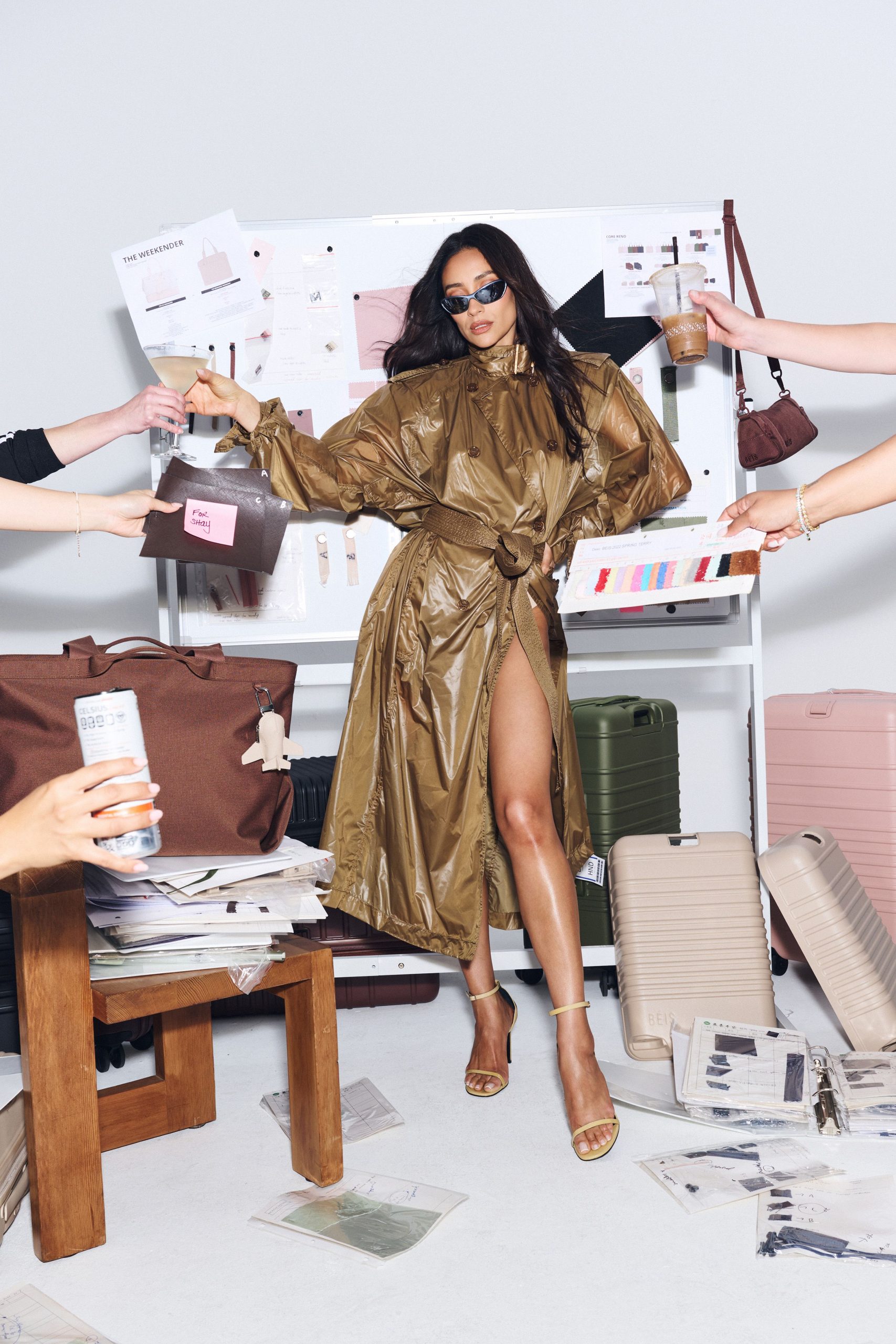
Vogue Business sits down with the luggage label’s founder Shay Mitchell and CEO Adeela Hussain Johnson to unpack its plans under Samsonite.Vogue Business sits down with the luggage label’s founder Shay Mitchell and CEO Adeela Hussain Johnson to unpack its plans under Samsonite.

It’s two weeks post-acquisition when I speak to Shay Mitchell over Zoom. Samsonite acquired an 85% stake in her travel and luggage brand Béis for $178.5 million on October 1, valuing the company at approximately $210 million. It’s the first time the actor — who first made her name on Pretty Little Liars — has spoken about the deal, and she and Béis CEO Adeela Hussain Johnson are both visibly excited about the milestone, eight years since Mitchell launched the brand with a suite of duffel and weekender travel bags.
“I’ve had Samsonite on my vision board and my lock screen, for a while,” Mitchell tells me. “It’s very surreal. We’ve done a lot the past eight years, but there is so much more that we have planned now that we know we can do.”
Previously, LA-based brand incubator Beach House Group owned 70% of the Béis business. Mitchell — who owned the rest — sold half of her 30% stake in the Samsonite deal, but retains her role as founder and creative director. Johnson, who was appointed in 2024, also remains in post. In the run-up to the acquisition, it generated approximately $210 million in net sales in 2025, largely from its US direct-to-consumer (DTC) channel.
Instagram content
“We’re at a team offsite right now. It’s been two weeks now [since the acquisition]. And I said to the team, ‘Raise your hand if you feel like things are different,’ and nobody did,” Johnson says. “That’s the point. That’s Samsonite’s intention, and that’s our intention as the leadership team.”
Alongside its flagship brand, Samsonite’s portfolio includes Tumi, Hartmann and American Touriste. It’s a sizable business, with group revenues reaching $3.5 billion in fiscal 2025. The group was attracted to Béis because it represented a gap in its portfolio: the young female consumer, Johnson explains. “Shay and I were very intentional in shaping what role Béis plays in the market and what role it doesn’t play,” she says. “We have very clear consumer centricity in our business. That makes you very attractive to a strategic company like Samsonite.”
“We didn’t launch with the roller, and 50% of our revenue comes from non-roller, lifestyle categories,” Johnson continues. “I think that is a very intentional strategy for us as a business. How do we meet her [the target consumer] in all the different stages of her life, however she’s moving and grooving? I think that’ll be where we continue focusing on innovation.”
While she used her platform to promote product in the early days, dialog with customers is key to Béis’s growth and longevity, Mitchell explains. The brand creates or tweaks products based on user feedback, which she notes down in a little black book that she takes to design meetings. “I may read a lot more comments than I should,” Mitchell smiles. “But I feel like our next idea, our next product, is in the DMs. And when we put something out there, we get instant feedback. That’s incredible knowledge for us.”
The Weekender bag, one of the brand’s early models and a driver for Béis’s non-roller lifestyle range, was ‘revamped’ in July. But when Mitchell took to Instagram, she found negative feedback on the relaunch, notably about it hurting people’s shoulders. The team quickly performed “surgery” on the Weekender in a video to fix the pain points and invited top customers from across the US to its LA HQ, to test the Weekender 2.0 before launch.
Instagram content
Béis pop-ups also reflect its consumer-centric strategy. Mitchell saw lots of comments from people whose bags had gotten dirty during their travels, so held a car wash-style “luggage wash” in LA for people to have their cases and bags cleaned for free. “Because we don’t have a bricks-and-mortar story yet, pop-ups are our way of doing that and getting to meet our customers face to face,” Mitchell says.
Post-acquisition plans
With the new investment, bricks-and-mortar stores are a clear long-term goal. But first up, global expansion and new product development — with Samsonite’s backing. “We can now take advantage of [Samsonite’s] global infrastructure in a way that we probably weren’t ready to at a certain point earlier in our journey as a brand,” Johnson says. “From a scale standpoint, we already know what works domestically [in the US], and I think we do it really well. So now it’s how do we make this global? And I think having a partner like Samsonite gives us legs that we otherwise wouldn’t have.”

Mitchell’s focus is design, so is keen to learn from Samsonite, which has been in business for 116 years, to boost what Béis can do on the innovation front. “I can now call someone and ask, ‘Can you take a look at this before we go into development? Is there anything you would change?’” she says. “I feel like we have crushed it so far. But there’s so much more to learn and I feel like Samsonite is the ultimate teacher — they really are so open to helping us learn, specifically in design, but also with factories and suppliers.”
Johnson and Mitchell can’t yet share concrete plans, but global expansion is what they’re most excited about. “We have a lot of data showing that the demand is there globally, and we actually have consumers [abroad] that spend as much as the product costs just to get it delivered,” Johnson says. “It’s about really leveraging the information that we have. Samsonite is a global brand — they know how to do it, they know what markets are working.”
As it eyes new markets, notably the UK and Asia, Béis will begin by taking its pop-up model global. “It is that global expansion that’s super important to all of us,” Mitchell adds. “I want to be able to do pop-ups in London. I want to be able to pop-up in Asia in a cool and special way, and hit those markets that maybe haven’t heard of us yet.”
But the plan is to continue to “surprise and delight” consumers, she says. When thinking up new categories and products, it’s very intuitive. “The categories that we show up in are very authentic to our team,” Mitchell says. “I was pregnant, so we did diaper bags because I couldn’t find something that worked. I have a notebook that I keep of our community’s feedback. We’ll continue to listen in that way.”
Béis’s 50-strong team hasn’t grown much despite the brand’s rapid expansion, which has been a challenge, Johnson and Mitchell agree. With Samsonite, they can leverage its teams and experience to “professionalize” the brand as it grows. “Our team is so small, which is crazy for what we’ve been able to do,” Johnson says. “There is a scrappiness that’s sort of ingrained, and we hire for that. We want people with different mindsets and backgrounds, but also who have grit and treat the business like it’s their own. But there are pain points like capital investment and infrastructure, too. Growth requires investment, and I think we’re with a partner who understands that and understands our category and where those investments make sense.”
“This year was a big one for us. So to feel like we can top it in the next few years is a lot, but we will,” Mitchell says. “We keep talking about [Béis being on a] rocket ship. But we’ve only just closed the door on the gate, and now we’re about to move off. We haven’t even taken off yet.”