The Saudi Fashion Commission is advancing a circular model centered on recovery, material innovation and reuse.The Saudi Fashion Commission is advancing a circular model centered on recovery, material innovation and reuse.
In the heart of the holiest city in Islam, a profound transformation is taking place. As millions of pilgrims descend upon Mecca for the annual Hajj season, they arrive bound by a tradition of equality and humility, represented by the ihram. These two pieces of unstitched white cloth, worn by every male pilgrim regardless of their status or wealth, are more than just garments; they are symbols of a spiritual journey.
Yet, once the pilgrimage concludes, these symbols often face a linear end, contributing to a mounting global crisis of textile waste. The Saudi Fashion Commission is rewriting this narrative, positioning Saudi Arabia at the intersection of ancient faith and cutting-edge innovation through the Sustainable Ihram Initiative.
The initiative represents a pivotal shift in how the kingdom approaches its cultural heritage and environmental obligations. Under the umbrella of Saudi Vision 2030, the nation is pivoting toward a diverse, sustainable economy with an ambitious goal of achieving carbon neutrality by 2060. Within this framework, the commission has established sustainability as one of its seven core strategic pillars.
By focusing on the ihram, which is a garment produced and discarded in massive volumes, the commission is not merely addressing a waste problem. It is creating a blueprint for circular fashion that is deeply rooted in local culture.
The scale of the challenge is as vast as the pilgrimage itself. In 2023 alone, about 1.8 million pilgrims performed Hajj, joined by millions more throughout the year for Umrah. For the male pilgrims, this translated to millions of square meters of cotton and polyester-blend fabrics. Data from the commission suggests that in 2023, the volume of Ihram fabric used reached over 8,000 tons. As the Ministry of Hajj and Umrah works toward a capacity of 30 million annual pilgrims by 2030, the cumulative weight of discarded ihrams is expected to reach a staggering 100,000 tons. To put that in perspective, that is enough fabric to encircle the globe nearly 10 times.
Historically, the global textile industry has been a significant environmental offender, accounting for up to 8 percent of greenhouse gas emissions and 9 percent of microplastic pollution in the oceans. With 73 percent of garments worldwide ending up in landfills or incinerators, the traditional “take-make-waste” model is increasingly untenable. The Sustainable Ihram Initiative seeks to disrupt this cycle by implementing a circular model: reduce, reuse and recycle.
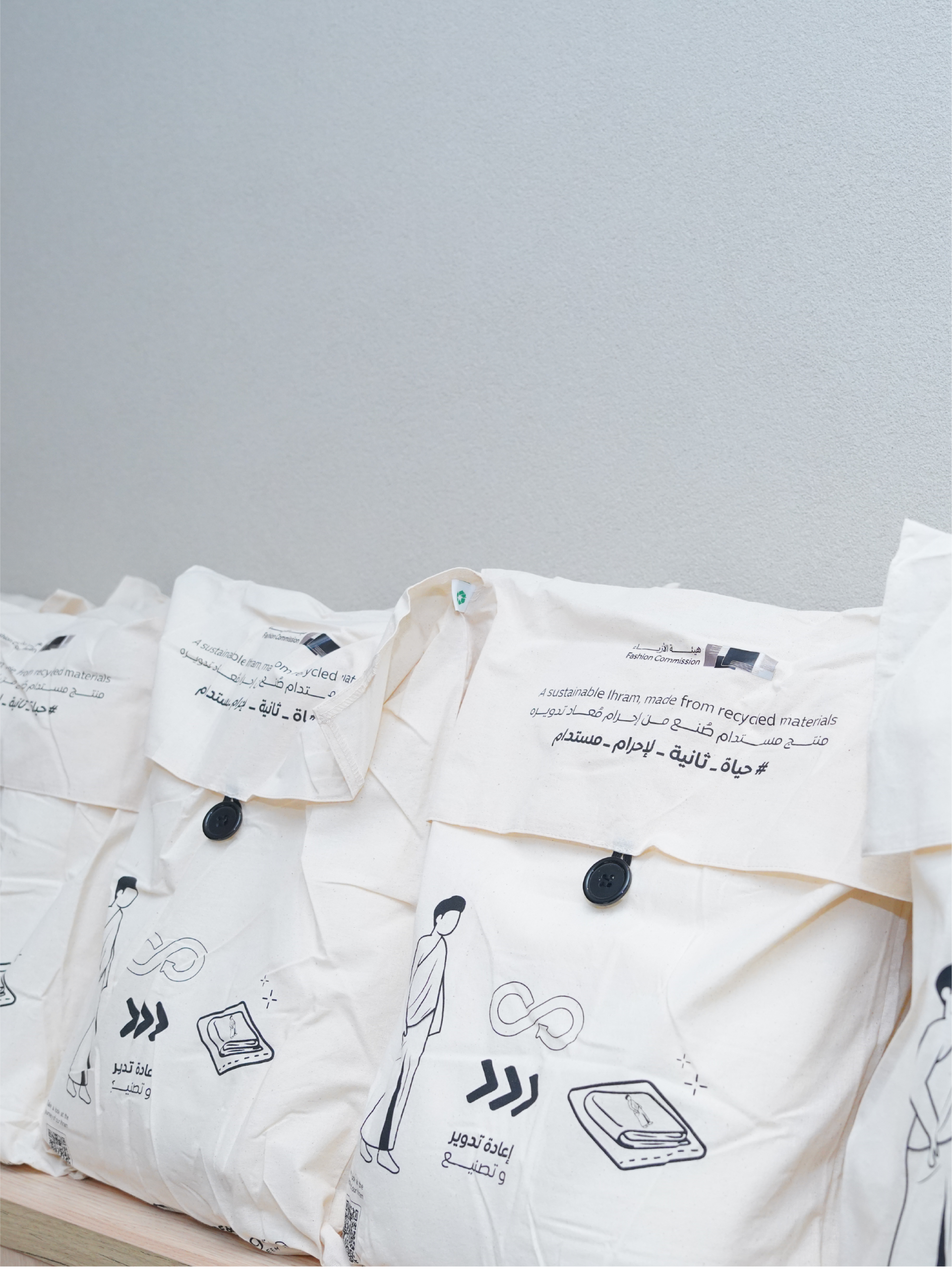
The process began with a rigorous study and a series of strategic partnerships. Collaborating with the Saudi Investment Recycling Company (SIRC), the Royal Commission for Makkah City and Holy Sites (RCMC), Tadweem, and the vertical textile group Sanko, the fashion commission has developed a system to collect, sort and process used ihrams. In 2023, partners successfully collected 34 tons of these garments during the Hajj season. Through advanced textile-to-textile recycling technology, these discarded cloths are being transformed into high-quality recycled fibers, which are then woven into brand-new ihrams.
These recycled garments are intended for resale or distribution as gifts, serving as a tangible education for the public. The environmental stakes are remarkably high. It is estimated that by successfully recycling these materials at scale, the kingdom could help reduce carbon emissions by a massive 615 million tons of CO2 equivalent. This contributes directly to the national target of reducing emissions by 278 million tons per annum by 2030.
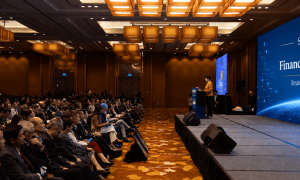
However, the transition from a linear to a circular economy is not solely a technical challenge; it is a cultural one. A study by the RCMC indicated that the initial willingness of pilgrims to purchase recycled ihrams was low, likely due to misconceptions regarding the purity or quality of recycled textiles. This is where the fashion commission’s role as a driver of systemic change becomes vital. By launching the initiative at high-profile events such as the Islamic Arts Biennale in Jeddah, the commission is working to reframe sustainability as a modern extension of the Islamic values of stewardship and the preservation of the Earth.
Burak Cakmak, chief executive officer of the Saudi Fashion Commission, emphasizes that the success of these efforts rests on the shoulders of the younger generation. He notes that with the majority of the Saudi population under the age of 30, there is a unique opportunity to influence consumer behavior early. If this demographic can be encouraged to make “smart choices” about purchasing and recycling, they can spark a massive shift in the future of apparel sustainability. The initiative aims to move the needle from viewing a garment as a disposable commodity to seeing it as a resource with a continuous lifecycle.

When asked about the impetus behind launching this initiative, Cakmak said the scale of ihram usage during Hajj and Umrah “presents a clear opportunity to rethink how garments produced and used at such volume can evolve more responsibly. As outlined in the Fashion Futures paper, ‘Ihram Circularity: Weaving a Greener Hajj and Umrah Experience,’ this is not only a question of material use, but of how circularity can be embedded into systems that operate at scale.”
Cakmak said through the Recyclable Ihrams initiative, “we are advancing a circular model centered on recovery, material innovation and reuse, with the potential to significantly reduce environmental impact while preserving the respect and integrity of the garment. It reflects a broader ambition to demonstrate how responsible practices can be applied meaningfully within the global textile and apparel system.”
Beyond the environmental impact, there is a compelling economic argument for this shift. The global textile industry faces significant commercial risks due to environmental pressures. By developing localized recycling infrastructure and fostering expertise in textile waste management, Saudi Arabia is creating new business models. This move diversifies the economy in line with Vision 2030, opening doors for research and development and the potential export of sustainable materials. The initiative proves that purpose-driven innovation can be both ethically sound and economically viable.
The Sustainable Ihram Initiative also complements other efforts by the fashion commission, such as the Swap Shop program, which encourages consumers to exchange unwanted clothes rather than discarding them. Together, these programs form a comprehensive strategy to weave sustainability into the daily lives of citizens and visitors alike.
As the next Hajj season approaches, the call for pilgrims to participate in this greener journey becomes more urgent. The ihram has always been a garment of transition — worn as a person moves from their worldly life into a state of spiritual purity. Now, it is also a garment in transition in a physical sense. By choosing sustainable options and participating in recycling programs, pilgrims can ensure that their journey of faith also respects the sanctity of the natural world.
The significance of this project extends far beyond the borders of Mecca. It serves as a global example of how high-volume, ritual-based products can be integrated into a circular economy without losing their sacred meaning. It demonstrates that tradition and technology are not at odds. Instead, technology can be used to uphold the very values of humility and responsibility that the tradition was built.
In the vision of the Saudi Fashion Commission, the future of fashion is one where waste is designed out of the system, and every thread tells a story of renewal. The Sustainable Ihram Initiative is the cornerstone of this vision. As the kingdom continues to grow its capacity to host the world, it is ensuring that the path to Mecca is not just a path of spiritual enlightenment, but a path toward a cleaner, more responsible future.
Editor’s note: For news and events, data and reports and other insights, visit the Fashion Futures website, HERE. Fashion Futures can be found on Instagram at ksa_fashionfutures or HERE.