At the latest Homo Faber biennial in Venice, the celebrated British artist and designer presents an ode to craft in all its forms.At the latest Homo Faber biennial in Venice, the celebrated British artist and designer presents an ode to craft in all its forms.

It all starts with a hand. In a darkened, cavernous room on the island of San Giorgio Maggiore, a film shows a hand reaching out across a black backdrop, followed by the other appendages of makers welding, carving, brushing, hammering, drilling, tracing. In the process, the room itself is illuminated, revealing a workshop deserted in a hurry by its artisans, clay, sawdust, fabric, paper, and paint scattered across the atelier workbenches. Heading down a corridor, the faces of the makers are displayed in portraits lining the walls, hall-of-fame style: the 500 or so people behind the 700-plus works assembled for this year’s biannual Homo Faber exhibition in Venice.
“It draws your attention to the process and practice and intense dedication of time contained within every masterwork you are about to see,” says Es Devlin, the co-curator of the biennial, titled “An Island of Light,” that I’m visiting on a baking-hot September morning in Venice. (The show runs all the way through to September 31 at the Fondazione Giorgio Cini, if you’re planning a trip.)


Another highlight is the dramatic mise-en-scène staged by Devlin in the Palladian refectory of the former Benedictine monastery, with a long uplit table running down the center designed to evoke “a sunbeam through a crack in the doorway.” As Devlin herself describes it, the table is laid with “a feast of pure white forms in every imaginable material from ceramic to feather to paper, shell, silk lacquer, and Lego.”

Floating above in the entryway are a series of breathtaking paper sculptures by the Chinese artist Wen Qiuwen based on sketches of Venetian birds drawn by Devlin—kestrels, egrets, herons, terns—that appear at first majestic and monumental, then reveal themselves as an architecture of folded paper and air.

Then, just when your eye had grown attuned to the nuances of all those varying shades of white, Devlin pulls the rug from out from under you (figuratively, at least) by plunging you into a prismatic, mirrored room with a vast rug handmade by Jaipur Rugs woven in every color of the rainbow, a kaleidoscope of vibrant objects all around you.

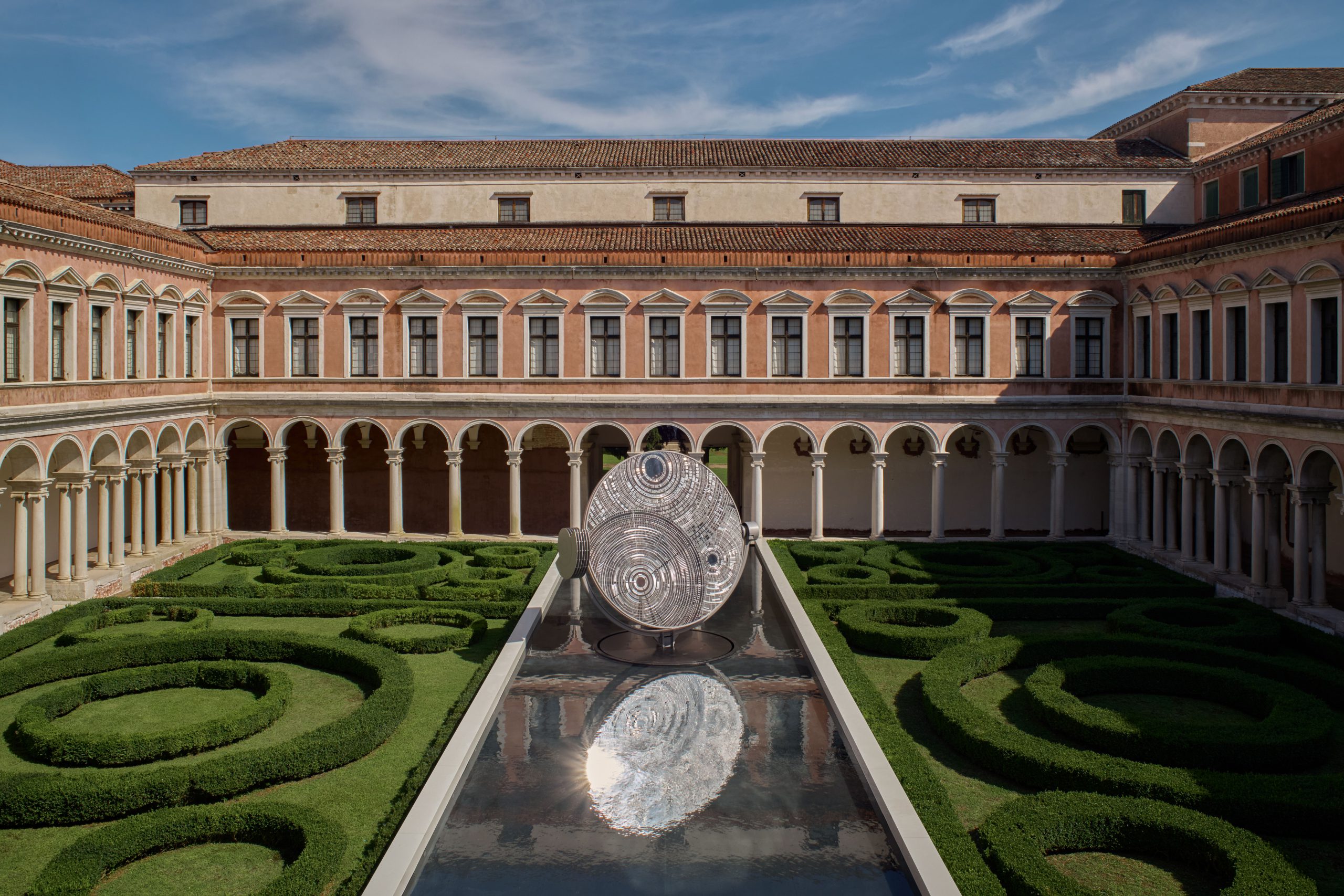
Punctuating all of this is a series of large-scale installations and kinetic structures Devlin designed for some of the most striking spaces: an enormous sculpture of a giant engraved mirror above a reflecting pool in the middle of a cloister that revolves throughout the day and is accompanied by a soundscape of raindrops say, say, or the hypnotic half moon that rises from the glossy black water of a shadowy indoor swimming pool, stacked with the milky glow of Korean moon jars. (The latter is one of the exhibition’s most dazzling moments, not least for the rich variety of interpretations of the moon jar across various traditions—porcelain, glass, delicately inlaid mother of pearl—that line each side of the room.)

For Devlin, it relates to the fact that the project is as much about cultural history as it is about craft. “While researching Venice and in the island of San Giorgio Maggiore and Fondazione Cini I discovered that these places of searing beauty were both born of necessity, conflict and grief: the city of Venice was established by refugees, fleeing conflict on the mainland, seeking refuge in the inaccessible and inhospitable marshy islands in the lagoon,” says Devlin. “The Fondazione Giorgio Cini was founded by the wealthy industrialist Vittorio Cini after the loss of his son Giorgio in a plane crash. Often the most powerful and resonant art and music is made by through who urgently have to make it: who have found the enzyme that can catalyze their pain into poetry and purpose.”

The Homo Faber project is the brainchild of the Michelangelo Foundation, a non-profit organization based in Geneva dedicated to preserving and promoting master craftsmanship worldwide. It was co-founded in 2016 by Richemont chairman Johann Rupert, with the Homo Faber project being largely overseen by his daughter, Hanneli, and the foundation’s executive director, Alberto Cavalli. (There’s a presence of some of the Richemont brands within the exhibition, with jewelry by Cartier and Van Cleef & Arpels and a knitted Alaia gown on display, but they’re woven in sensitively so as to never feel overbearing.) For Hanneli and Cavalli, collaborating with Devlin was a no-brainer. “Es is one of the most extraordinary and talented artists I have ever worked with,” he tells me. “We have all learned a lot from her: enthusiasm, clarity, passion, discipline, and an attention to what human hands can do to create beauty, every day.”

It’s this which is perhaps the most powerful takeaway. Despite the awe-inspiring, monumental works here, it’s often the pieces operating at a smaller scale that beguile you most with their intricacy and workmanship. (As well as the pipe dream of potentially owning them: a jewelry box of flowers cast in resin or a shapely glass vessel might fit neatly into a corner of your home; an enormous rotating mirror and reflecting pool perhaps less so.) It probably shouldn’t be surprising that it’s often the works made at the most human scale that feel the most, well, human. “It was particularly moving to witness the artisans visiting the exhibition. A glass maker from Hawaii who works alone, told me he felt he’d met his brothers and sisters—that he’d met his community within the installation of works that echoed his own,” says Devlin.

It’s also augmented by the army of “young ambassadors” milling about every room wearing dip-dyed, pastel-hued jumpsuits, ready to explain the process and backstory behind every piece. You can’t help but leave feeling inspired—whether to get crafty and create your very own version of that first messy atelier space, or simply to linger over the human-made details that surround us in the cities and rooms we pass through every day, but don’t always take the time to appreciate.
“To see awe, wonder, and admiration in the eyes of the visitors every time they enter into a room is for us the best reward for these two years of hard, passionate, and inspiring work,” says Cavalli. “Very often, at the end of the visit, they use the adjective ‘spiritual,’ because their visit to Homo Faber touched their emotions profoundly.” As I left the monastic gardens of the Fondazione Giorgio Cini and began my journey back to the heart of the city via water bus, that’s exactly how I felt.