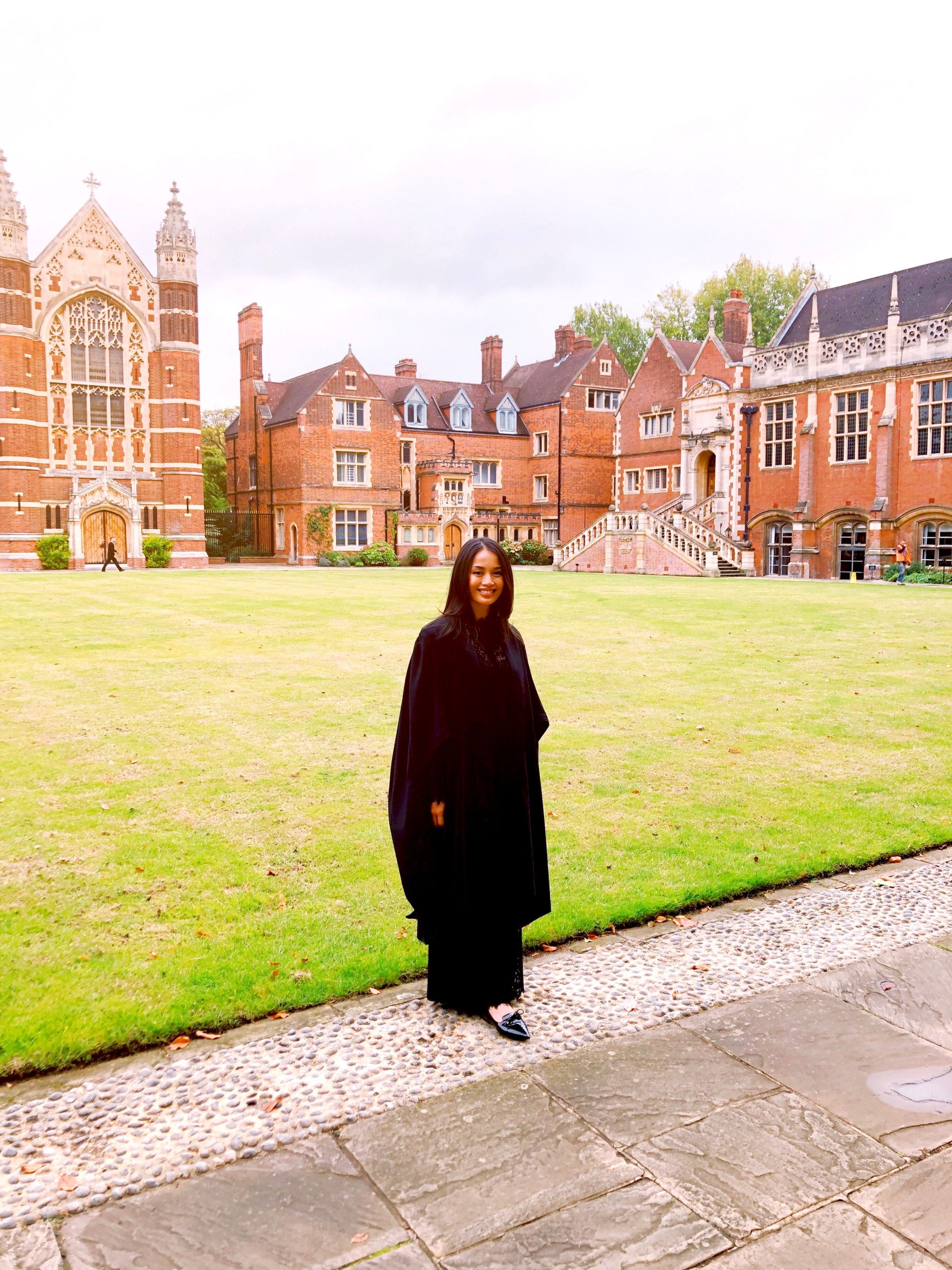
“I could write a second memoir solely on the racism I experienced at Cambridge University as a Master’s and PhD student,” writes Jill Damatac, a Filipino-American author who was a student at Cambridge in 2019.“I could write a second memoir solely on the racism I experienced at Cambridge University as a Master’s and PhD student,” writes Jill Damatac, a Filipino-American author who was a student at Cambridge in 2019.

In the beginning, Cambridge seemed nice enough. On the cool, overcast October day of my matriculation into the university in 2019, my classmates and I walked onto Selwyn College’s Old Court, excited and taking pictures of each other in our traditional robes. As we strolled around, I observed a pair of dons nearby, also in their black robes, watching us. Their eyes took in our group of eight, which included a Black Zambian-Swiss woman, one Black American woman, one Filipino American woman (me), and one British Indian man.
One of the dons, an old white man, leaned over to his colleague, another old white man, and theatrically ruffled his robes, whispering as we passed:
“These must be the creative writing students.”

As a PhD student, the particular subtlety of British racism persisted: invitations to participate in marketing photos and video shoots that aimed to recruit students of color, then a thank you in the shape of an English Faculty mug plastered with the names of only white authors; the faculty inviting only white students to a private dinner with Black American poet and academic Claudia Rankine, whose work focuses, I kid you not, on race, microaggressions, and systemic racism; professors at my mini-viva questioning my use of the term “Asian American canon,” insisting that “canon” was the remit of white authors (and reciting names to me as I fought back tears). When I became a guest lecturer at the university’s MSt in creative writing, I was told I would be considered for a full lecturer role once my first book was published the following year. A week or so later, I found that they had given the full lecturer role to a fellow PhD student—a white woman whose first book, as of this writing, has yet to publish.
All of the above is abhorrent, clearly racist to those of us who have had to live under the heavy thumb of prejudice all of our lives. All of the above is merely run-of-the-mill general Cambridge (or Oxbridge) racism. It is also nothing compared to the anti-Black racism that has animated this university—a beneficiary of the transatlantic enslavement of Black people—for centuries. What I experienced was, for me, survivable compared to the anti-Black mob both in Cambridge and in the British media that hounded Dr. Jason Arday to his death at the age of 41, despite his having been cleared of accusations of plagiarism.
The cruel tragedy of the online terrorism faced by Dr. Arday is that none of it required him to have done anything. All he had done was earn a professorship and commit the unspoken sin, rooted in envy, of becoming a public figure. He was 37 when the university appointed him, its marketing teams putting him in its press releases and photographs (how useful!): a Black man standing inside one of the crown jewels of British life with a set of keys in his hand.
When Dr. Arday became a professor, British anti-Blackness awoke from its nap—it’s never a long slumber. Nathan Cofnas, a university fellow and a “race realist”—whose beliefs include the spurious claim that in a “true meritocracy” Black people would “disappear from almost all high-profile positions outside of sports and entertainment”—accused Arday of plagiarism. Cofnas had a history of anti-Black behavior at the University, with 58 complaints filed against him by Black students claiming racism. Cambridge cleared him of wrongdoing, citing “free speech.” It strains credulity that Cofnas’s racist scholarship found a place at Cambridge at all, yet as an alumnus of color, I can’t help but feel unsurprised.
The sad and predictable irony is that barefaced hypocrisy at Cambridge persists, in stark contrast to how Dr. Arday was treated. In 2021, a Cambridge graduate recognized his own sentences in a journal article published by his former supervisor, Dr. William O’Reilly, associate professor of Early Modern History, who had lifted some 4,000 words from essays he had marked with notes of praise. Cambridge’s own regulations describe plagiarism as gross misconduct normally meriting dismissal. The tribunal found the acts negligent rather than deliberate. O’Reilly keeps his post to this day. No statistician was commissioned to analyze his back catalogue, no newspaper put his face on a front page. No columnist asked what his case revealed about standards at the university.
In my own years as a PhD student, I slowly confronted my own aspirations, towards which I had become ambivalent over my four years at the university. In my memoir, I wrote: “Was this what all of my suffering [as an undocumented immigrant] was for? So that I could become a part of the same imperial machinery?”
In 2023, I left my PhD because of the insidious racism, even though I did not have the courage to say so to the faculty at the time. They had made it clear to me what I was to them: a fluke, useful for marketing materials, a creative writing graduate with a book deal, one best kept quiet so as to not offend my classmates; an interloper who had misunderstood what a canon is.
To this day, I still think about the two dons on Old Court, indignantly ruffling their robes in the wet October light, in disbelief at the sight of us: Black and brown students with the imagination, talent, and audacity to stand where they couldn’t accept, to dare to dream of a future beyond the outdated confines of where they thought we belonged.