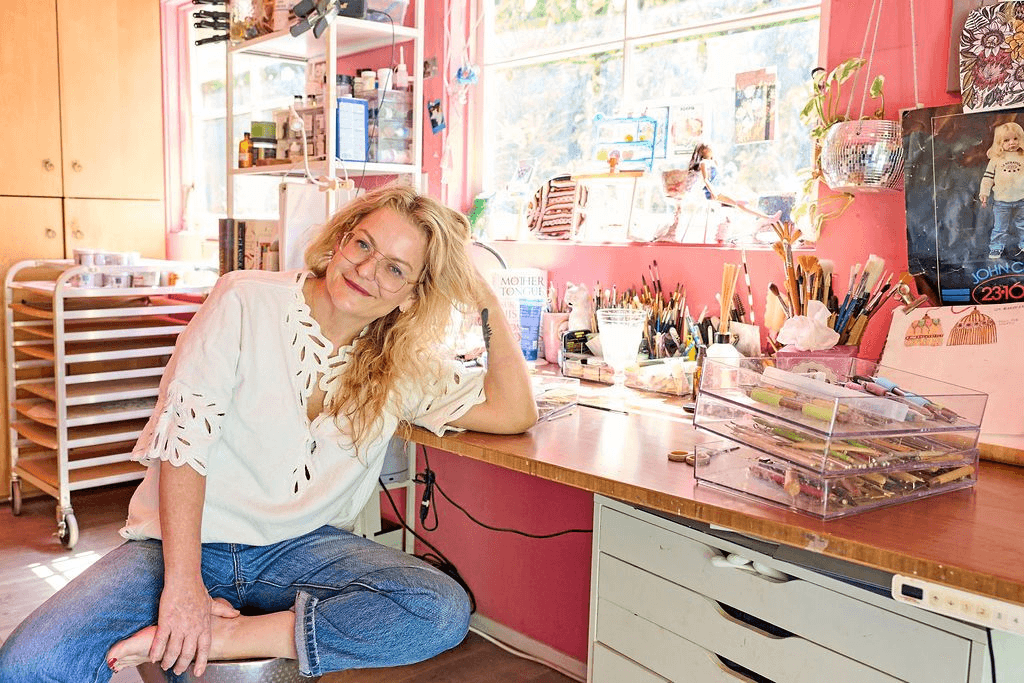
Meet Tina Charad, the graphic designer whose ceramic art has gained a cult following among actors and filmmakers.Meet Tina Charad, the graphic designer whose ceramic art has gained a cult following among actors and filmmakers.
.jpg)
Tina Charad knew she wanted to work in film when she first saw Baz Luhrmann’s Romeo + Juliet. “I was just blown away,” she recalls. At the time—in the late 1990s—she was a 21-year-old graduate of the Chelsea School of Art in London. “I didn’t really understand what production design was, but the visual tapestry—it was just so rich,” she says. “I wanted to live in the world.”
Now, decades into a career as a graphic designer for film and television, she has conjured the Technicolor grit of 1969 Los Angeles for Quentin Tarantino’s Once Upon a Time in Hollywood, digitally crafting the signage and storefronts that made Hollywood Boulevard and other iconic locations come to life on screen. She has designed elaborate murals, gold leaf-detailed shoji, advertisements, period-specific fabric patterns, movie posters, and more for films such as La La Land, The Batman, and Maleficent. The job requires deep research, precision, and skill—and if all goes well, all this effort goes unnoticed. “You don’t want it to stand out. You want to just believe that you’re there,” she says.

Charad, who is 51 and was born in South Africa, has long had a perfectionist streak. Even as a kid in art class, “I thought everything had to be photorealistic,” she says. Teachers would tell her to loosen up, but that obsessiveness served her well in Hollywood.
Even so, over the years, she began to gravitate toward something a bit messier, which lent itself to her own creative work. “I took up ceramics to get off the computer—I spend all day digitally Photoshopping,” she says. She would often drive by a ceramics studio, and finally decided to give it a try one day. “I made terrible bowls, but I loved making them,” she says.
She taught herself at first, then took classes at Glendale Community College. When her husband was diagnosed with cancer, she gave up her practice for a few years to care for him. After he passed away nine years ago, ceramics became a way of working through her grief. She now makes plates, bowls, vases, wall hangings, ceramic cats, and more in her home studio in Pasadena, some of which are sold at Pierce & Ward, the Los Angeles design studio known for modern heirlooms. In September, she will have a pop-up exhibition at Clare V in Los Angeles, and in 2027, she will have an exhibition at Knysna Fine Art in Knysna, South Africa.

Over the years, Charad has continued developing her style, finding inspiration in the news, stories from her life, and even her cats. (She has three black cats, but draws the line at four: “I think if you have four cats and are a widow, then the math starts to get a little bit uncomfortable,” she says, with a laugh). She counts the artists Jennifer Rochlin, Hylton Nel, and Daisy Makeig-Jones (who was a pottery designer for Wedgwood best known for her “Fairyland Lustre” series) among her influences. And aesthetically, more is more. “I’ve never met a pattern or an over-the-top color scheme that I didn’t love,” she says.

As decorative as they appear, there’s a subtle political charge to her work. Charad is most interested in exploring the hypocrisies, vanity, and superficiality that she feels mark our time. By incorporating lines of text she writes—which are akin to short poems—she processes life through her work, and aims to create a humorous record of now. (An example: “I’m not vain. I just feel the world needs to see more of me.”) As she explains, “The ceramic is the vehicle to tell this ridiculous, absurd little story.”
.png)
Graphic design is still a part of Charad’s work—after all, she is a pragmatist, and it’s a paycheck. But she is increasingly invested in the worlds she is building in her ceramic studio, rather than for the screen. Charad likes the physical aspect of it, and the unknowability of a handmade object. “Is this going to work? Is this going to not break? Is this going to still stand up?” she says. “Maybe. Maybe it won’t.”