The spring 2027 season marked CPHFW’s 20th anniversary, its most international edition ever, and an explosion of color after years of minimalism.The spring 2027 season marked CPHFW’s 20th anniversary, its most international edition ever, and an explosion of color after years of minimalism.

After four days of back-to-back shows, another season of Copenhagen Fashion Week (CPHFW) has come to a close. The spring 2027 schedule was especially packed, as brands clamored to join CPHFW’s 20th anniversary celebrations, and the event drew its biggest crowd ever.
For CEO Cecilie Thorsmark, whose opening speech normally strikes a political note, this season was a palette-cleanser: a chance to celebrate the brands for what they do best. “Copenhagen Fashion Week is only as great as the brands and designers that make up our schedule,” she said at the 20th anniversary gala on Monday night, attended by models Alana Hadid and Adwoa Aboah, as well as DJ Louise Chen. “Our industry has had to navigate some incredibly challenging years, which have tested businesses and demanded extraordinary resilience. To me, the schedule is a testament to the resilience of our industry.”

There were triumphant returns for brands that had taken a break from runway shows, strong debuts from both Nordic and international talent, and a general buzz that saw brands hosting gifting suites, dinners and side-events alongside the main schedule. Here’s what you missed.
International guests make a splash
In a bid to cement Copenhagen’s place as the fifth fashion city, CPHFW is now more international than ever. Alongside Nordic talents like Finland’s Almada Label and Sweden’s Sson, London-based emerging brand Paolina Russo and Lagos-based Iamisigo continue to show in the Danish capital, having debuted there in 2023 and 2025, respectively, when they each won the Zalando Visionary Award. Paolina Russo had one of the buzziest shows, with a battle of the bands between Olivia Rodrigo support act Grace Ives and Copenhagen music group Haloplus+, as well as a 600-strong audience buoyed by fans and members of the public.

This year’s Zalando Visionary Award winner — Institution by Galib Gassanoff — presented one of the season’s strongest shows. The former LVMH Prize finalist normally shows in Milan, and will again in September, but created a special collection for its guest slot. To bring the show to life, it took over Copenhagen’s Statens Museum for Kunst (SMK), filling its central atrium — affectionately dubbed ‘Sculpture Street’ —w ith rich woven carpets sourced from the Caucuses, Anatolia, Northern Iran, and Central Asia. The collection celebrated Georgian and Azerbaijani crafts, nodding to Gassanoff’s roots, and somehow managed to capture both the minimalism of Copenhagen fashion and its love of hygge. “There was a real point of view to the collection,” says Moda Operandi senior buyer Kelsey Lyle. “It was directional and incredibly considered.”
Another highlight was the inaugural international guest slot. According to Thorsmark, the plan is to roll this out every season, inviting different sustainability-minded designers from around the world. New York export Collina Strada rose to the occasion, staging the penultimate show of the week as the sun set over Copenhagen’s canals (a string quartet made the wind-beaten catwalk even more dramatic). The collection — made especially for Copenhagen, and entirely of one-off upcycled looks — was a step up in terms of craftsmanship. The intricate basket weave dress was a particular highlight, as were the tightly pleated denim jeans that, according to designer Hillary Taymour, her factory initially said were impossible to make.

“I’ve always admired what Copenhagen has built. It feels like one of the few fashion weeks where sustainability isn’t treated as a trend or a marketing angle,” says Taymour. While her upcoming show in New York this September will be for sale, the Copenhagen show was a one-off storytelling opportunity, constructed from Collina Strada’s own deadstock fabrics, spanning the brand’s 18-year history. “The Copenhagen show gave us the freedom to tell a very focused story. This show is almost like its own chapter, more intimate and centered around material exploration and craftsmanship. More than anything, I wanted to remind people that fashion can still surprise you.”

By Malene Birger returned to the CPHFW schedule after a six-year hiatus, during which the brand transitioned to a new CEO and refocused its market position. “Over the past year, we have been building towards this moment, and as the SS27 collection came together, it became clear that the timing was right. We felt we had the momentum to mark our return to the runway,” says brand director Barbara Gullstein. “In our time away, CPHFW has evolved significantly. Returning felt not only meaningful for the brand, but also an opportunity to support the industry in our home market and reconnect with the community that has helped shape Danish fashion on the global stage.”
It was a homecoming in every sense. The show was hosted at Friheden, the private estate that belongs to creative director Emilie Martinsen-Kønigsfeldt’s parents. “The show was timed to begin just as the evening light turned golden,” recalls Lyle. “It was one of those rare moments where the location, atmosphere, and clothes come together seamlessly — a reminder that the most memorable shows are about creating an emotional connection, not just presenting a collection.”

Bigger brands supporting emerging names
CPHFW hit a snag last year, when homegrown brands Saks Potts and (Di)vision closed their doors, and two key players — Cecilie Bahnsen and Ganni — decamped to Paris in 2021 and 2024, respectively. But larger Danish brands continue to have a presence in the capital, even if they don’t show on-schedule. This season, Ganni donated some of its deadstock fabrics to fledgling zero-waste brand Stem, which held its first runway show after a series of more intimate craft workshops-cum-presentations. Stem creative director Sarah Brunnhuber created seven one-off looks from the deadstock — her first foray into synthetics and print. It was an explosion of leopard print, picnic checks and heavy floral jacquard, pushing the boundaries of Stem’s signature zero-waste weaving techniques. Ganni celebrated with a street party that saw its creative director Ditte Reffstrup dancing on the bonnet of a car.

One of Copenhagen’s most successful exports is jewelry giant Pandora — the biggest jewelry company in the world by volume. This year, Pandora sponsored the CPHFW opening gala, as well as the New Talent program, which provides mentoring, monetary support and showcasing opportunities to emerging brands for up to three seasons. Pandora also provided jewelry for soon-to-be graduates Anne-Sofie Madsen and Taus. “Creativity is the fuel that keeps industries like fashion and jewelry alive,” says Pandora CEO Berta de Pablos-Barbier. “So supporting new talent is an absolute necessity, because creativity needs renewal, a fresh pair of eyes. Helping this new talent break into the industry, whether through financial support, creative advice or visibility, is an important thing for us.”
Elsewhere, a slew of emerging brands partnered with footwear brands to bring their shows to life. Paolina Russo partnered with Ecco to update its original Joke shoe with rainbow bedazzled laces. Nicklas Skovgaard, whose show saw models ferried onto the runway in classic cars, linked up with Spanish sneaker brand Hoff for the second season in a row. And Anne-Sofie Madsen collaborated with sportswear giant Nike, reimagining some of its signature shoe shapes, and designing oversized logo tees bearing the slogan: “The future feels good on you.”
But it was O.Files that delivered the strongest footwear collaboration of the week, according to former Browns buying director Ida Petersson, now the co-founder of brand strategy and creative agency Good Eggs. “O.Files is new kid on the block, and one of the Wessel & Vett prize finalists,” she notes. “Its deconstructed folds on a simple Adidas base made for the coolest sneaker collaboration of the week, alongside a strong line up of clean ready-to-wear, with its signature pleated denim and tailoring.”
Minimalism loosens its grip
As the earliest womenswear fashion week, Copenhagen is a good trend barometer for the rest of the shows. And it seems the lace trend we spotted across the last two seasons will endure through SS27: the fabric was “everywhere”, on the CPHFW runways, Petersson says. At The Garment, there were lace-trimmed slips styled over relaxed tailored pants, and semi-sheer lace-trimmed culottes. At Opéra Sport, there were embellished lace tops and lace-paneled dresses. Semi-sheer crochet dresses also featured heavily, as did color-pop see-through shifts at insider label Mr Larkin, which put on its first runway show at V1 Gallery.

As ever, the true mark of Copenhagen fashion is the high-low styling. It’s sporty outerwear and fashion-forward sneakers paired with voluminous dresses, or slinky dresses and breezy shirts with textural scarves tied as bandanas, belts, and bag charms. We saw this everywhere from Baum und Pferdgarten, whose show in The King’s Garden was overrun with locals, to Skall Studio, the only outdoor show to get caught in the rain.
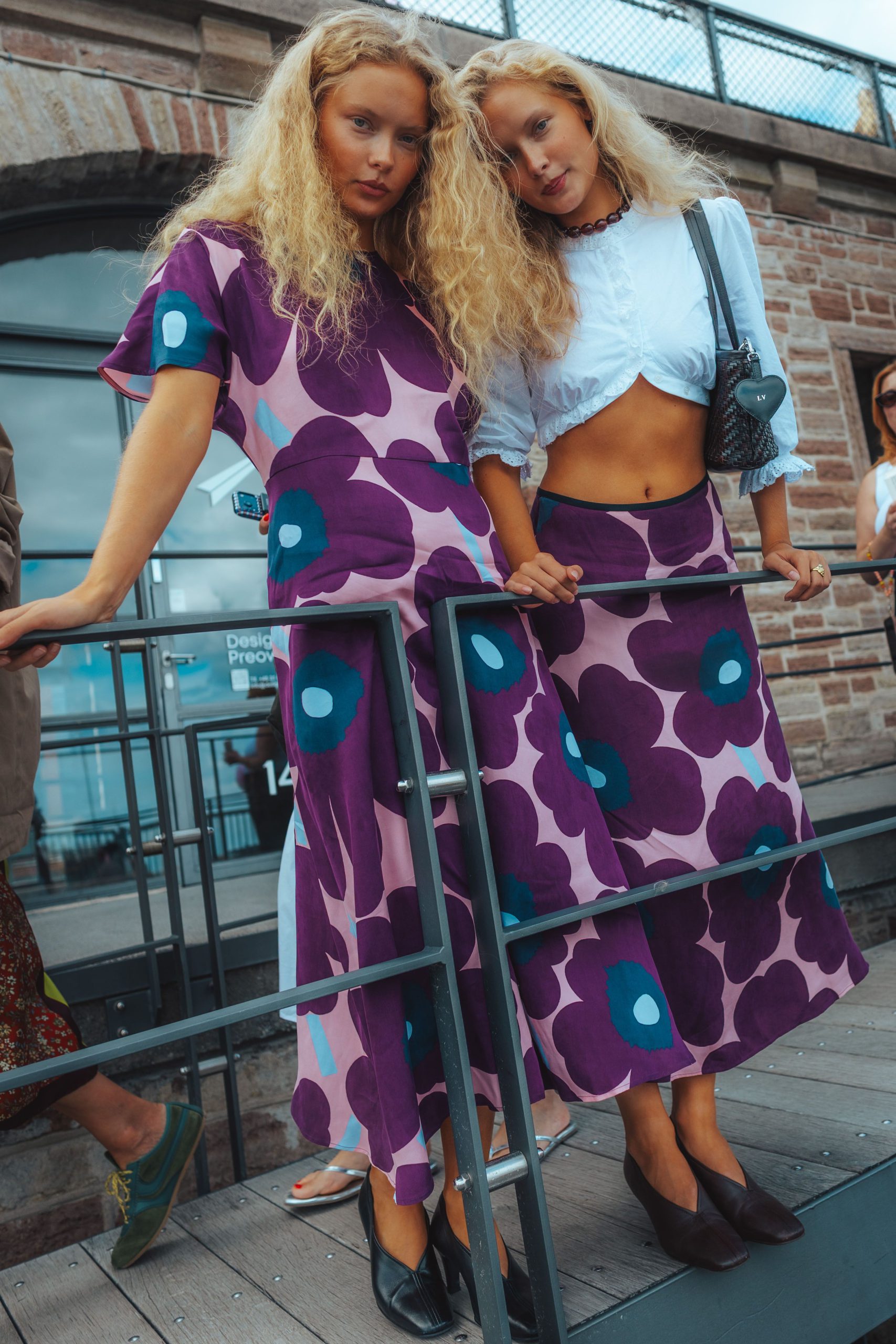
Off the runway, the debate over whether hyper-girly Scandi street style is a lie raged on. While stark monochrome color palettes and functional, minimalist silhouettes will always have a place in Danish fashion, this season felt like a return to color, and not just at the characteristically maximalist Caro Editions, which closed out the week. “I loved the color and texture explosions happening at almost every show, and also on the attendees themselves. Even when a show was pared back, the details or a dramatic train kept it from being too plain,” says Peterssen. “It’s fair to say that — at least in Denmark — quiet minimalism is dead.”