I thought I had left my hometown behind. The Dallas Cowboys Cheerleaders proved me wrong.I thought I had left my hometown behind. The Dallas Cowboys Cheerleaders proved me wrong.

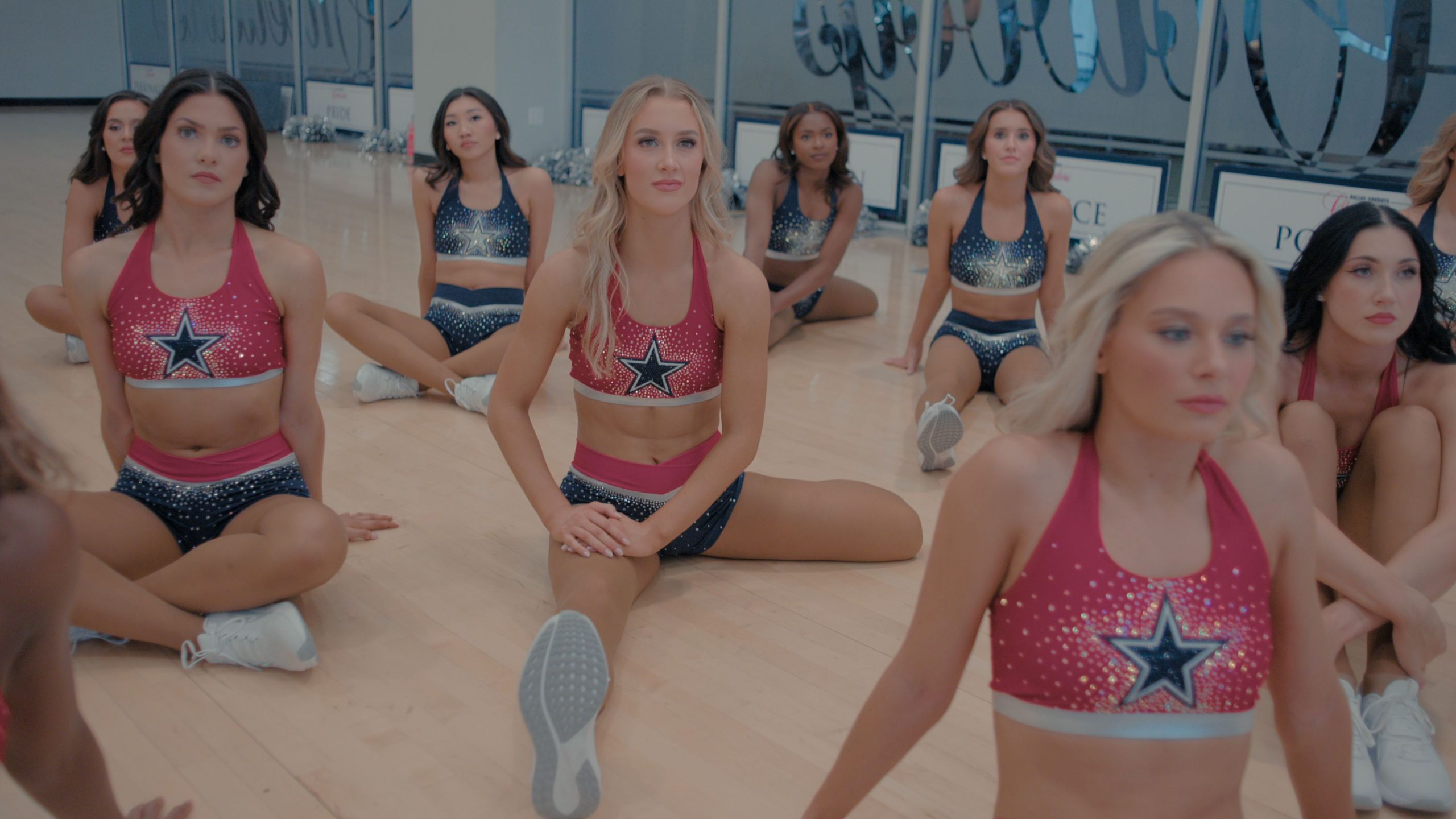
Since leaving Dallas in my early 20s, I’ve found solace roughly 1,500 miles east of my hometown, in New York. But the wiser part of me has always sensed that eventually, a stroke of fate would lead me to reembrace my roots. I just never expected that event to arrive in the form of 36 star-spangled, spray-tanned women sashaying and high-kicking across my television screen.
The first time I started Netflix’s America’s Sweethearts, the Emmy-nominated docuseries about the Dallas Cowboys Cheerleaders, I had to turn it off. The hair was too sprayed, curls too done, makeup too baked, and lashes too thick. The focus on appearances felt antiquated. I’ve spent the better part of the last decade trying to unlearn the beauty expectations and the body dysmorphia that run rampant in the South. I’ve questioned patriarchal narratives and challenged my encoded impulse to bend for the male gaze. I’ve darkened my Dallas blonde, denied the call to conform, and rejected the idea that a woman’s worth can be defined by how well she wears her gender role. But curiosity led me to try watching the show again. The cast’s Texas accents drew me in. This is what raised you, girl. Like it or not. By season two, I was hooked.
Most of the girls on the team have full-time jobs outside of their dance careers. “She is smart,” Finglass and Trammel will say about a candidate with an impressive degree or profession. They’d say smart with the same intonation I remember Southern women using when I was growing up. It was one thing to be pretty, but pretty and brainy? Now that was somethin’. But I was relieved to learn that DCC has evolved beyond the Dallas dialogue I would hear about women and their cognitive aptitude. “We are looking at how they think under pressure,” says Finglass. “Intelligence is a requirement.” The most reliable evidence of change, of course, is in the cheerleaders’ pay raise. “Our efforts were heard, and we ended up getting a 400% increase,” veteran Megan McElaney shares in season two after advocating for the long-overdue adjustment. “Dancers are athletes. They have so much value.”
On America’s Sweethearts, Makeover Day is the long-awaited training-camp ritual where the rookie candidates spend a day at the salon. “It’s a soft, dreamy look,” a makeup artist says of the DCC vision. “Almost as if they’re walking around with a pink light on them.” Finglass works alongside the lead hairstylist, Kevin Ozowski, to identify each candidate’s ideal hair color, style, and makeup look before they join the team. “Hairography” describes the way a dancer uses her hair as a prop. “Their hair is an accent to the choreography,” Finglass says. “In the ’70s and ’80s, for the Dallas Cowboys Cheerleaders, and even Texas and just women in entertainment in general, hair was a way of getting attention.” Ozowiki agrees, “Everything is bigger here in Texas. We want big hair, big cars, big houses. I would say it’s the true Southern way.” When Faith Ward, an Australian rookie candidate, struggled with hairography, the team made the bold decision to put her hair in a “high twisted fashion pony.” It’s against the status quo, but it would have to work.
When I left Texas to attend college in North Carolina, my Southern codes stood out, even though I was still below the Mason-Dixon line. My new East Coast friends were confused when I plugged in two different hot tools and created a “getting-ready station” on the floor in front of my dorm-room mirror. What are you doing? they’d ask as I’d straighten my hair before class, doll myself up to go to the cafeteria. I thought everyone did this.
These days, hair is in a high ponytail—not the twisted fashion kind—more often than not. I’ve retired my straightener (for the most part). By the time I arrived in New York as a 21-year-old intern, my urge to satisfy a singular definition of what a woman should be had begun to fade. The more I established myself away from Dallas, the more I resented what I had learned there. When, at a work event not long ago, a guy said I “must have been a cheerleader,” I took offense. I never cheered. I thought I couldn’t be farther from that.
It was Reece Weaver who made me realize I was wrong. A fan-favorite Dallas Cowboys Cheerleader originally from Jacksonville, Florida, Weaver joined the team in 2023 and quickly rose in the ranks. She fit the mold; her hair was long, and her kicks were high. But she had a secret third thing going for her that was shinier than her rhinestoned audition costume. “It’s very human to worry about your next steps in life,” she told the crew while trying out. “But I’m really trying to be optimistic that no matter what life brings, it’s meant to be.” Weaver has big dreams, and so do I. We wear different costumes, but our survival mechanisms are similar.
I thought about the way my dad would ask me every day before school, “What does a good day start with?” He began the tradition when I was young and eager to answer correctly, “A good attitude!” He continued it into my teens, when I would grumpily mumble, “Dad, I have to go. Fine, a good attitude.” He was right—a good attitude is effective. I hold tightly to this truth. I take it with me everywhere I go. It’s central to my entire constitution, and it’s not unlike that of a Dallas Cowboy Cheerleader.
I’ve been hard on my hometown, often with good reason. I still roll my eyes at the Dallas way of placing prettiness on a pedestal. But I know that if a person refuses their roots, they’re likely running from something. And maybe I was. I realize now that I was afraid my hometown would gobble me whole if I accepted any part of it. But the women on the field aren’t the kind of placating, self-abandoning women I so feared becoming—far from it. “They show up every day, they put their heart in it, they’re resilient,” one superfan says. I wonder if DCC won the hearts of their viewers because staying positive and kind seems like a novelty in today’s polarizing, hyper-online world. But the girls handle internet hate with grace, too. “You have two choices when you get criticism,” rookie candidate Karley Swindel says. “You can let it get you down or use this as an opportunity.”
In the latest season of America’s Sweethearts, Weaver turns in her uniform. She says she’s ready to take a “leap of faith” into a new chapter and to leave Dallas behind. “My cup is filled to the brim,” she tells Trammel and Finglass. “And if my absence gives another girl an opportunity for her cup to be filled, then I consider that the greatest honor.” She had done it all. She danced at the front of the formation during “Baby I’m a Star,” traveled to New York for press trips, and persevered through three training camps. “I lived under other people’s expectations for too long,” she says. “Now it’s time to live by my own choices.” As she put DCC in her rearview, she promised to “keep sprinklin’ those stars.” And maybe that, in the end, is what it means to come home: resigning from what no longer fits and keeping the rest.