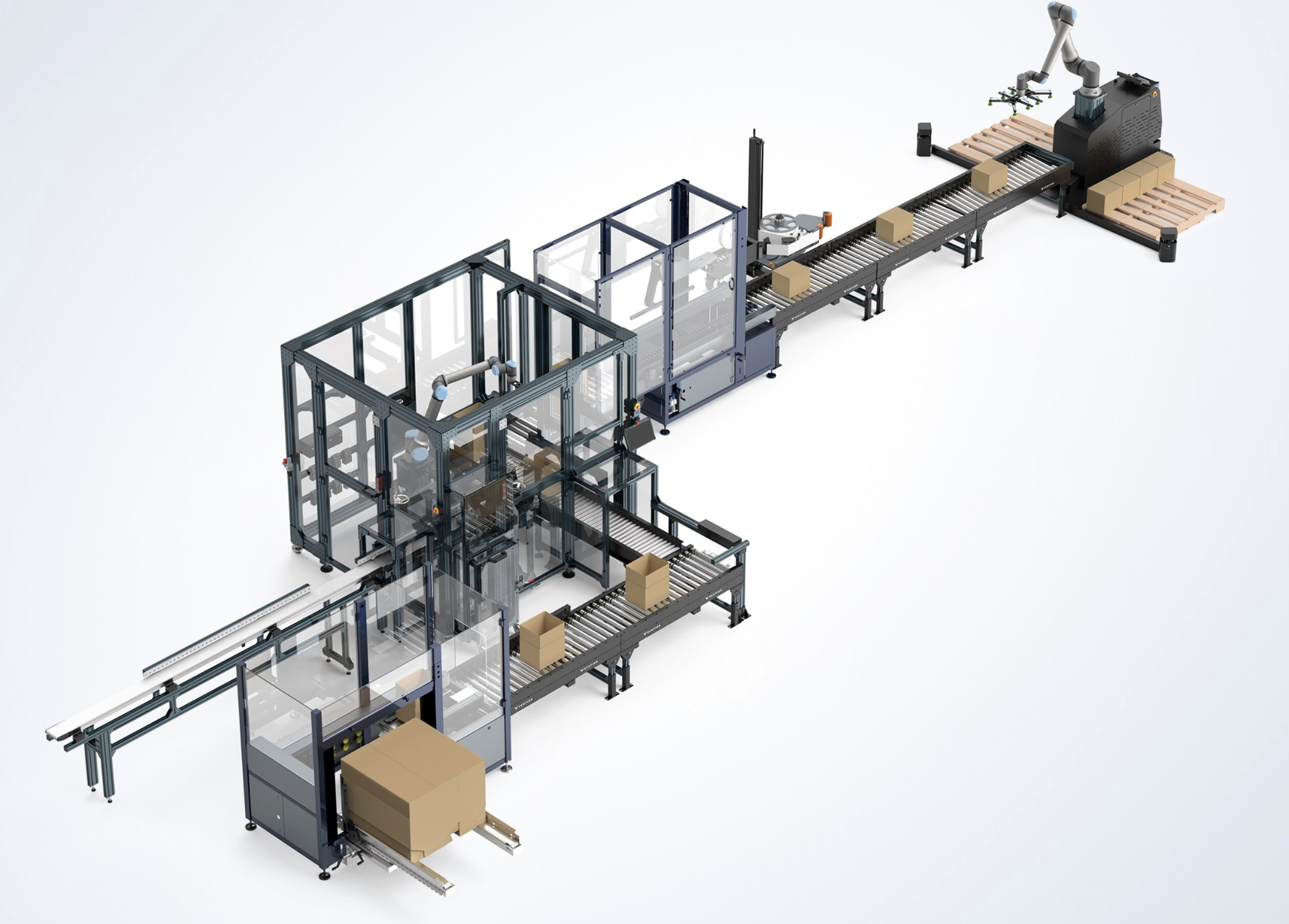
Robotic-powered packers take center stage at Interpack.Int.Robotic-powered packers take center stage at Interpack.Int.
This week, we learned that French apparel brands on their home turf are enjoying an uptick in sales versus international brands. A report from Joor also revealed the growth of independent retailers in the country. Meanwhile, the latest research from Centric Software Inc. showed just how important AI technology is in easing margin pressure.
There are also new technologies being showcased this week at the Interpack 2026 trade show in Germany, including a robot-powered conveyor packer.
The French fashion market is currently experiencing a robust period of growth, with data from Joor indicating a significant upward trajectory through the start of 2026. Following a period of contraction in 2023 and 2024, French brands saw an 18 percent increase in transaction volume in 2025, effectively outperforming other major international markets like the U.S. and Italy.
This momentum has accelerated rapidly in the first quarter of 2026, where sales surged by 40 percent compared to the previous year, driven by both a higher volume of units sold and increased average price points.
Global demand for French style remains strong, particularly within the EMEA region, which accounts for two-thirds of all brand sales. Domestically, French retailers have shown remarkable loyalty, with local purchases of French brands rising by 24 percent in 2025. In terms of product categories, accessories have emerged as a primary growth engine, expanding by 21 percent and representing a much larger share of the market than is typically seen on the Joor platform. Apparel and leather goods also remain core pillars, collectively ensuring that these top categories represent the vast majority of total sales.
The retail landscape in France is increasingly dominated by independent boutiques, which now account for 79 percent of transaction volume as large department stores see a decline in market share. These retailers are highly focused on domestic and regional sourcing, with 87 percent of their orders placed with brands based in Europe.
To capitalize on this resilient market and the recent 54 percent spike in retailer purchases during early 2026, Joor has introduced a new digital showcase designed to connect international brands with France’s leading independent fashion stockists.
Retailers are entering a period of rapid transformation as new data shows a widening gap between how quickly consumer demand shifts and how slowly decisions move through traditional retail organizations. That’s a topline assessment from a new research report from Centric Software Inc., titled “Reducing Margin Pressure in a More Volatile Retail Environment.”
Citing survey data from Deloitte, the authors of the report said 96 percent of global retail executives expect revenue growth while 81 percent anticipate margin expansion, yet many acknowledge that their operating models are too slow for today’s market.
Meanwhile, AI is emerging as the defining competitive differentiator, with McKinsey estimating that generative AI could unlock $240 billion to $390 billion in annual value for the industry. Retail leaders highlighted at NRF 2026 that AI is no longer experimental. Smart consumer agents, predictive forecasting and real‑time pricing engines are rapidly moving into mainstream adoption. But despite heavy investment, many retailers and brands still struggle to realize the full financial impact because their systems and workflows remain fragmented and sequential.
The report’s authors said the shift toward connected, AI‑driven decision-making is reshaping every stage of the product lifecycle. Forecasting insights now influence product development before designs are finalized, inventory constraints shape pricing strategies in real time and store‑level demand signals automatically adjust fulfillment. This “coordinated execution” reduces excess inventory, protects margin and accelerates response to demand shifts.
The report emphasizes that “the real advantage is not deploying more AI models. It is connecting decisions across the product lifecycle.”
Early adopters are already seeing measurable gains. Retailers using connected AI systems report up to 50 percent productivity improvement, 60 percent faster time‑to‑market, 30 percent inventory reduction and 15 percent margin improvement. These benefits vary by category. Apparel brands gain speed to market, home and lifestyle retailers improve working capital efficiency and specialty retailers reduce markdown exposure. The report highlights that when intelligence flows seamlessly across planning, pricing and inventory, “margin improves, risk declines and performance accelerates across the enterprise.”
Looking ahead, the competitive gap between AI‑enabled retailers and slower adopters is expected to widen. Retail and brand leaders agree that the question is no longer whether to adopt AI, but whether organizations can redesign workflows to translate insights into action at speed. The report concludes that AI‑powered lifecycle execution is becoming the new standard, warning that retailers who fail to adapt will face higher inventory risk, slower response times and growing margin pressure.
To download the report, CLICK HERE.
Vention has launched its third‑generation Rapid Series Palletizer in Europe at Interpack 2026, expanding its end‑of‑line automation lineup across EMEA. The system, which was already introduced in North America, is part of Vention’s unified platform that lets manufacturers design and run full packaging lines without the complexity of traditional integration.
At the show, which runs from today through May 13 in Düsseldorf, Germany, Vention said it partnered with Universal Robots to demonstrate a full packaging workflow. The booth combined a UR10e case‑packing cell, Vention’s modular conveyor system for product movement and accumulation and a UR20 palletizer, showing how collaborative robots and modular hardware can create flexible, easy‑to‑deploy packaging lines.
The new palletizer can be installed in as little as four weeks, with full end‑of‑line systems ready in twelve. The company said in a statement that this is several times faster than typical automation projects. Vention’s conveyor ecosystem, powered by MachineMotion AI, supports synchronized product flow and quick line changes. The company said the solution is especially useful for high‑mix operations facing labor shortages, with automation capable of replacing up to 10 operators per shift.